Showing posts with label chicken. Show all posts

Sunday, March 26, 2017

Rhubarb and Patience

I have never been a fan of rhubarb.  Stringy and bitter with poisonous leaves.  How did it ever end up on anyone's table?  However, Peter loves it and we grow it in the garden.  Every Sunday during the season I stew a few stalks and he has a spoonful every day for breakfast.  This summer we planted an all-year round variety so now we have twice as much.  I don't like to not eat the food we produce so I did a little investigation.  I can tell you now that rhubarb is a vegetable, not a fruit and if you eat it as dinner rather than pudding it is actually very palatable [=delicious (ed.)].
Start with a simple rhubarb and chard dish. I served this with pork sausages.  If you cook the sausages first in a pan and set aside,  you can cook the chard and rhubarb in the same pan. Add 1 finely chopped shallot to the pan and cook over a medium heat for about 5 minutes. Add a little olive oil if required. Stir in 1 1/2 tsp black mustard seeds and 2 finely chopped garlic cloves. Cook 1 minute. Add 1/2 cup thinly sliced rhubarb and 500g rainbow chard leaves, a handful at a time, with a large pinch of salt. You can thinly slice the chard stalks and add some with the rhubarb, but I don't think you want them all.  I always save the stalks if I don't use them straight away and use them up during the week.  Cook until the greens wilt and become tender, about 10 minutes. Season with more salt and pepper. Serve sausages on top of greens.
What about a chicken tagine with rhubarb?  Start by poaching some rhubarb. Combine 1 1/4 cups water and 1 cup sugar in a medium saucepan. Add vanilla seeds and pod. Bring to a boil over medium heat, stir until sugar dissolves and add 2 cups diced rhubarb. Reduce heat to low and gently simmer rhubarb for 5 minutes, or until it can be easily pierced with the tip of a knife but remains intact. Do not overcook or else rhubarb will fall apart. Strain rhubarb over a bowl. Put the syrup aside to use another day.
Now on to the chicken.  I used bone-in leg quarters - what used to be called a Maryland - but you could use boneless thighs if you are delicate about bones. Season the chicken on both sides with salt and pepper. Heat a large Dutch oven over medium-high heat and add 2 tbsp olive oil. When oil is hot, brown chicken pieces, in batches, on both sides until golden, about 3 to 4 minutes per side. Remove and set aside.
Pour off all but 2 tablespoons of fat from the Dutch oven and add 1 finely chopped onion. Reduce heat to medium and cook, stirring and scraping the bottom of the pan to deglaze, until onion begins to soften, 2 to 3 minutes. Add 1 each of finely chopped carrot and leek. Cook, stirring often, for 3 to 4 minutes until vegetables are tender. Add a clove of crushed garlic and cook, stirring, about a minute. Add 1/2 tsp turmeric and 1 tsp sweet paprika and stir.
Return chicken to Dutch oven and add 1 cup chicken stock, 1 cinnamon stick, 1/2 tsp sugar and salt to taste. Bring to a simmer, then reduce heat, cover and simmer 35 minutes. Add 4-6 pitted green olives then cover and simmer another 15 to 20 minutes, or until chicken is falling off the bones. Stir in 1 to 2 tablespoons  of the rhubarb syrup. Season to taste.
Before serving, stir in parsley and 1 cup of the poached rhubarb and heat through over low heat.  Serve with rice or couscous.
You can make a delicate jelly with the leftover poaching liquid.  You need 4 leaves of gelatin for 2 1/4 cups of liquid.  Soften the gelatin in a bowl of cold water.  Make the rhubarb syrup up to the 2 1/4 cups by topping up with soda or prosecco.  Add a tsp of lemon juice.  Bring the liquid to the boil and take off the heat.  Squeeze out the gelatin leaves and stir into the hot liquid.  Pour into a dish and refrigerate to set.  I had made mine too late in the day and it was not quite firm enough so I just spooned into a glass with lemon jelly and lemon sorbet.  If you are prepared, your jelly will have set so that you can cut it into cubes and decoratively arrange on a plate.
Now that I am on a bit of a rhubarb roll, I made another rhubarby pudding.
First I made a rhubarb spoom.  Yes that is a thing. Cut about 4 stalks of rhubarb into 2 cm lengths and put in a saucepan with 1/2 cup water and 1/2 cup sugar (or less according to your taste).  Heat gently until the sugar is dissolved, bring to the boil and simmer covered until the rhubarb is tender about 5 minutes.  Cool and puree until very smooth then chill completely.  Stir in 1 tbsp rosewater. Beat two egg whites until they form soft peaks.  Add 2 tbsp sugar and beat until you have stiff peaks.  Now this is the magic.  Fold the egg white into the puree making sure they are completely mixed.  Transfer to a freezer-proof container and freeze for four hours.  You now have a smooth creamy mixture that contains no fat and has not required churning.
Finally, I roasted some rhubarb. Cut about 8 stalks of  rhubarb into 6 cm pieces and place in a medium bowl. Finely grate the zest of half an orange over the rhubarb and then squeeze the juice of the whole orange into the bowl. Split 2 vanilla beans and scrape out the seeds and place both in the bowl. Add 2 tbsp liquid honey and stir to combine. Pour the rhubarb into a baking dish and arrange the pieces so that they lie flat. Bake at 175 for 15 to 20 minutes. Remove the vanilla pods. Serve the rhubarb and the spoom with the syllabub from October 2014.

Sunday, August 2, 2015

Persian delights

In March 2011, I first made khoresht-e gheimeh then in November 2013 I discovered khoresht-e ghormeh sabzi.  I revisited both of them this winter and went on to make khoresht-e mast with chicken and maygoo polow with prawns and herbs.  Most satisfying, I mastered chelow, the classic Persian rice dish and this is now my go-to rice dish.  I am also working my way through the variations.  If you want to know more about Persian cooking borrow the book, Saraban, from the library.  If you just want to make a delicious meal let me tell you how.  I always make these dishes for six because they freeze well and then there is always something delicious in the freezer during the film festival when there may not be time to cook after a movie.
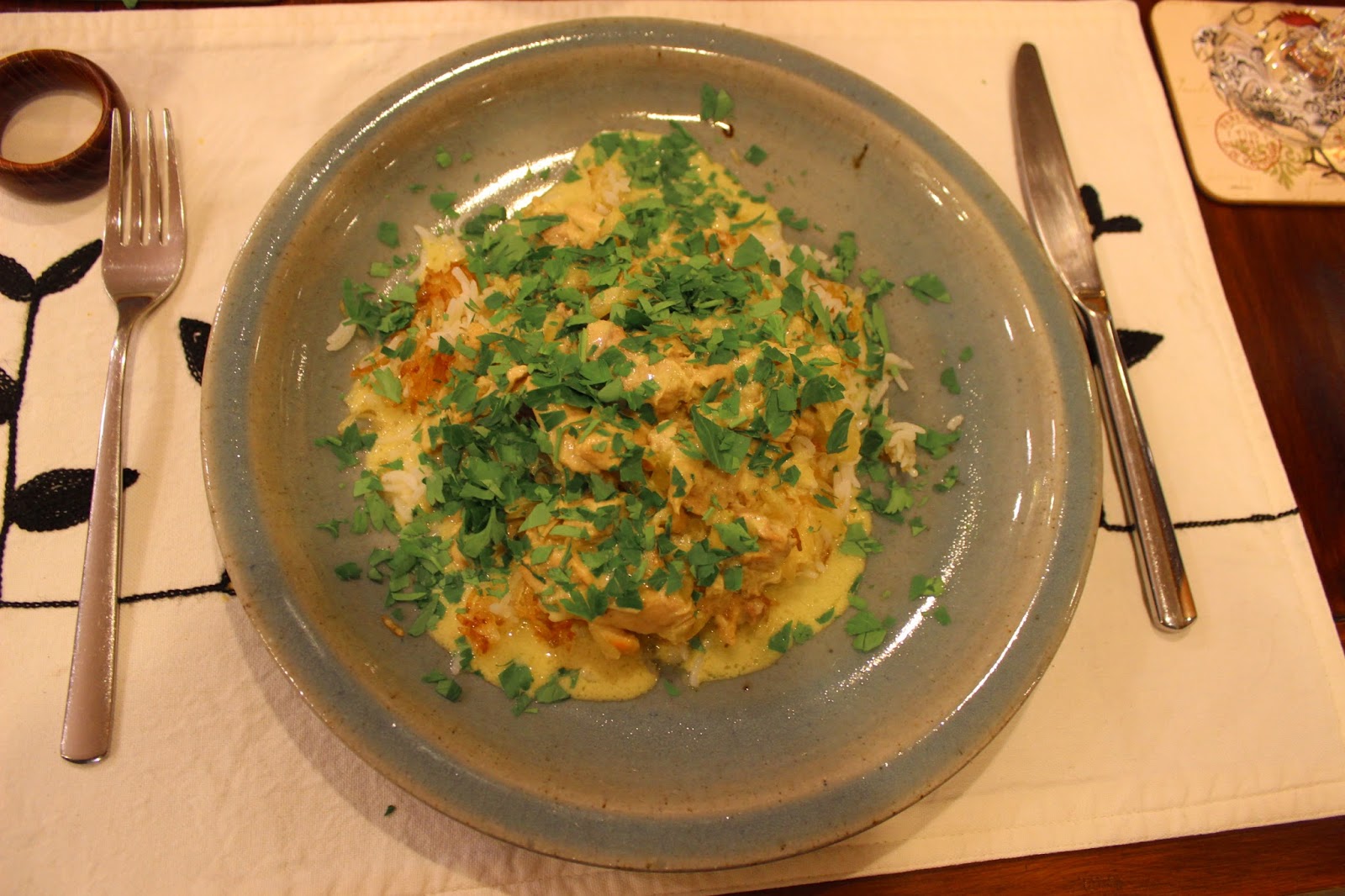
The chicken khoresht is great if you don't have two or three hours to cook the lamb version.  This will only take an hour once you've sweated the onions.  To start, sweat 2 finely chopped onions with 2 finely sliced celery sticks until soft.  Stir through 1 tsp ground cumin, 1/2 tsp  ground ginger, 1/2 tsp ground cardamom, 1/4 tsp cayenne, 1/2 tsp ground black pepper and cook for a few more minutes.  Cut 1 kg of boned chicken thighs into 2 or 3 pieces each.  Add them to the pan and brown briefly over a high-ish heat making sure they are all coated with the spicy onion mix.  Add a bay leaf, 500 ml chicken stock, a few saffron threads, zest and juice of a lime and juice of an orange.  Season with salt and simmer for an hour or so.  While the stew is cooking whisk 350g of Greek yoghurt with an egg.  When the stew is ready, whisk a few tablespoons of the hot broth into the yoghurt and egg mix then pour it all into the stew.  Add 1 tbsp slivered pistachios and cook at a bare simmer for five minutes to thicken.  Stir in one direction only and be sure not to let it boil or it will curdle at this stage.  Now Greg Malouf adds golden raisins but I do not.  It brings back memories of terrible 70s curries and I can't quite do it.  Apricots and prunes, yes but raisins, no.
Now as I mentioned above I feel I have mastered the Persian chelow and I am not sure what I was afraid of.  You need to allow about 80 minutes but most of that time it is looking after itself so it's no effort.  The recipe is for 6 so I just do 1/3 when making for two.
Wash 300g basmati rice and leave to soak in a generous quantity of warm water for 30 mins (30 minutes doing nothing with rice).  Strain the rice and rinse it again with warm water.  Follow these steps and you will be rewarded with perfectly separating grains.  Now boil a large saucepan of water, salt generously and stir in drained rice.  Boil at a rolling boil, uncovered for 5 minutes. I bring the water to the boil while the rice is soaking to save time and I turn it off if necessary so it only takes a minute or two to reboil when needed. Strain and rinse again and drain off as much of the water as you can.  Now is the tricky bit but it's not really tricky at all.  Melt about 40g of unsalted butter with 2 tbsp warm water and set aside.  Heat 1/4 cup oil with 1 tbsp water on a medium high heat in a large saucepan - the one you used to boil the rice.  When the oil begins to sizzle spoon in enough rice to cover the base of the pan in a thin layer - this is going to form a crust.  Spoon in the rest of the rice gradually building it up to a pyramid.  Don't tip it all in because you want it loosely piled to achieve the fluffy separateness.  Use the handle of a wooden spoon to poke a few holes down through the rice to the base of the pan.  This is to help it steam.  Now drizzle the melted butter over the rice.  Wrap the saucepan lid in a tea towel and tightly cover the pan.  Leave it on the medium high heat for a few minutes until you see some steam trying to escape then turn right down and leave for 40 minutes.  Another 40 minutes doing nothing with rice.  Don't peek.  It won't hurt if you leave it for up to an extra 20 minutes.
When you are ready to serve plunge the pan into a few inches of cold water in the sink.  The sudden change in temperature cause the rice to shrink from the sides of the pan loosening the delicious crunchy bottom.  Now invert the pan into a serving dish and it may plop out as one glorious mound with a beautiful golden crust.  Or it may not.  In which case just scoop the crust, known as the tah-deeg, over the top. Once you have mastered this you can do all sorts of variations to the crust with yoghurt, potatoes or bread.
And you can make an complete dish of the rice such as maygoo polow with the addition of herbs and prawns. Wash soak and parboil the rice.  Soak 1 tsp fenugreek seeds for 10 minutes, then gently fry in a frying pan with a small finely chopped onion, 1 tsp ground black pepper, 1 tsp turmeric, 1/2 tsp ground ginger.  Add a chopped deseeded tomato and 200g peeled prawns with tails on.  Don't worry if they're not.  Stir briefly until the prawns just begin to colour.  Remove the pan from the heat and stir through 1/3 cup finely snipped chives, 1/3 cup shredded flat leaf parsley, 1/3 cup shredded dill sprigs.  You can also add coriander if you must.  Now start to prepare your parboiled, drained rice for steaming.  Heat the oil and put the layer of rice in the bottom for the pan.  Scatter a layer of the prawn mix and layer up your pyramid with rice and the prawn mix ending with a layer of rice.  Poke the holes, drizzle over the butter, wrap up the saucepan lid and go off and do something else for 40 minutes.  Don't peek.  When done tip out as described above. 
You can serve all Persian meals with a herb salad and flat bread.  I sometimes serve stews with wilted spinach seasoned with nutmeg.
If you would like to carry the Persian theme through to coffee whisk some mascarpone with a little honey and lemon zest.  Slit some medjool dates to remove the stone, but don't cut in half.  Pipe the mascarpone mix into the dates and sprinkle with pistachios and rose petals.

Sunday, July 26, 2015

La Pasta in Casa

I thought it would be nice to make pasta and I bought 00 flour.  Some considerable time later I thought, "Must get on to that pasta making" and I bought a pasta machine.  More time passed and I thought, "Must get that pasta machine out of the box".  So at last the flour and machine were introduced.  It transpired that some years had passed between the initial thought and the action.  The flour was no longer viable and the pasta was not a success.  Undeterred I bought another bag of flour and this time it all came together.
Making pasta really is quite simple.  Just make sure your flour is fresh!  I consulted Marcella Hazan, her son, Giuliano and the New York Times.   This is what worked for me.  Start with 1 egg per 100g flour.  You need at least two eggs to get a quantity you can work with and you can dry it and store in an airtight container so there is no issue with having more than you need.  Before you begin, clear your work surface because you will need plenty of room once you start rolling.  Pour the flour into a mound on the work surface.  Note that marble is too cold and won't work.  Make a well in the centre of the flour and break the eggs one at a time into the well.  Beat the eggs gently with a fork until the yolks and whites are mixed together - actually this proved a bit hard and I resorted to whisking the eggs first before pouring into the well.  With the fork, gradually incorporate the flour into the egg until the egg is no longer runny.  Work from the inside wall of the well.  If the egg escapes onto the bench it is not easy to recapture.  Once you've reached the stage where you have quite a viscous mixture, quickly bring the remaining flour over the egg mixture and scoop it up, mixing with your hands until you have a moist but not sticky dough.  Wrap the lump of dough in cling film to stop it drying out at all and clean the work surface and your hands ready for kneading.  Knead the dough until it is very smooth and silky - this only takes a couple of minutes if all is well. Rewrap in cling film and rest for at least 20 minutes.
Set up your machine for rolling and get out lots of tea towels to lay out the rolled dough.   Cut a three-egg dough into six portions and keep the ones you are not working with wrapped in cling film.  Flatten the chunk of dough in your fingers and start to feed the dough through the machine starting at the widest setting.  Feed each portion through this setting three or four times, folding into three after each roll.  Then, reducing the rollers by one notch each time roll all the pieces through the machine and lay them out on dry tea towels.  Leave to dry a little so that it feels a bit leathery but not brittle.  Maybe 10-20 mins.
When they are ready, shape your pasta.  We made fettuccine according to the instructions on the machine.  To store the ribbons, wrap them loosely around your hands to form nests then leave to dry on a tea towel before storing in an airtight container.  They will keep for months.
To cook drop the pasta in a large saucepan of well salted boiling water and boil with the lid off for a few minutes until al dente; 2-3 mins will be enough on the day of making. 
I rediscovered the classic tomato sauce for pasta.  Put two tins of tomatoes in a saucepan with a halved onion and 100g butter.  Simmer over a low heat about 40 minutes until the tomatoes have reduced and slightly separated from the butter.  Discard the onion and either use the sauce immediately, set aside to reheat later or freeze. This sauce is indescribably good.   It will keep for a few days in the fridge. Serve this on any kind of pasta including filled shapes, which is our next project.  I served the first batch with cauliflower florets that I had lightly steamed then roasted in olive oil with a sprinkling of chilli flakes.  Just top with the sauce and some grated parmesan.
We used the reserved fettuccine with chicken and mushrooms with tarragon, which is a dish well worth trying.  We have made this two or three times and it is nice with any of the suggested accompaniments.
We  made some pappardelle by loosely rolling the sheets and cutting by hand about two centimetres wide.  We served this with my go to Bolognese recipe.  This sauce with pappardelle is one of my favourite pasta dishes and the home made pasta just made it better.
This experiment has been worth the effort and we will be keeping it up. Next we will be trying stuffed pasta.  If you have any suggestions about making pasta at home please share.  All ideas welcome.

Sunday, July 12, 2015

Chicken dinner

We don't eat chicken as often as we used to.  Not even to make stock because we can buy frames at Moore Wilson.  Recently we needed to replenish the stock and I recalled a wonderful chicken recipe with orzo and leeks, which I discovered last year.  This is such a simple way to serve a roast chicken meal with minimum effort and put at least one more meal on the table during the week, as well as replenish your stock stores. 
Sit a chicken in a roasting pan, breast side up.  Pour over the juice of a lemon, rubbing some into the skin, then stuff the lemon skins into the cavity along with some sprigs of thyme and rosemary, and tarragon if you have it.  Ours has died back for the winter. 
Drizzle the chicken with olive oil and dot with a little butter.  Chop some more of the herbs and sprinkle over, then season with sea salt and black pepper.  Add about 2cm of water to the pan and lots of unpeeled garlic cloves.  A dozen would be good.  Roast at 200 for 70 minutes or until done. 
Transfer the chicken and garlic to a plate, cover with foil and keep warm while you prepare the accompaniments. Add about 1/4 cup white wine to the pan juices, bring to the boil on the stove top and reduce to a pouring cream consistency. 
Meanwhile, and I would start this just before taking out the chicken, boil a saucepan of water for the orzo and sauté in a little olive oil a finely sliced leek in a heavy bottomed frying pan.  Cook the leeks until they are soft and sweet then add 2-3 bunches of finely sliced spinach.  Cook the orzo (or risoni or any rice shaped pasta) according to the instructions on the packet and mix with the leek mixture.  Pile the orzo mixture onto a serving plate and top with the chicken and garlic then drizzle over the reduced winey pan juices.  This will become your go to chicken recipe. 
Next day make stock.  The left over orzo makes a good weekend lunch  - just heat and add any other left over greens you have in the fridge.  You could add some cooked puy lentils if there is not so much orzo and more of you.
During the week you could use up the left over chicken in a pasta dish.  Make a tomato sauce by gently frying chopped garlic in a little olive oil then add a crumbled dried chilli, 2 tsp dried oregano and 3 tins of tomatoes.  Simmer for an hour then add a tbsp. red wine vinegar and stir well to make sure all the tomatoes are broken down.  You can use what you need now and freeze the rest in batches for later.  Once you've set aside some to freeze add the shredded left over chicken and maybe some blanched broccoli or whatever green vegetable you have to hand.  Serve with penne or fusilli pasta topped with grated parmesan. Or your home made tagliatelle.  But that is another story.

Sunday, April 19, 2015

Good Food

When I first came to Wellington in 1985 I regularly clipped the recipes from the Listener and collected them in a scrap book.  Initially Lois Daish and Annabel Langbein alternated weekly and then Lois took the column over for many years.  Many of these recipes were and still are my go to source for family staples.  Most of my favourites were captured in Good Food which my mother  bought me and which is now rather dog-eared and stained.  Later I collected all Lois' books.  One recipe that wasn't in any of the books was my go-to meat loaf recipe, aptly titled My Meatloaf.  When we were renovating the kitchen all the cooking books were packed away for the duration and this scrap book never reappeared.  I have searched high and low and always hope that it will turn up along with a book about coffee by Claudia Rodin that my mother once gave me.  They must both be in the same carton - if you've seen it let me know or if you ever happen across a copy of the coffee book, I would love to replace it.
The recipe from the book whose loss I have most regretted is the meatloaf.  I have tried over the years to find another.  Friends have passed on recipes which were good but not as good. The problem is often consistency - they are too smooth whereas I remembered Lois' as being coarser, a bit more substance. Recently I discovered that a good friend is Lois' neighbour and I told her my dilemma.  She mentioned this to Lois and now I have the recipe back in my collection.  The original column had a photo of the loaf cooked in a tin but I didn't recall this as I had only clipped the recipe not the picture.  I had always shaped the loaf according to Lois' instructions in the recipe.  This is how it was intended.
When I read over the recipe, it read very much like many of the other recipes I had tried but when I made it, it was clear that it was the right one both in flavour and consistency.  To make Lois' and my meatloaf, sauté a finely chopped onion in a little butter with some finely chopped thyme and sage.  In a large  bowl mix 2 cups of fresh breadcrumbs with a cup of milk, two eggs and salt and pepper.  Add the onions and 500g each minced beef and pork.  On a lightly greased baking tray form the mix into a sausage-shaped loaf.  Cover with 6-8 rashers of bacon.  Bake at 200 for 45-60 mins.  We used to serve this with mashed potato and broccoli and home made tomato sauce.  This was just perfect.  This is quite a large quantity and will feed a crowd (or our family of seven).  I think you could easily halve it.  Just watch your cooking time and don't let it dry out.  On this occasion I froze the left overs in two portions for future occasions.
We have many other favourites from Good Food.  Louisiana chicken salad  was often Isabel's birthday choice and Jasper requested it when he was recently home from France. I always make the broccoli salad with our own crop although Lois may not recognise my modifications.  All these are just great family meals which were always popular in our house and which we now all have in our repertoires.  I am so glad to be reunited with My Meatloaf.


Tuesday, February 10, 2015

Feeding hungry hordes

We had young relatives visiting from the UK and it seemed the perfect opportunity for some summer family meals.  Unfortunately Wellington did not turn on barbeque weather but we made the best of it.  We started the weekend with an extended family dinner and I couldn't go past a leg of lamb which we had the butcher butterfly for us.  Ideally we would have cooked this on the barbeque but it does just as well on the flat grill on the stove top.  Marinade the lamb for an hour in a blend of 3 tbsp Greek yoghurt, juice of a lemon, 4 crushed cloves of garlic and 2 tbsp dried oregano.  When the grill is very hot, lift the lamb from the marinade, shake off any liquid then lay it on the grill skin-side down.  Cook for about 10 minutes until crisp on the outside.  Turn and brush with the remaining marinade, then continue to cook for around 20 minutes until crisp on the outside and slightly pink within or of you prefer, grill a shorter time and finish in the oven at 200.  Season with salt while cooking.  Rest for around 10 minutes before serving.  Peter does all this because, as you know, I don't really cook large pieces of meat. 
I served this with a classic Greek salad and tzatziki. I also decided to make skordalia for the first time and it was a hugely popular.  For 6-8 people, boil about 150g Agria potatoes or another excellent mashing variety.  It doesn't seem like a lot of potatoes for the hungry hordes but it will be sufficient.  Drain immediately.  Pound three cloves of garlic with salt in a mortar and sieve the potatoes through a very fine sieve or potato ricer.  Mix in the garlic until you have a smooth puree.  Don't use the food processor unless you are planning to hang wallpaper, in which case you will have a lovely garlic infused paste. Beat in 100ml olive oil a little at a time, as if you were making mayonnaise.  You are looking for an emulsion.  Add juice of half a lemon and a little water if you need to loosen the mix.  Serve as a sauce with the lamb.
And then for pudding we had a strawberry and rose wine granita.  So easy.  Blend 500g strawberries, 3 tbsp honey, 2 tbsp of any berry liqueur and 1 tbsp lime juice.  Add a cup of the rose and blend again.  Either still or sparkling wine will be good.  I used sparkling. Pour into a shallow freezer-proof container and freeze.  Two or three times before serving take the tray out and mix through any big chunks of ice, pulling the frozen side edges towards the centre with a fork.  Fluff up the granules and serve in tall glasses on top of mixed berries.  You will need long spoons or long tongues to get the berries from the bottom of the glass.
On Saturday night I decided to do chicken with a quinoa salad.  I  chopped and changed for ages. Quinoa or couscous? At the very last minute I plumped for quinoa.  It was the best decision.  It is actually like a quinoa tabouleh but lighter.  For 4, cook 1 cup quinoa according to the instructions on the packet.  Make a vinaigrette with oil, red wine vinegar and garlic and 1/4 tsp each ground ginger and cinnamon and stir through the cooled quinoa.  Fold in 1 cup diced cucumber, 10 or so roughly chopped cherry tomatoes, 2 thinly sliced spring onions, 1/4 cup sunflower seeds, a good handful or mint or parsley or both and season with salt and pepper.  Serve with grilled chicken.  Season boned chicken breast, skin on with Moroccan style spices  - ras el hanout or whatever you have in the cupboard.  Use as many chicken breasts as you need for your diners.  I tend to think 120g per person and chicken breasts can vary hugely in size.  Cook the chicken on the barbeque grill or if it is windy at your house in a saute pan with a little oil.  Rest then slice and serve with the salad, a dollop of cottage cheese and a drizzle of olive oil. 
For pudding, Phoebe made  chocolate mousse using our secret family recipe.  She used an additional secret ingredient so even if you thought you knew the recipe you don't now.  Only Phoebe and I hold the secret.
On Sunday I returned to an old favourite, beef with yellow split peas.  This has the delicious pumpkin seed dressing.  I also served julienne of carrot and courgette with a pesto dressing. Mix 2 tbsp pesto with 3 tbsp olive oil and one of lemon juice. Season with salt and pepper.
For pudding, I did an old Peter Gordon recipe of marinated strawberries and pawpaw.  Marinade about 500g halved strawberries in 75 ml dessert wine in the fridge for a couple of hours.  Separately marinade 1/2 a peeled and seeded chopped pawpaw in 1 tbsp lime juice.  When ready, gently toss together with a few mint leaves and splash over the juice.
You may notice that we are a bit short of photos.  That sometime happens when we have a crowd.  You'll have to imagine the lamb.

Sunday, May 26, 2013

Best of British

We seem to have a lot of cooking books of regional cooking & I thought a nice way to start making more use of them was to pick a country for a Saturday night meal.  Last weekend we had two British meals which provided two midweek meals as well.  I also thought it would be a nice idea to have a seasonal arrangement of those charming mini pumpkins on the sideboard.  I just buy a couple each week & we eat our way through them.
The first British meal was venison loin with barley risotto & roasted roots.  Start with the barley because it takes a while.  Saute a thinly sliced leek with a little butter & oil & a sprig of thyme until softened.  Stir in 250g pearl barley with 1/2  the hot  chicken stock (500ml of 1 litre).  Put the lid on & simmer 20 minutes or so until all the stock is absorbed. Just keep adding stock over the next 40-60 mins until the barley has the consistency you like to eat.
While that is cooking, heat the oven to 200 & dice 1/2 a swede, 1 red onion, 1/2 large carrot & 2  turnips into 1-2cm cubes.  Toss in a roasting dish with 2 rashers chopped streaky bacon & a couple of sprigs of rosemary.  Season well & drizzle over some olive oil.  Cook 30-40 mins until the vegetables are done.
Put the leaves of two rosemary sprigs in a pestle & mortar with 5-6 juniper berries & salt & pepper.  Bash them then mix in a splash red wine vinegar & a swig of olive oil.  Rub all over your venison loin.  We had 400g for two & that stretched to 2 meals.  When you think you are 20 mins away from dishing up, heat a little olive oil in a pan to a high heat.  Cook the loin around 18 mins turning every 2 mins.  Do not overcook.  You want it rare to medium rare. Place on a warmed plate & rub it with a little butter while it rests.  Get up the roasties & stir through some marmalade which will give it a lovely gloss.  Serve it all with a few handfuls of watercress & other green leaves dressed with a little oil & balsamic.
Later in the week make a rustic huntsman's pie with the leftovers.  This is just shepherd's pie with venison.  I made a sofrito with onion, carrot & celery then added the finely chopped venison & left over barley & veg.  I topped with a mash of swede, pumpkin & potato because that is what I had in my cupboard.  You might have a different combination.  I had too much mash so I froze the surplus for another day.  My freezer is full of surplus mash which is great for a potato topped dish & sometimes I forget to label it so I am not sure which vegetable I have until it is done.
On Sunday we did Jamie Oliver's empire roast chicken. I served this with peas - it felt like the right thing to do. You could expand this if you had a crowd maybe with a variation on dhal & some spicy beans.
Leftovers became a pilaf the next day & Peter took the remainder for his lunch the day after.  For that I adapted an old favourite.  I left out the pine nuts & the preserved lemon and added a little garam masala with the turmeric.  I just added the shredded cooked chicken & peas with the rice.  I used 1 cup rice & 2 cups stock.  We served it with the cranberry sauce that needs to be used. Meals like this make weekday eating so easy.

Saturday, February 9, 2013

Golden Weather

Wellington has had an outstanding summer and we have eaten outside more than usual.  This has been very conducive to summer dining and we have had lots of salady things and summer vegetables.  The garden has really enjoyed the sun and we have been racing to catch the courgettes before they escaped to marrowdom.
Summer feels right for Spanish cooking and we remembered a while back, on Rick Stein's series on Spain, he made an intriguing Catalan pasta dish which we've been meaning to try for ages.  Catalan use Fideua noodles which are short thin pieces of dried pasta similar in thickness and texture to spaghettini.  We found something called fadennudeln, which is German but which fitted Rick's description.  You could just use spaghettini & break it up.  Whatever you decide, have a go.
The recipe said to make a fish stock with tomato passata but we actually had some tomato sauce we wanted to use up so we improvised a bit and just used that, diluted with some light chicken stock.  I would make the fish stock next time if I had the time.
In the paella pan (if you don't have one use a regular slope sided pan), fry 2 cloves of thinly sliced garlic.  Keep a close eye on it because garlic burns easily and you are looking for golden rather than charred.  As soon as it colours scoop it out & set aside.  Add 150g of the noodles and fry them in the garlicky oil  until they are golden.  Again you are looking for light golden rather than dark.  Stir in 500g of the tomatoey stock or stocky tomato sauce, a little salt & the fried garlic.  Bring to the boil, then reduce & simmer 9 minutes or so until all the liquid has evaporated.  Remove from the heat, cover with an opened out newspaper and leave to rest.  When Rick did this all the pasta strands pointed upwards but that didn't happen for us.
While the pasta is resting cook the seafood.  We had squid and prawns which worked well.  You'll want to have them prepared before you start the pasta so maybe I should have mentioned this at the top of the page.  You should always read the whole recipe before you start.  Don't you hate it when you're halfway through cooking tonight's dinner when it says "now put in the fridge overnight"?
Use 75g-100g each of peeled prawns and sliced squid.  Heat a little olive oil in another pan, add the squid & prawns over a high heat for 1-1 1/2 minutes until just cooked but nicely caremelised.  Season with a little salt and serve alongside the pasta.  To serve the pasta, dot with aioli (which the Spanish call alioli).  If you don't like seafood you could probably sautee some chicken thighs cut into quite small pieces.
Now that the aubergine season is in full swing we have been making aubergine stacks with chicken and cheese.  We were inspired to this by a delicious meal we ate at the house of one of you.  I don't know if this is what you did but this is our method.  Slice two chicken breasts into thinner slices and flatten the thicker slices by bashing between cling film.  You want thin escalopes of chicken that will sit on a slice of aubergine.  Brush the chicken pieces with oil & white wine vinegar & season.  Fan grill at 200 for about 15 minutes turning once.
Slice an aubergine lengthwise and brush with olive oil.  Grill on a ribbed hot plate or heavy bottomed pan 2-3 mins each side  then finish off with 5 mins under the fan grill.  Grill thick slices of haloumi.  Heat through a small quantity of that homemade tomato sauce you always keep in the freezer.  To assemble, lay a slice of aubergine on the plate, top with a slice of chicken, a slice of haloumi, some torn basil leaves and top with a splodge of tomato sauce.   I think you could be flexible here and think about trying different cheeses & herbs.  Maybe try oregano with the haloumi & mozarella with basil.  You'd probably have to pop the assembled stack under the grill to melt the mozarella.  Or try paneer with coriander.
Last Sunday I made an outstanding vegan pudding I had been meaning to try.  This was inspired by a recipe from the raw food people in Auckland, Little Bird.  I don't actually subscribe to the raw food philosophy any more than I embrace veganism or gluten free for its own sake, but I will champion any meal prepared with good quality ingredients that tastes great.  These chocolate ganache tarts certainly measure up.  This is the version we saw on River Cottage Veg.  I used cashews instead of pecans - cheaper.  I used Blue Coconut oil, Green & Black organic fairly traded cocoa and I substituted the maple syrup for the agave nectar.  Actual maple syrup not maple flavoured syrup!  I also made individual tarts using muffin pans and a couple of extras served in a dish as mousse.  Think about freezing & serving as ice cream.  Note that you must serve this really chilled - at room temperature you may taste the avocado.  It will taste less sweet when chilled so sweeten to a little sweeter than your taste prior to chilling.  It is really rich so think about mini servings.  It is truly delicious so hungry people may eat two but people who overfilled on mains won't manage it even if they think they want to.
On a final note, over the next month we are hosting visitors from foreign parts  - the UK & Canada.  What shall I feed them?  Any suggestions for meals which show off what we produce in New Zealand and are summery?


Saturday, December 1, 2012

Hola - it's a phiesta!

When a teenager asks to have a party many images leap into the mind of a parent.  Most of them are ones you don't wish to play out in your home.  Our children therefore steer away from the party word and instead suggest they would like to arrange a small gathering to celebrate their birthday or the end of exams or whatever.  I always call this thing "not a party" - until Phoebe & I were sitting down to discuss the food preparations for this year's birthday "not a party".   Her favourite cuisine is Mexican and as the event morphed from a planned barbeque and salad to a Mexican evening I coined the term Phiesta.  She made me promise not to say it in public, so this is just between us.  Don't tell anyone.
All good events start (and/or finish) with a cocktail (see last week's entry) so we began the evening with the ubiquitous Margarita.  I always thought I didn't like this drink and was pleased to see the back of a bottle of tequila which had been lurking since Phoebe made a batch of Margarita cupcakes a year or two ago.  It turns out I was mistaken and we now have to replace the bottle. 
To make the perfect Margarita, fill a glass with ice, add 1 1/2 oz tequila, 1 oz lime juice, 1/2 oz cointreau.  Stir until chilled.  You can make this in a salt rimmed glass or not.  Just one and you too will be planning a phiesta.
I should note that you need to buy a good quantity of limes, chillis of various kinds & avocados.  We started with tostaditas.  These involved topping good quality round corn chips (we used Mexicano) with a salsa, morsel of something meaty and a pinch of salad.  The first was prawns tossed in garlic & olive oil then sauteed.  This was assembled with a dab of almond salsa on the corn chip,  then a couple of shreds of iceberg lettuce, a small slice or two of perfectly ripened avocado. Then the prawn, another dollop of salsa & a sprinkling of finely chopped coriander or if like me you are averse, flat leaf parsley.  I used prawn cutlets & removed the tails after cooking. 
Make a quantity of almond salsa - it will be popular as a dip.  Take 2 dried guajillo chillis & tap out the seeds.  Soak them in boiling water for half an hour.  I bought them at Moore Wilson or you can probably buy them on line.  When they are done soaking, roughly chop them & blend them in a processor with 2/3 cup sour cream (I use Zany Zeus), 1/2 cup blanched roasted almonds, 1/2 cup grated cheddar, 2 tbsp coriander/ parsley, zest of a lime plus 3 tsp juice, salt & pepper.  Add more lime juice to taste & to get to a consistency you like.
Second tostadita was chicken.  Cut a chicken breast in half to get two thin flat pieces. Marinade in 2 tbsp olive oil, 1 tbsp lime juice, 1 tsp cumin, 1 tsp smoked paprika, 1 clove crushed garlic, salt & pepper.  This is enough for two breasts.  Cook the chicken in a pan until golden and slice or shred.
To assemble, spread the corn chip with refried beans then top with a slice or 2 of chicken, a dollop of lime crema then top with a little pile of julienned radish & coriander/parsley.
To make refried beans, heat a little oil in a pan and soften 1 finely chopped onion with 2 cloves crushed garlic.  Add 1 1/2 tsp cumin, 1 tsp dried oregano, 2 tsp finely chopped chipotle peppers in adobo sauce and cook for a couple of minutes.  If any teenagers mistake the chilles for tomatoes & eat three before realising the error, a glass of milk will help.  Don't ask me how you get three down before you notice they're not tomatoes! Back to the pan.  Add 2 tins of beans - you could use pintos or really whatever YOU like.  I used Westbrae organic chilli beans which was a mix of black, pinto & kidney - not flavoured which the label suggested but I assume intended for use in chilli or refried beans.  Cook gently for a few minutes to heat through then crush half the beans with a fork or other mashing implement.  Don't be precise - you just want some beans mashed & some not.  Stir through coriander/ parsley and 2 tbsp sour cream.  Oh, and add parsley/coriander to the list above.
To make the lime crema, mix 1/2 cup sour cream with 1/2 cup thick yoghurt, 1 clove crushed garlic, zest of a lime, 1 tbsp lime juice, salt & pepper.
I made an interesting dip with tomatillos & avocados.  I have sometimes bought tomatillos fresh at Moore Wilson but on this occasion I had to buy tinned.   Blend the tin of drained tomatillos with 1/2 cup coriander/parsley, 1 clove crushed garlic, 2 avocados, 2 tbsp lime juice, salt & pepper, tabasco to taste.
When I make guacamole I usually just mash avocados with a splash of lemon or lime & some hot sauce.  I went to a bit more trouble and the result was amazing.  Pound 1/2 small very finely chopped red onion, 1 lge finely chopped red chilli, 1 clove crushed garlic, 1/2 cup finely chopped coriander/parsley, 1 tsp sea salt, in a pestle & mortar until you have a smoothish thick paste.  I initially tried to blend it but you really need to go down the pounding path.  Transfer to a large bowl & scoop in 2 large perfectly ripened avocados with lime juice to get the taste & consistency you want.  Fold in some extra of the green herb you are using
For the main event we did tacos filled with pork carnitas and a vegan version with refried beans (sans sour cream).  I got 1 1/2 kilos pork shoulder, skin off, fat on, and cut it into approx 3 cm chunks.  Put it into a large roasting pan and toss with 2 cloves crushed garlic, 1 tsp cumin, 1 tsp sea salt, 2 tbsp water & cover tightly with foil.  Braise at 170 for an hour and a half.  It will be exceedingly tender.  When it's cooled remove the fat and drain off most of the liquid - leave about 2 tbsp.  I made this the day before & refrigerated overnight.  To serve put the pork in a saute pan & sprinkle over 2 tbsp soft brown sugar.  Cook over a high heat until the meat is golden brown & caramelised then sprinkle over the juice of a lime & let it bubble up.
We put dishes of the pork, beans, all the dips, a dish of shredded lettuce, and a pico de gallo on the table with plates and pieces of parchment paper (for ease of handling and left them to have what they wanted. 
Pico de gallo is a fresh tomato salsa.  Dice 2 cups tomatoes  - if they seem liquidy, sprinkle on a little salt & leave them to drain in a colander for 1/2 an hour.  Combine them with 1 clove crushed garlic, 1/4 cup finely chopped red onion, 1 finely chopped red chilli, 1/2 cup finely chopped green herb, juice of a lime, olive oil - I used Olivo's chilli infused - salt & pepper.
For afters, I made a chocolate cinnamon chilli cake.  This is sooo easy & so delicious.  Melt 200g butter & 200g dark chocolate in a large bowl over a pan of hot water.  Use the bowl you are going to mix the cake in. Stir in 1 cup caster sugar & 1 tsp vanilla extract & leave to cool.  Mix in 4 lightly beaten eggs, 2 tbsp flour, 1/2 tsp salt, 1 tsp cinnamon, 1/2 tsp cayenne.  Pour into a greased, lined 20cm cake tin and bake 25 mins at 170.  It may not seemed cooked but you want a delicate almost crisp crusty top with something sludge-like within.  Leave to cool completely in the tin.
 To serve dust with icing sugar mixed with 1/2 tsp each cocoa & cinammon.  I think it would be nice to dust over a paper doily to make a pretty design but we didn't appear to have one.  Must buy some.  Serve with whipped cream infused with vanilla extract, and candied pepitas.
Pepitas are pumpkin seeds.  Combine an egg white (not beaten) with 1/2 cup caster sugar, 1/4 tsp cinnamon & 70g pumpkin seeds.  Spread this on a lined baking tray & bake at 170 for 10 mins turning once.  To turn it I laid another piece of paper over the top & flipped it then peeled off the first piece.  It was still a bit sticky in parts but it crisps up when cooled.  Break it into bits to serve.
We also served Margarita cupcakes - the vegan version.  These called for coloured sugar crystals & it just happened that we had bought Phoebe a tin of these from Dean & De Luca in NYC.
And in case you were wondering, in spite of the Margaritas and Corona beer served with lime wedges and eating slightly messy food on their knees, the house looked almost as tidy when the phiesta-goers left as when they arrived.  When one reveller came into the kitchen looking for something to mop up a spill, Peter asked how large, wondering whether to provide a sheet of paper towel or the whole roll.  The response - approximately 50 millilitres!

Saturday, August 18, 2012

Catching Up

It's been a while.  We've not been going hungry.  We have been eating delicious dinners everyday and baking bread every week.  I have had other things going on and I haven't made the time to sit down and record them.  The photos however have been taken and I thought I would take this opportunity to update you on how we have been eating over winter. 
I've just picked three highlights.  I'd never made Coronation Chicken before.  Have you?  I thought I would have a go this Queen's birthday with all the Jubilee events going on and I was very pleasantly surprised.  It wasn't even that complicated.  I used Rosemary Hume's original recipe and I pretty much stuck to the recipe even when it sounded a bit odd e.g. apricot jam & mayonnaise.  I did just poach chicken breasts rather than a whole bird because it was only for three.  The rice salad with peas was delicious.  Try it in the summer or at the next Jubilee.
On the retro theme I also recently made a prawn cocktail with a classic Rose Marie sauce and Steak Dianne.  It's worth revisiting those old favourites - they were popular for a reason.  Perhaps I'll have a dinner party with a retro theme.
Phoebe gave Peter a very exciting pizza cutter for his birthday and, yes, I know that was a while ago, however pizzas have now been eaten & sliced & I can report that it is very effective.  I should have some of the other gadgets in the series.  The pizzas were also good.  I made one classic margherita & looked to Hugh for inspiration.  I always use Hugh's magic bread dough for pizza these days. Any dough left over shape into a loaf, make a couple of cuts in the top and pop in the oven at 250 for about half an hour or till it sounds hollow when tapped on the bottom.  I have made the beetroot pizza and recommend it along with the kale and onion, however on this occasion I did potato, rosemary & blue cheese.  The classic margherita & this one are the two pizza greats.   They also do a fabulous version of this at Scopa in Wellington - it's the Rosa Maria.  While I'm on the topic of the Bresolin brothers, we had the Wellington on a Plate menu last week at Duke Carvell's between movies and it was a stunner.  And tomorrow is the Moore Wilson Food Heroes which is one of the highlights of my culinary year. 
My house guests gave me Ottolenghi's Plenty and I made Chickpea, tomato & bread soup.  Make this soup.  Ottolenghi describes this as a warming & filling meal in a bowl after which you need nothing but a "little pillow to rest your head on".  It's true.  Try it.
And there are many more gems to be found in the book.  It has become one of my "go to" books when I have a vegetable & need an idea.
And I have to tell you about the dinner I have just eaten.  Peter made us braised fish with leeks, thyme and potatoes. 
For two, cook a couple of waxy potatoes, sliced 1/2 cm thick, for about 4 minutes & set aside to cool a little.  Halve a leek & slice about 1cm thick. Mix the cooked potatoes & leeks with 2 tbsp melted butter, some thyme leaves & a clove of crushed garlic.  Tip into a wide saute pan - Peter used the cazuela - pour over 1/4 cup white wine & 1/2 cup chicken stock & bring to the boil.  Cover with baking paper, seal with foil or a tight fitting lid & put the dish in the oven at 180 for about 45 mins.  Cut about 350 g white fish into large pieces & place on top of the veg.  Pour over a little cream, season & scatter with grated Parmesan.  Cook uncovered until the fish is cooked - about 15 mins.  Serve with lemon wedges.

Saturday, April 28, 2012

The Big Apple

Tagine Saturday was such a success but now it's over.  Peter bought me a cazuela for my birthday & the second half of my paella book is all about rice in the cazuela, so off  we go with cazuela Saturday.  The cazuela is a beautiful dish & I think would also be perfect for risotto so I am going to try that too.  The book says that the Spanish cook almost everything in the cazuela.  It distributes & retains heat well & is great for simmering & braising and cooking rice on the stove top.  These cazuela dishes are more soupy than paella which is a drier dish with that lovely crust on the bottom.We started with something simple - white rice with herbs.  If you don't have a cazuela do this in your Le Creuset or other Dutch oven style pot.  For 4, bring 4 cups of water to the boil in the cazuela.  Blend 2 cloves garlic & 1 tbsp parsley with 1/2 cup water in the processor.  When the water reaches the boil, add the garlic mix & a pinch salt.  The rice makes a difference here & I would recommend Spanish rice - Bomba or Calasparra.  If you don't have those use a short or medium grain rice - Calrose, Japanese short grain, or any of the Italian rices.  Don't use long grain or Basmati.  Add 2 cups rice with a bay leaf and a stripped thyme stem.  Yes, strip the leaves off the thyme stem!  We used the thyme leaves in the accompanying chicken.  Cook uncovered stirring occasionally for 10 minutes over a medium high heat.  Check the seasoning at this point.  Reduce the heat & cook another 8 minutes or until most of the liquid is absorbed & the rice is al punto - the Spanish equivalent of al dente. You don't want this to be dry & fluffy and it's not quite creamy like risotto but something in between.  You just have to judge.  This was so delicately flavoured that I think you want to serve it with something equally light like chicken or fish.
 We had our old favourite chicken with herbs.  Sprinkle 4 chicken thighs with salt & pepper & brown on both sides in butter with a little oil.  Lower the heat, cover & cook another 8-10 minutes until the chicken is cooked through.  Set the chicken aside & tip away most of the fat from the pan.  Add finely chopped spring onion & when golden add 3/4 cup liquid - a mixture of chicken, stock, white wine, water. Scrape up all the bits on the bottom of the pan & reduce the liquid.  Add a handful of chopped herbs & pour over the chicken.
Sunday we went for a walk at Makara.  It was a lovely afternoon & half of Wellington was there.  We spotted some wild samphire & we had bought a fillet of porae from Yellow Brick Road at the city market, so we picked a little for dinner.  It was the perfect addition to our fish supper with roast potatoes & courgettes.
There was polenta in the cupboard & I thought it should be used up so we had chicken involtini - I think this means rolled up - with polenta.  This seems fiddly but isn't really & is worth the effort.  Make a creamy polenta - for 4, I use 6 cups water or stock to 1 1/2 cups polenta & add Parmesan & a knob of butter at the end.  Heat the oven to 200 & cut 2 large chicken breasts into six slices each including the tenderloin.  Pound them between 2 sheet of baking paper to about 4mm thick.  Lay out each slice, top with a sliver of prosciutto & a slice of mozarella.  You'll want 2 balls of mozarella for four.  Season & roll up, lay a sage leaf on top &  secure with a toothpick.   Brown on each side in a pan with butter.  You'll need to push the stick though when you turn it but it's not nearly as fiddly as it sounds.  Cook in batches so as not to crowd the pan then transfer to an oven proof dish & cook in the oven another 8-10 minutes.  In the pan crisp up a few sage leaves in butter.  Serve the chicken on a bed of polenta topped with crispy sage.
And of course you are wondering what became of the apples.  Well, Anzac Day was Apple Wednesday in our house & the smell of apples wafted through the house.  Try this cake substituting apples for pears.  I made three of these.  I cut the apples in quarters & then sliced them almost through from the fat side of the wedge (like a hasselback potato) before caramelising.
If you find you can't fit all the caramelised apples into the cake, take a break & eat the leftovers with a dollop of vanilla ice cream.  You deserve it.
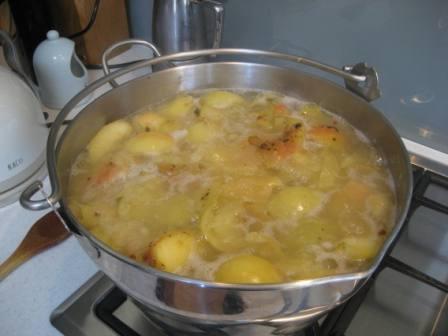
That didn't make much of a dent in the apples and it was Florence White to the rescue with  a Somersetshire recipe for apple butter.  Quarter the apples - don't peel or core & put everything into a preserving pan.  I filled mine to the top - the recipe assumes you are using windfall apples so you just have as many as you bothered to pick up.  Cover the apples with water or water & cider.  I added liquid about 3/4 up the side of the pan.  Stew to a pulp which took about an hour.  Press through a sieve which was a little messy as there was a great deal of pulp & I had to use more than one bowl.
Wash out the pan, measure the pulp, then return the pulp to the pan.  Simmer for about an hour until quite thick.  Add 3/4 lb (330g) sugar for every pint (600ml) of pulp. I actually put much less - I started with a cup per quart (2 pints) then added 1/2 lemon plus peel per quart, then added more sugar and tasted till it seemed right- not losing the appley tartness.  But do remember the sugar is the preservative.  Boil up until it is stiff enough to spread without running.  Use the jam crinkle method to test.  Pour into sterilised jars & "cover in the old fashioned way with a piece of paper dipped in brandy".  That's what she says!  She adds that if properly made this will keep for 2 years.  We'll see.  It is so yummy that I could just spoon it out of the jars.  So far I have had it for breakfast on fruit with yoghurt.  You could certainly serve as apple sauce with pork.
That was not the end of the apples.  I peeled & thinly sliced a few then blanched to stop the discoloration & when cooled bagged up in pie quantities & froze.  We will have 3 or 4 pies over the winter.  The rest were stewed with rhubarb.  And that is the end of apples.


Saturday, March 24, 2012

Rollover meals

I am now flipping through the tagine book picking up the ones I missed, mainly because they were unseasonal when I did the first round.  This week we had a creamy shellfish tagine with prawns & mussels.  For 2 steam a dozen mussels in your usual way.  We use a little wine. Reserve the liquor for later.  Shell the mussels & chop them up a little if you like, but leave a few on the half shell to be decorative.
Heat some olive oil in a pan or tagine. Stir in 3 finely chopped shallots & 1/2 a fennel bulb.  Stir in 1 tsp harissa paste - we were lucky enough to be given a jar of homemade harissa at Christmas & this is just the right warmth.  Pour in 150 mls of the reserved liquor & bring to the boil.  Stir in 75 mls cream, the juice of 1/2 a lemon & a dozen prawns.  Simmer gently until the prawns are cooked.  Season with salt & lost of black pepper & return the mussels to the pan to warm through.  Sprinkle with parsley to serve.
As so often happens one small thought leads to an entire meal.  The thought was  - I need to use up those little gem lettuces before they go to seed.  What about peas & lettuce - otherwise known as petit pois a la Francaise?  That goes nicely with roast chicken.  And we do have some carrots that are ready to pick.  Enter baked chicken with lemon, potato & green olives served with petit pois & steamed baby carrots.
I didn't want to roast a whole chicken so we did Maryland pieces.  Cut some roasting potatoes into smallish chunks & lay in the roasting dish.  Scatter over quartered red onion, a handful of green olives, some slices of lemon, a few chunks of pancetta & a couple of bay leaves.  Stir 1 tbsp each tomato paste & balsamic vinegar into 75 mls chicken stock & pour over potatoes.  Lay the chicken pieces on top, skin up & drizzle with olive oil, then sprinkle with salt & pepper.  Roast for 50 minutes then test the chicken to ensure the juices run clear.  Transfer the chicken to a plate to keep warm & whack the oven up to 220.  Return the veg to the oven until the potatoes are cooked through & beginning to colour. 
And you'll see we make good use of leftovers.  The potatoes go in the weekday salads & the peas & carrots are reserved for Monday's soup.
Chop the fennel left over from Saturday, a stick of celery, 2 spring onions, & a couple of courgettes into small dice.  Heat a pan & add a little olive oil &  knob of butter.  Add the veg except for the courgettes & cook 10 minutes or so until soft.  Add 500g vegetable or chicken stock & when it has come to the boil add the courgettes.  Cook for a minute & add 100g peas & broad beans - I would use fresh in spring but frozen is good.  Cook for another couple of minutes & add Sunday's leftover peas & lettuce plus the chopped carrots. Add a little more shredded lettuce if you like.  Simmer another minute, add chopped herbs then season.  Serve with grilled sourdough.
We planted a few buttercrunch lettuces & one of them grew into the biggest lettuce I have ever seen.  We have been having it for lunches.
The winter veg have arrived and it is hard to know which to choose.  Put together about 400g of vegetables - shallots, carrots, parsnip, pumpkin, beetroot, potato.  Chop them into chunks or thick slices with the slower cooking items in smaller pieces.  Put them into an ovenproof dish.  Add 1 finely chopped clove of garlic, olive oil, salt & papper.  Roast the veg at 190 until all are cooked through & beginning to caramelise. 
Beat 6 eggs with chopped herbs & season.  Pour over the vegetables & scatter over grated cheese.  Return to the oven for 10-15 minutes until the egg is set & the cheese is golden. Serve with a salad to try & get through some of the giant lettuce & use the leftovers in lunch salads.  It slices nicely & is good warm or cold.
Thursday we had that pinto chilli.  There was part of the tin of pintos and part of the tin of tomatoes left over so I heated those through with the left over lunch lentils & a splash of balsamic then served on sourdough toast topped with a poached egg for Saturday brunch.
During the week I had such a treat.  One of you kind readers, having read last week's entry, turned up on my doorstep with 2 kilos of green tomatoes.  I have made the chutney and will be delivering some to the tomato donor in the morning.  Phoebe will also be delighted because a jar or 2 will be wending its way to her this week.