Sunday, July 26, 2015

La Pasta in Casa

I thought it would be nice to make pasta and I bought 00 flour.  Some considerable time later I thought, "Must get on to that pasta making" and I bought a pasta machine.  More time passed and I thought, "Must get that pasta machine out of the box".  So at last the flour and machine were introduced.  It transpired that some years had passed between the initial thought and the action.  The flour was no longer viable and the pasta was not a success.  Undeterred I bought another bag of flour and this time it all came together.
Making pasta really is quite simple.  Just make sure your flour is fresh!  I consulted Marcella Hazan, her son, Giuliano and the New York Times.   This is what worked for me.  Start with 1 egg per 100g flour.  You need at least two eggs to get a quantity you can work with and you can dry it and store in an airtight container so there is no issue with having more than you need.  Before you begin, clear your work surface because you will need plenty of room once you start rolling.  Pour the flour into a mound on the work surface.  Note that marble is too cold and won't work.  Make a well in the centre of the flour and break the eggs one at a time into the well.  Beat the eggs gently with a fork until the yolks and whites are mixed together - actually this proved a bit hard and I resorted to whisking the eggs first before pouring into the well.  With the fork, gradually incorporate the flour into the egg until the egg is no longer runny.  Work from the inside wall of the well.  If the egg escapes onto the bench it is not easy to recapture.  Once you've reached the stage where you have quite a viscous mixture, quickly bring the remaining flour over the egg mixture and scoop it up, mixing with your hands until you have a moist but not sticky dough.  Wrap the lump of dough in cling film to stop it drying out at all and clean the work surface and your hands ready for kneading.  Knead the dough until it is very smooth and silky - this only takes a couple of minutes if all is well. Rewrap in cling film and rest for at least 20 minutes.
Set up your machine for rolling and get out lots of tea towels to lay out the rolled dough.   Cut a three-egg dough into six portions and keep the ones you are not working with wrapped in cling film.  Flatten the chunk of dough in your fingers and start to feed the dough through the machine starting at the widest setting.  Feed each portion through this setting three or four times, folding into three after each roll.  Then, reducing the rollers by one notch each time roll all the pieces through the machine and lay them out on dry tea towels.  Leave to dry a little so that it feels a bit leathery but not brittle.  Maybe 10-20 mins.
When they are ready, shape your pasta.  We made fettuccine according to the instructions on the machine.  To store the ribbons, wrap them loosely around your hands to form nests then leave to dry on a tea towel before storing in an airtight container.  They will keep for months.
To cook drop the pasta in a large saucepan of well salted boiling water and boil with the lid off for a few minutes until al dente; 2-3 mins will be enough on the day of making. 
I rediscovered the classic tomato sauce for pasta.  Put two tins of tomatoes in a saucepan with a halved onion and 100g butter.  Simmer over a low heat about 40 minutes until the tomatoes have reduced and slightly separated from the butter.  Discard the onion and either use the sauce immediately, set aside to reheat later or freeze. This sauce is indescribably good.   It will keep for a few days in the fridge. Serve this on any kind of pasta including filled shapes, which is our next project.  I served the first batch with cauliflower florets that I had lightly steamed then roasted in olive oil with a sprinkling of chilli flakes.  Just top with the sauce and some grated parmesan.
We used the reserved fettuccine with chicken and mushrooms with tarragon, which is a dish well worth trying.  We have made this two or three times and it is nice with any of the suggested accompaniments.
We  made some pappardelle by loosely rolling the sheets and cutting by hand about two centimetres wide.  We served this with my go to Bolognese recipe.  This sauce with pappardelle is one of my favourite pasta dishes and the home made pasta just made it better.
This experiment has been worth the effort and we will be keeping it up. Next we will be trying stuffed pasta.  If you have any suggestions about making pasta at home please share.  All ideas welcome.

Sunday, July 12, 2015

Chicken dinner

We don't eat chicken as often as we used to.  Not even to make stock because we can buy frames at Moore Wilson.  Recently we needed to replenish the stock and I recalled a wonderful chicken recipe with orzo and leeks, which I discovered last year.  This is such a simple way to serve a roast chicken meal with minimum effort and put at least one more meal on the table during the week, as well as replenish your stock stores. 
Sit a chicken in a roasting pan, breast side up.  Pour over the juice of a lemon, rubbing some into the skin, then stuff the lemon skins into the cavity along with some sprigs of thyme and rosemary, and tarragon if you have it.  Ours has died back for the winter. 
Drizzle the chicken with olive oil and dot with a little butter.  Chop some more of the herbs and sprinkle over, then season with sea salt and black pepper.  Add about 2cm of water to the pan and lots of unpeeled garlic cloves.  A dozen would be good.  Roast at 200 for 70 minutes or until done. 
Transfer the chicken and garlic to a plate, cover with foil and keep warm while you prepare the accompaniments. Add about 1/4 cup white wine to the pan juices, bring to the boil on the stove top and reduce to a pouring cream consistency. 
Meanwhile, and I would start this just before taking out the chicken, boil a saucepan of water for the orzo and sauté in a little olive oil a finely sliced leek in a heavy bottomed frying pan.  Cook the leeks until they are soft and sweet then add 2-3 bunches of finely sliced spinach.  Cook the orzo (or risoni or any rice shaped pasta) according to the instructions on the packet and mix with the leek mixture.  Pile the orzo mixture onto a serving plate and top with the chicken and garlic then drizzle over the reduced winey pan juices.  This will become your go to chicken recipe. 
Next day make stock.  The left over orzo makes a good weekend lunch  - just heat and add any other left over greens you have in the fridge.  You could add some cooked puy lentils if there is not so much orzo and more of you.
During the week you could use up the left over chicken in a pasta dish.  Make a tomato sauce by gently frying chopped garlic in a little olive oil then add a crumbled dried chilli, 2 tsp dried oregano and 3 tins of tomatoes.  Simmer for an hour then add a tbsp. red wine vinegar and stir well to make sure all the tomatoes are broken down.  You can use what you need now and freeze the rest in batches for later.  Once you've set aside some to freeze add the shredded left over chicken and maybe some blanched broccoli or whatever green vegetable you have to hand.  Serve with penne or fusilli pasta topped with grated parmesan. Or your home made tagliatelle.  But that is another story.

Monday, June 1, 2015

From the sea to our table

I love food from the sea.  Fish, shellfish, crustaceans  - I love them all.  We have such great seafood here and I love to showcase it with visitors.  Some people, though, can be a little delicate when it comes to seafood so I tend to fall back on lamb or other safe choices.
I was therefore delighted when we recently hosted visitors from Scotland who wanted to try everything.  I just prepared a variety of sea foods and put them all on the table for people to help themselves.  We had bluff oysters  with a little pepper, green-lipped mussels and littleneck clams steamed in white wine and parsley and flaked Coromandel Smoking Company kingfish on a dish.  For pepper seared tuna, mix a little sesame oil with a tsp English mustard and brush over a tuna fillet cut in a log of even thickness at each end.  Heat a dry frying pan until it is very hot and sear the tuna on the long sides.  Take out of the pan immediately and cool.  With a sharp knife slice as finely as you can and serve with finely sliced spring onion, soy sauce and wasabi.
For a ceviche-style dish get some good quality fillets of white fish such as blue cod and slice as thinly as you can.  Lay out on a large platter and dress with finely sliced spring onions and deseeded red chillies.  Just before serving squeeze over the juice of a lime or two.
This was accompanied with salad greens.  It was so simple, it was hardly cooking but was really delicious.
A few weeks ago a friend gave me some tuna.  You may recall I have been the beneficiary of this friend's bounty in the past.  This time we prepared two quite different dishes. 
The first was spiced tuna with an aubergine relish.  To make the relish, which would also go well with lamb or chicken, cut an aubergine into cubes, toss in olive oil and bake in a single layer on a baking tray at 200 for 30 mins or so.  In a frying pan, soften half a finely chopped red onion then add 1/2 tsp each coriander, cumin, cinnamon, paprika and cook for a minute.  Add 1/2 tin chopped tomatoes, 2 cloves crushed garlic, 1/2 a finely chopped green chilli and bring to a simmer.  Add the cooked aubergine and add a pinch sugar, a squeeze of lime and salt and pepper to taste.
Brush the tuna steaks with olive oil and season then sear in a hot grill pan two minutes each side.  Serve on the aubergine and top with mint leaves.
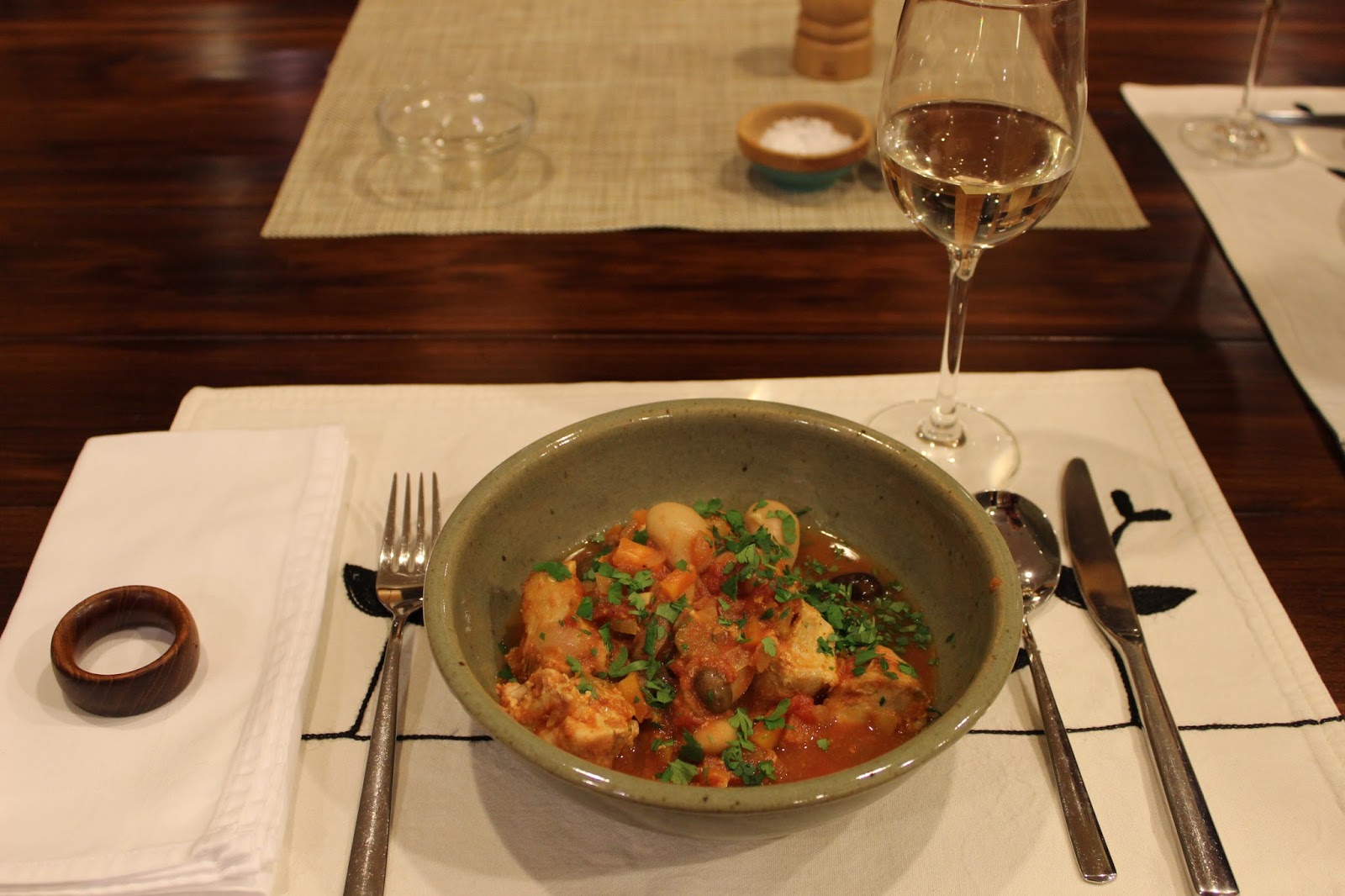
For something quite different we had our old favourite tuna and white bean stew.  This is a traditional Mediterranean method where the tuna is cooked in a sauce.  Using a tuna steak per person, sear the steaks first in a pan and set aside.  In the pan, saute 1/2 a finely chopped onion, 1/2 a finely diced carrot, 1/2 a stick of finely diced celery, 2 cloves of finely chopped garlic with 1/4 tsp each toasted cumin and coriander seeds, coarsely ground.  Add 1/2 tsp Spanish paprika and a handful of black olives.  Lay the tuna back in the pan in one layer and add 1/2 tin chopped tomatoes and 1/2 cup chicken stock.  Simmer about 15 minutes then add 1/2 jar of cooked butter beans and gently mix through.  Sprinkle with parsley to serve.  You will want some crusty bread to mop up the sauce at the end.