Tagine Saturday was such a success but now it's over. Peter bought me a cazuela for my birthday & the second half of my paella book is all about rice in the cazuela, so off we go with cazuela Saturday. The
cazuela is a beautiful dish & I think would also be perfect for risotto so I am going to try that too. The book says that the Spanish cook almost everything in the cazuela. It distributes & retains heat well & is great for simmering & braising and cooking rice on the stove top. These cazuela dishes are more soupy than paella which is a drier dish with that lovely crust on the bottom.

We started with something simple - white rice with herbs. If you don't have a cazuela do this in your Le Creuset or other Dutch oven style pot. For 4, bring 4 cups of water to the boil in the cazuela. Blend 2 cloves garlic & 1 tbsp parsley with 1/2 cup water in the processor. When the water reaches the boil, add the garlic mix & a pinch salt. The rice makes a difference here & I would recommend Spanish rice - Bomba or Calasparra. If you don't have those use a short or medium grain rice - Calrose, Japanese short grain, or any of the Italian rices. Don't use long grain or Basmati. Add 2 cups rice with a bay leaf and a stripped thyme stem. Yes, strip the leaves off the thyme stem! We used the thyme leaves in the accompanying chicken. Cook uncovered stirring occasionally for 10 minutes over a medium high heat. Check the seasoning at this point. Reduce the heat & cook another 8 minutes or until most of the liquid is absorbed & the rice is
al punto - the Spanish equivalent of
al dente. You don't want this to be dry & fluffy and it's not quite creamy like risotto but something in between. You just have to judge. This was so delicately flavoured that I think you want to serve it with something equally light like chicken or fish.

We had our old favourite chicken with herbs. Sprinkle 4 chicken thighs with salt & pepper & brown on both sides in butter with a little oil. Lower the heat, cover & cook another 8-10 minutes until the chicken is cooked through. Set the chicken aside & tip away most of the fat from the pan. Add finely chopped spring onion & when golden add 3/4 cup liquid - a mixture of chicken, stock, white wine, water. Scrape up all the bits on the bottom of the pan & reduce the liquid. Add a handful of chopped herbs & pour over the chicken.

Sunday we went for a walk at Makara. It was a lovely afternoon & half of Wellington was there. We spotted some wild samphire & we had bought a fillet of porae from Yellow Brick Road at the city market, so we picked a little for dinner. It was the perfect addition to our fish supper with roast potatoes & courgettes.

There was polenta in the cupboard & I thought it should be used up so we had chicken involtini - I think this means rolled up - with polenta. This seems fiddly but isn't really & is worth the effort. Make a creamy polenta - for 4, I use 6 cups water or stock to 1 1/2 cups polenta & add Parmesan & a knob of butter at the end. Heat the oven to 200 & cut 2 large chicken breasts into six slices each including the tenderloin. Pound them between 2 sheet of baking paper to about 4mm thick. Lay out each slice, top with a sliver of prosciutto & a slice of mozarella. You'll want 2 balls of mozarella for four. Season & roll up, lay a sage leaf on top & secure with a toothpick. Brown on each side in a pan with butter. You'll need to push the stick though when you turn it but it's not nearly as fiddly as it sounds. Cook in batches so as not to crowd the pan then transfer to an oven proof dish & cook in the oven another 8-10 minutes. In the pan crisp up a few sage leaves in butter. Serve the chicken on a bed of polenta topped with crispy sage.

And of course you are wondering what became of the apples. Well, Anzac Day was Apple Wednesday in our house & the smell of apples wafted through the house. Try this
cake substituting apples for pears. I made three of these. I cut the apples in quarters & then sliced them almost through from the fat side of the wedge (like a hasselback potato) before caramelising.

If you find you can't fit all the caramelised apples into the cake, take a break & eat the leftovers with a dollop of vanilla ice cream. You deserve it.

That didn't make much of a dent in the apples and it was
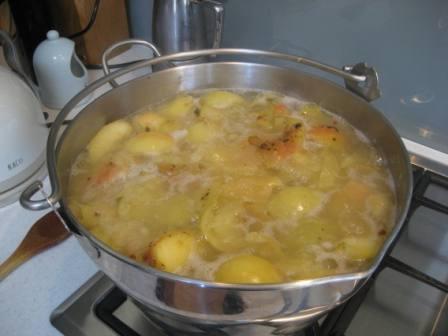
Florence White to the rescue with a Somersetshire recipe for apple butter. Quarter the apples - don't peel or core & put everything into a preserving pan. I filled mine to the top - the recipe assumes you are using windfall apples so you just have as many as you bothered to pick up. Cover the apples with water or water & cider. I added liquid about 3/4 up the side of the pan. Stew to a pulp which took about an hour. Press through a sieve which was a little messy as there was a great deal of pulp & I had to use more than one bowl.

Wash out the pan, measure the pulp, then return the pulp to the pan. Simmer for about an hour until quite thick. Add 3/4 lb (330g) sugar for every pint (600ml) of pulp. I actually put much less - I started with a cup per quart (2 pints) then added 1/2 lemon plus peel per quart, then added more sugar and tasted till it seemed right- not losing the appley tartness. But do remember the sugar is the preservative. Boil up until it is stiff enough to spread without running. Use the jam crinkle method to test. Pour into sterilised jars & "cover in the old fashioned way with a piece of paper dipped in brandy". That's what she says! She adds that if properly made this will keep for 2 years. We'll see. It is so yummy that I could just spoon it out of the jars. So far I have had it for breakfast on fruit with yoghurt. You could certainly serve as apple sauce with pork.

That was not the end of the apples. I peeled & thinly sliced a few then blanched to stop the discoloration & when cooled bagged up in pie quantities & froze. We will have 3 or 4 pies over the winter. The rest were stewed with rhubarb. And
that is the end of apples.
 We haven't had a fish soup for ages and this week we tried a variation on an old favourite. For 2, steam a dozen mussels in 1/2 cup white wine until the mussels have opened. Set the mussels aside and strain the cooking liquor through a fine sieve. You'll want about 3/4 cup of liquid. Set a couple of mussels aside to garnish & halve the rest. Rinse out the pan and put it back on the heat with a little olive oil & butter, 1/2 leek finely sliced & 1/2 fennel bulb finely sliced. Season, cover & cook over a low heat about 10 mins until tender. Add a clove of crushed garlic, some fresh thyme & a pinch of saffron. Cook about a minute. Add the mussel liquor, 1 1/2 cups chicken stock & 1/4 cup cream. Bring to the boil & simmer 10 minutes. Add about 300g firm white fish cut into bite-sized pieces. We used porae from Yellow Brick Road - responsibly caught via long-line on day boats, traceable,
certified by Friends of the Sea. I added that because, if you check the app I mentioned last week, porae is listed as a bad choice. Simmer 3 mins or so until the fish is just cooked then take off the heat and add the mussels & some chopped parsley. Add a reserved mussel to each bowl along with some fennel fronds & a grind of black pepper. Serve with freshly baked sourdough.
 A real find this week was the Dutch favourite Stamppot. This is Dutch sausage & mash & is divine. I found the recipe on a Dutch blog along with other interesting ideas so we may be trying some Dutch fare over winter. I pretty much followed this recipe to the letter and although I was sceptical about the vinegar it was perfect addition. The recipe recommends adding a stock cube to the potato cooking water but, in fact, I boiled the potatoes in our home made stock. I bought the rookworst at Moore Wilson and again I didn't expect to like it but it was delicious. I also think this would be nice with a good pork sausage and a blob of apple butter. Did I mention that I had made it again this year, but this time with more sugar because last year it didn't keep well? This year's batch is much firmer & could be spreadable but still delicious.
 We also went back to that old favourite kedgeree. We got some beautiful smoked fish from YBR but I can't recall what it was. I was reminded how much I love kedgeree and I'm sure it will reappear on our table before too long.