Showing posts with label rice. Show all posts

Sunday, August 2, 2015

Persian delights

In March 2011, I first made khoresht-e gheimeh then in November 2013 I discovered khoresht-e ghormeh sabzi.  I revisited both of them this winter and went on to make khoresht-e mast with chicken and maygoo polow with prawns and herbs.  Most satisfying, I mastered chelow, the classic Persian rice dish and this is now my go-to rice dish.  I am also working my way through the variations.  If you want to know more about Persian cooking borrow the book, Saraban, from the library.  If you just want to make a delicious meal let me tell you how.  I always make these dishes for six because they freeze well and then there is always something delicious in the freezer during the film festival when there may not be time to cook after a movie.
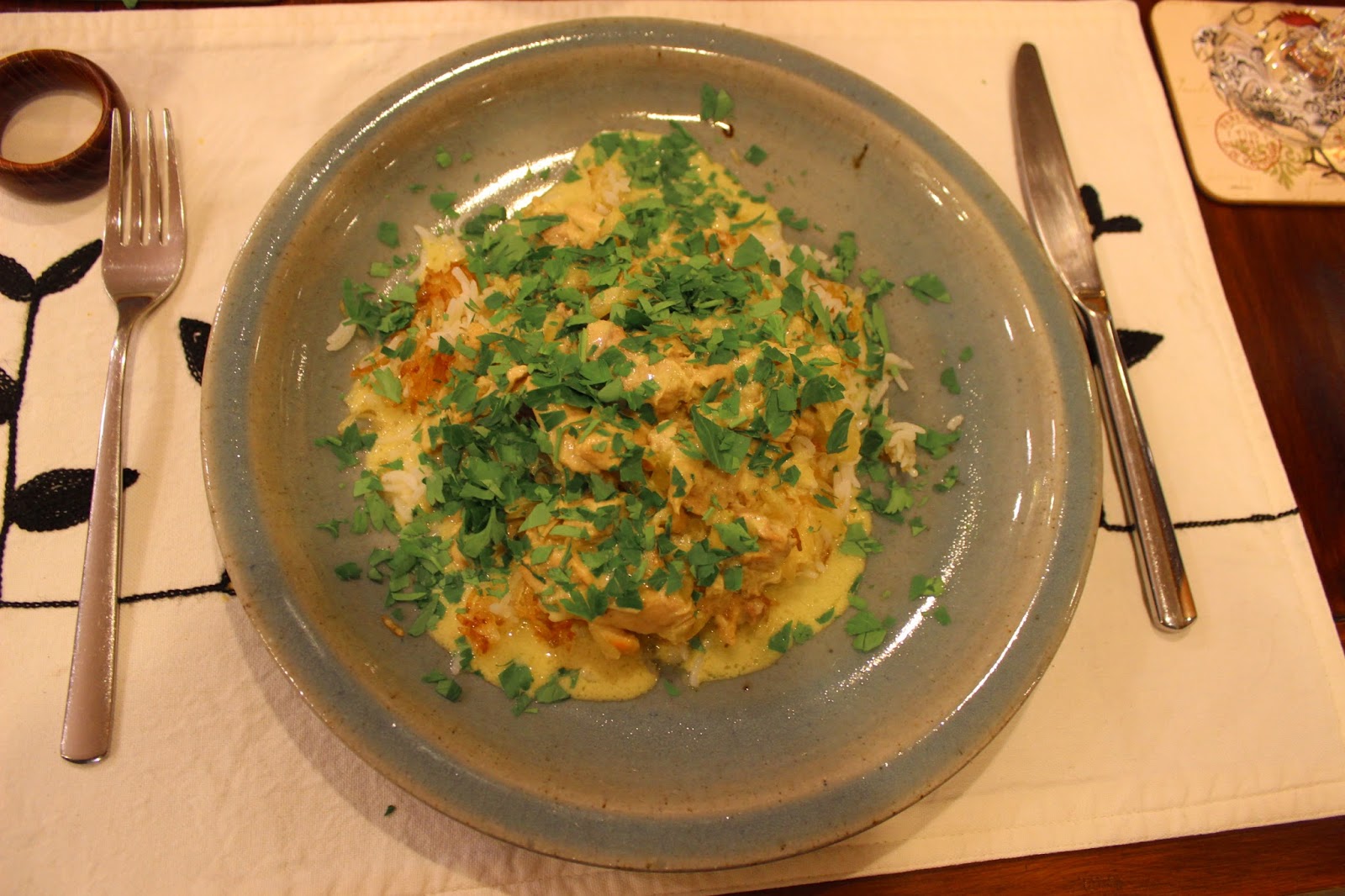
The chicken khoresht is great if you don't have two or three hours to cook the lamb version.  This will only take an hour once you've sweated the onions.  To start, sweat 2 finely chopped onions with 2 finely sliced celery sticks until soft.  Stir through 1 tsp ground cumin, 1/2 tsp  ground ginger, 1/2 tsp ground cardamom, 1/4 tsp cayenne, 1/2 tsp ground black pepper and cook for a few more minutes.  Cut 1 kg of boned chicken thighs into 2 or 3 pieces each.  Add them to the pan and brown briefly over a high-ish heat making sure they are all coated with the spicy onion mix.  Add a bay leaf, 500 ml chicken stock, a few saffron threads, zest and juice of a lime and juice of an orange.  Season with salt and simmer for an hour or so.  While the stew is cooking whisk 350g of Greek yoghurt with an egg.  When the stew is ready, whisk a few tablespoons of the hot broth into the yoghurt and egg mix then pour it all into the stew.  Add 1 tbsp slivered pistachios and cook at a bare simmer for five minutes to thicken.  Stir in one direction only and be sure not to let it boil or it will curdle at this stage.  Now Greg Malouf adds golden raisins but I do not.  It brings back memories of terrible 70s curries and I can't quite do it.  Apricots and prunes, yes but raisins, no.
Now as I mentioned above I feel I have mastered the Persian chelow and I am not sure what I was afraid of.  You need to allow about 80 minutes but most of that time it is looking after itself so it's no effort.  The recipe is for 6 so I just do 1/3 when making for two.
Wash 300g basmati rice and leave to soak in a generous quantity of warm water for 30 mins (30 minutes doing nothing with rice).  Strain the rice and rinse it again with warm water.  Follow these steps and you will be rewarded with perfectly separating grains.  Now boil a large saucepan of water, salt generously and stir in drained rice.  Boil at a rolling boil, uncovered for 5 minutes. I bring the water to the boil while the rice is soaking to save time and I turn it off if necessary so it only takes a minute or two to reboil when needed. Strain and rinse again and drain off as much of the water as you can.  Now is the tricky bit but it's not really tricky at all.  Melt about 40g of unsalted butter with 2 tbsp warm water and set aside.  Heat 1/4 cup oil with 1 tbsp water on a medium high heat in a large saucepan - the one you used to boil the rice.  When the oil begins to sizzle spoon in enough rice to cover the base of the pan in a thin layer - this is going to form a crust.  Spoon in the rest of the rice gradually building it up to a pyramid.  Don't tip it all in because you want it loosely piled to achieve the fluffy separateness.  Use the handle of a wooden spoon to poke a few holes down through the rice to the base of the pan.  This is to help it steam.  Now drizzle the melted butter over the rice.  Wrap the saucepan lid in a tea towel and tightly cover the pan.  Leave it on the medium high heat for a few minutes until you see some steam trying to escape then turn right down and leave for 40 minutes.  Another 40 minutes doing nothing with rice.  Don't peek.  It won't hurt if you leave it for up to an extra 20 minutes.
When you are ready to serve plunge the pan into a few inches of cold water in the sink.  The sudden change in temperature cause the rice to shrink from the sides of the pan loosening the delicious crunchy bottom.  Now invert the pan into a serving dish and it may plop out as one glorious mound with a beautiful golden crust.  Or it may not.  In which case just scoop the crust, known as the tah-deeg, over the top. Once you have mastered this you can do all sorts of variations to the crust with yoghurt, potatoes or bread.
And you can make an complete dish of the rice such as maygoo polow with the addition of herbs and prawns. Wash soak and parboil the rice.  Soak 1 tsp fenugreek seeds for 10 minutes, then gently fry in a frying pan with a small finely chopped onion, 1 tsp ground black pepper, 1 tsp turmeric, 1/2 tsp ground ginger.  Add a chopped deseeded tomato and 200g peeled prawns with tails on.  Don't worry if they're not.  Stir briefly until the prawns just begin to colour.  Remove the pan from the heat and stir through 1/3 cup finely snipped chives, 1/3 cup shredded flat leaf parsley, 1/3 cup shredded dill sprigs.  You can also add coriander if you must.  Now start to prepare your parboiled, drained rice for steaming.  Heat the oil and put the layer of rice in the bottom for the pan.  Scatter a layer of the prawn mix and layer up your pyramid with rice and the prawn mix ending with a layer of rice.  Poke the holes, drizzle over the butter, wrap up the saucepan lid and go off and do something else for 40 minutes.  Don't peek.  When done tip out as described above. 
You can serve all Persian meals with a herb salad and flat bread.  I sometimes serve stews with wilted spinach seasoned with nutmeg.
If you would like to carry the Persian theme through to coffee whisk some mascarpone with a little honey and lemon zest.  Slit some medjool dates to remove the stone, but don't cut in half.  Pipe the mascarpone mix into the dates and sprinkle with pistachios and rose petals.

Sunday, August 10, 2014

Home and abroad

It's been a while but I find myself with a moment to spare and I thought I'd catch up with you.  We've been away.  This isn't an excuse but I thought I'd start by sharing some of the delights we ate while we were away.  We travelled to England and Scotland and I made a side trip to Rogat in the Netherlands.  We ate some amazing food and I am not going to mention the not so great - best forgotten.
There are some wonderful places to eat in London.  We made a day trip to Hampstead Heath and I wanted to eat at the Spaniard's Inn.  The food wasn't this good last time I was there.  We sat in the sun and enjoyed a leisurely lunch and a pint.  From the June menu, I had the Scotch egg and Peter had the terrine. We then shared the salad of bulgar wheat, quinoa, lentils, soy flakes, radish, pomegranate & asparagus.  There was one surprise with the salad - no asparagus.  And a slightly odd response to its absence.  The waitress had no idea what asparagus was and peered at the plate uncertain what was actually missing.  The chef and the duty manager were surprised that I had thought fit to mention its non-appearance.  That said, this was the best Scotch egg ever and  a wonderful salad sans asparagus.
I was keen to try out Ottolenghi's Soho offering, Nopi.  We couldn't get a table in the main restaurant but there was space at the downstairs bar.  It was a great atmosphere and great food.  We had a selection of dishes to share.  I was browsing in the Time Out and I found a review for another Middle Eastern restaurant in Soho, the Palomar.  If you only eat at one Middle Eastern restaurant in your life, make it this one.  Again we couldn't get a table but we did secure a perch at the bar where we could observe the food being prepared and the chefs having fun while they cooked.  
We had two great meals in Glasgow.   We were taken by friends to Two Fat Ladies at the Buttery.  This was a five-star restaurant specialising in fish.  We don't often eat out like this.  At the other end of the scale we went to a family run Italian restaurant, Sarti, which is definitely worth a visit. 
Phoebe searched out another amazing find in Canterbury.  Next to the railway station is the Goods Shed where produce was once stored before being transported by train.  This is now a Farmer's Market and restaurant serving locally sourced seasonal food.  I can't describe the meal - you'll have to try it out for yourself.
I also enjoyed home cooking in the village of Rogat in the Netherlands province of Drenthe.  I enjoyed traditional Dutch cooking including Stamppot, made with endive as a summer substitute for kale, and chervil soup.  Most of what I ate was produced from the back yard including eggs and honey.   
Since we've been back we have been enjoying some of the coldest weather Wellington can throw at us, so we thinking slow cooking and lots of winter greens.  Luckily the kale, cavalo nero and rainbow chard in the garden is keeping us going.  We have a new eatery in Wellington, Loretta, sister restaurant to Floriditas.  They have the ultimate comfort rice dish  - warm rice with broken sausage and thyme.  I am making a basic risotto with a sprinkle of chilli flakes and a handful of thyme leaves in with the very finely chopped onions.  I used pork & fennel sausages, skin removed and broken up.  Cook these lightly before adding the rice.  Add extra stock so the resulting dish is quite sloppy.  Add extra thyme at the end and omit cheese.  Truly.   I served with  leeks and winter greens from the garden.
You should also try a potato tagine-style stew which has become a staple at our table.  For four to six, soften a finely sliced onion and two roughly chopped carrots with a pinch of salt, in a heavy bottomed pan.   Add a teaspoon each of ground coriander, cumin, ginger, turmeric and paprika and a pinch of chilli flakes along with three crushed garlic cloves, zest of a lemon, tbsp clear honey, a couple of bay leaves and three long green chillis left whole.  Cook for a couple of minutes.  Add scrubbed red skinned waxy potatoes cut into chunks and turn in the spices. Add a tin of tomatoes, a tin of chickpeas, two cups chicken or vegetable stock and bring to the boil.  Cover and simmer fotry minutes.  Add a handful of green olives at the end and serve with dollops of Greek yoghurt (I use Zany Zeus) and scatter with toasted pumpkin seeds, a tsp of paprika and some finely chopped parsley (or coriander).  You will make this again and again.
 

Saturday, May 19, 2012

Eat your greens

We went straight from the simple cazuela to the grand sounding Arroz de Mar y Montana - sea & mountain rice - with chicken, pork, prawns & squid.  You want to make this for 4 or 6.  For 6, season about 300g diced pork and 6 chicken thighs then brown in a cazuela or casserole.  Transfer to a plate.  Take 4 good pork sausages & squeeze them out of their casings and form into  small balls.  Brown them all over then remove.  Add 250g squid cut into smallish pieces & 1 finely chopped onion.  Cook until the onion is soft then add a tin of chopped tomatoes & cook 15 mins.  Return the other meats to the pan along with any juices on the plate and add 1 tsp smoked paprika.  Add 6 cups water & simmer gently 1/2 an hour.  Make a picada which is usually a mix of herbs and nuts - maybe a Spanish pesto.  Perhaps one of you Spanish cooking experts can enlighten us here.  In this case 2 cloves garlic, 10 skinless hazelnuts (roast in the oven a few minutes and the skins will rub off) & 1 tsp flat leaf parsley.  Pound in a mortar & pestle, or blend, with a little of the simmering liquid until you have a smooth paste.  Sprinkle some saffron threads into the cazuela, bring the liquid to a boil & add 2 cups rice, the picada, & a handful of shelled prawns.  If you have ones with the shell on give them a quick turn first back with the sausage balls.  Make sure the rice is evenly distributed then cook uncovered on a medium boil for about 10 minutes, stirring occasionally.  Reduce the heat & cook until the liquid is nearly absorbed & the rice is al punto.
Now that the cold weather is closing in, try a spicy winter stir fry.  For 4, cut 2 carrots into thin batons, 2 parsnips into thin disks, 200g mushrooms finely sliced & 200g finely shredded Brussels sprouts.  Heat some sunflower oil in a wok or pan over a high heat & stir fry 6 finely sliced shallots & 1 hot finely chopped chilli for a few minutes.  Add the carrot & parsnip & cook 2 minutes.  Then add the mushrooms & 2 cloves finely chopped garlic & fry another couple of minutes.  Finally add the sprouts & cook another couple of minutes.  Season & add a pinch of sugar.  Scoop everything out of the wok, reduce the heat.  Add 4 tbsp soy sauce, 4 tbsp rice wine, 1 tsp Chinese five spice, a good squeeze lime juice and 4 nests of cooked drained egg noodles.  Cook a couple of minutes, then return the vegetables to the pan & toss through.  Serve with another good squeeze of lime juice.
One of my other favourite meals of the moment is chard & potato curry.  We have some rainbow chard growing in the garden and Wairarapa Eco Farms is now at the market every week.  Between us we produce a wealth of leafy greens for this dish.  You could use any waxy potato but I have been using Eco Farms Kowiniwini potatoes.  For 4, take about 500g rainbow chard, beetroot leaves, spinach, curly kale - whatever you have to hand.  Separate the leaves from the stalks.  Cut the stalks into 2-3 cm pieces & roughly chop the leaves.  Fry 1 finely sliced onion in a pan with sunflower oil until golden. Pound 3 cloves garlic with 1 finely chopped green chilli & a knob of chopped ginger with a pinch of salt, to a fine paste.  Add to the onion with 1 tsp garam masala, 1/2 tsp mustard seeds, 1/2 tsp ground cumin, 1/4 tsp turmeric & 3 cardamom pods.  Stir through, then add about 350g small waxy potatoes, quartered and the chopped stalks.   Fry a few minutes then add 400ml water, bring to a boil & simmer 12 minutes until the potatoes are tender.  Add the leaves & stir until wilted.
In a bowl mix 250g thick yoghurt, 1 1/2 tbsp tomato puree & a little curry liquid.  Stir this back into the curry & warm through gently.  Scatter over toasted mixed chopped nuts - almonds, cashew, pistachios and serve with rice or naan bread.
Try this Tunisian breakfast soup which I actually made for Saturday lunch.  Soften a finely chopped onion then add 2 cloves crushed garlic, 1 tbsp cumin & a finely chopped red capsicum.  Add a tin of chickpeas, a tin of tomatoes & 750ml chicken stock.  Simmer gently for 10 minutes.  Add 500g roughly chopped greens - the ones you didn't use in the curry.  Stir through 2 tbsp harissa paste. Grill a slice of sourdough bread per person & lay in the bottom of a bowl then pour over a ladleful of the soup.  Top with hard boiled egg, capers & a little more chopped capsicum with a drop of harissa.
I have often thought of making corn bread but never done so.  This week Hugh inspired me to have a go and it was a huge success.  His recipe include pumpkin and chillies both of which were lurking in the fridge looking for something to do.  I added a tin of creamed sweetcorn.  I think I have mentioned before this is a weakness of mine.  We couldn't eat it all so I divided into batches for the freezer & we will reheat for lunches from time to time. 
Finally I ordered some dumplings from Vicky Ha at the market and served them for Sunday dinner with my version of Alan Fong's greens.  I emailed Vicky & she put the dumplings aside for me with the dipping sauces and emailed me instructions on how to cook them.  They were truly wonderful.

Saturday, April 28, 2012

The Big Apple

Tagine Saturday was such a success but now it's over.  Peter bought me a cazuela for my birthday & the second half of my paella book is all about rice in the cazuela, so off  we go with cazuela Saturday.  The cazuela is a beautiful dish & I think would also be perfect for risotto so I am going to try that too.  The book says that the Spanish cook almost everything in the cazuela.  It distributes & retains heat well & is great for simmering & braising and cooking rice on the stove top.  These cazuela dishes are more soupy than paella which is a drier dish with that lovely crust on the bottom.We started with something simple - white rice with herbs.  If you don't have a cazuela do this in your Le Creuset or other Dutch oven style pot.  For 4, bring 4 cups of water to the boil in the cazuela.  Blend 2 cloves garlic & 1 tbsp parsley with 1/2 cup water in the processor.  When the water reaches the boil, add the garlic mix & a pinch salt.  The rice makes a difference here & I would recommend Spanish rice - Bomba or Calasparra.  If you don't have those use a short or medium grain rice - Calrose, Japanese short grain, or any of the Italian rices.  Don't use long grain or Basmati.  Add 2 cups rice with a bay leaf and a stripped thyme stem.  Yes, strip the leaves off the thyme stem!  We used the thyme leaves in the accompanying chicken.  Cook uncovered stirring occasionally for 10 minutes over a medium high heat.  Check the seasoning at this point.  Reduce the heat & cook another 8 minutes or until most of the liquid is absorbed & the rice is al punto - the Spanish equivalent of al dente. You don't want this to be dry & fluffy and it's not quite creamy like risotto but something in between.  You just have to judge.  This was so delicately flavoured that I think you want to serve it with something equally light like chicken or fish.
 We had our old favourite chicken with herbs.  Sprinkle 4 chicken thighs with salt & pepper & brown on both sides in butter with a little oil.  Lower the heat, cover & cook another 8-10 minutes until the chicken is cooked through.  Set the chicken aside & tip away most of the fat from the pan.  Add finely chopped spring onion & when golden add 3/4 cup liquid - a mixture of chicken, stock, white wine, water. Scrape up all the bits on the bottom of the pan & reduce the liquid.  Add a handful of chopped herbs & pour over the chicken.
Sunday we went for a walk at Makara.  It was a lovely afternoon & half of Wellington was there.  We spotted some wild samphire & we had bought a fillet of porae from Yellow Brick Road at the city market, so we picked a little for dinner.  It was the perfect addition to our fish supper with roast potatoes & courgettes.
There was polenta in the cupboard & I thought it should be used up so we had chicken involtini - I think this means rolled up - with polenta.  This seems fiddly but isn't really & is worth the effort.  Make a creamy polenta - for 4, I use 6 cups water or stock to 1 1/2 cups polenta & add Parmesan & a knob of butter at the end.  Heat the oven to 200 & cut 2 large chicken breasts into six slices each including the tenderloin.  Pound them between 2 sheet of baking paper to about 4mm thick.  Lay out each slice, top with a sliver of prosciutto & a slice of mozarella.  You'll want 2 balls of mozarella for four.  Season & roll up, lay a sage leaf on top &  secure with a toothpick.   Brown on each side in a pan with butter.  You'll need to push the stick though when you turn it but it's not nearly as fiddly as it sounds.  Cook in batches so as not to crowd the pan then transfer to an oven proof dish & cook in the oven another 8-10 minutes.  In the pan crisp up a few sage leaves in butter.  Serve the chicken on a bed of polenta topped with crispy sage.
And of course you are wondering what became of the apples.  Well, Anzac Day was Apple Wednesday in our house & the smell of apples wafted through the house.  Try this cake substituting apples for pears.  I made three of these.  I cut the apples in quarters & then sliced them almost through from the fat side of the wedge (like a hasselback potato) before caramelising.
If you find you can't fit all the caramelised apples into the cake, take a break & eat the leftovers with a dollop of vanilla ice cream.  You deserve it.
That didn't make much of a dent in the apples and it was Florence White to the rescue with  a Somersetshire recipe for apple butter.  Quarter the apples - don't peel or core & put everything into a preserving pan.  I filled mine to the top - the recipe assumes you are using windfall apples so you just have as many as you bothered to pick up.  Cover the apples with water or water & cider.  I added liquid about 3/4 up the side of the pan.  Stew to a pulp which took about an hour.  Press through a sieve which was a little messy as there was a great deal of pulp & I had to use more than one bowl.
Wash out the pan, measure the pulp, then return the pulp to the pan.  Simmer for about an hour until quite thick.  Add 3/4 lb (330g) sugar for every pint (600ml) of pulp. I actually put much less - I started with a cup per quart (2 pints) then added 1/2 lemon plus peel per quart, then added more sugar and tasted till it seemed right- not losing the appley tartness.  But do remember the sugar is the preservative.  Boil up until it is stiff enough to spread without running.  Use the jam crinkle method to test.  Pour into sterilised jars & "cover in the old fashioned way with a piece of paper dipped in brandy".  That's what she says!  She adds that if properly made this will keep for 2 years.  We'll see.  It is so yummy that I could just spoon it out of the jars.  So far I have had it for breakfast on fruit with yoghurt.  You could certainly serve as apple sauce with pork.
That was not the end of the apples.  I peeled & thinly sliced a few then blanched to stop the discoloration & when cooled bagged up in pie quantities & froze.  We will have 3 or 4 pies over the winter.  The rest were stewed with rhubarb.  And that is the end of apples.


Saturday, November 5, 2011

Spring Vegetables

This week we had a rather unusual tagine - chicken with grapes and artichokes.  For four, marinade 4 chicken breasts, cut into strips, in a mix of 2 crushed garlic cloves, 1 tsp turmeric, juice of a lemon, 1 tbsp olive oil.  Leave 1-2 hours.  Heat 2 tbsp olive oil in the tagine, and stir in 2 onions halved length ways & sliced with the grain.  This is what I did with the onions last week as well and I did it in the rice later in the week because I like the way it turns out.  Add 1/2 a thinly sliced preserved lemon with 1 tsp sugar.  Saute until slightly caramelised.  Toss in the marinated chicken slices, then add 1-2 tsp harissa paste, depending on how hot you want it, and 2 tsp tomato paste.  Pour over 300ml chicken stock & bring to the boil.  Cover & simmer 15 minutes.  Toss in a jar of artichoke hearts, cover & cook a further 5 minutes.  Add about a dozen green grapes halved length ways and flat leaf parsley, season & serve with couscous & a salad.  This was nice but not my favourite.  Worth a try.
We bought some beautiful snapper at the market on Sunday and served it with a fresh salsa verde type sauce.  For two, finely chop 1 clove garlic then add a small bunch parsley, a dozen or so basil leaves, 2 tsp capers & zest of a lemon.  Chop them all together as finely as you can, tip into a bowl, add the lemon juice & season well.  Add enough olive oil to make a thick puree.  Set aside.
Pan fry the fish using your usual method & when it is nearly done, add a knob of butter & the herb mix.  As the butter melts, stir it with the herbs & spoon them over the fish.  This should take about 1/2 a minute.  Pour the herby sauce over the fish on the plates.  I served it with baby carrots, asparagus & crushed baby potatoes.
This week I made a spring risotto with our own peas & broad beans.  They were a bit weeny - but still delicious, and a plate full of bright green with creamy rice is a beautiful thing to look upon.
For two, blanch 1/2 cup each of peas and broad beans with a bunch of thin asparagus sliced into about 3 pieces, in 1 1/2 cups chicken stock.  In a risotto pan soften 3 baby leeks & 3 spring onions finely sliced.  Add 1/2 cup of rice & prepare your risotto in the usual way.  At the end add the blanched vegetables with a tbsp each of finely chopped mint & flat leaf parsley.  At this stage I usually stir through a knob of butter, cover & let stand a couple of minutes then stir through Parmesan, season & serve.
On the same theme later in the week I did a saffron rice with peas.  In a large saucepan heat a tbsp sunflower oil & soften 1/2 an onion with 1/2 tsp garam masala.  I sliced the onion lengthways as noted above.  Try this - it's quite good.  Soak a few threads of saffron in a tbsp hot water & add to the onions along with 3-4 pitted prunes, sliced lengthways, 1/2 cup brown basmati rice and 1 cup chicken stock.  Bring to the boil, cover & cook until the water has evaporated & the rice is fluffy.  Add 1/2 cup blanched peas at the end.  If you are using frozen just pour boiling water through them in a sieve.  Stir in the parsley. 
While the rice is cooking combine 2-3 lamb fillets with 1 tbsp lime juice, 1/4 tsp cinnamon, 1/2 tsp cumin & 2 tsp sunflower oil.  Just before the rice is ready pan fry the lamb about 4- 5 minutes, then cover &  rest 5 minutes.  Slice & serve with the rice.

Saturday, October 29, 2011

French pizza and Scottish tagine

This is the tagine I first made the day after I was given the book.  It never fails to please.  Make a marinade with one grated onion, 3 crushed garlic cloves, a knob of grated ginger, finely chopped parsley, a pinch of saffron threads, juice of a lemon, salt & pepper, 3 tbsp olive oil.  Add chicken thighs with bone in, or legs.  You could get Maryland pieces and cut them in two then you have both.  You want 1-2 pieces per person depending on the size of your diners.  Rub the marinade well into the skin & refrigerate 1-2 hours. 
Heat a tbsp olive oil with a knob of butter, in your tagine.  Remove the chicken pieces from the marinade & brown well on both sides.  Pour over the marinade & add just enough water to come halfway up the sides of the chicken pieces.  Bring to the boil, cover & bake in the oven at 180 for about 45 minutes.   Add 2 preserved lemons, cut into strips, 175g cracked green olives & 1 tsp dried oregano.  Return to the oven for a further 20 minutes.  Sprinkle some fresh oregano over the top to serve.  I served it with steamed carrots tossed with toasted cumin & coriander seeds & mint.
Sunday being rugby I decided we should do the right thing & eat pizza in front of the telly.  I made RWC Final Pizza - one half black & white, the other red, white & blue for Le Tricolore.
I also made Olivo's delicious parsnip skordalia for rugby snacks.  Toss 500g parsnips, quartered lengthwise, with 1 tbsp Helen's cumin oil and 2 tsp cumin seeds and place in a roasting pan. Put in the oven and roast at 190 for about 25 minutes until cooked through and golden. Cool.  Place the parsnips in a food processor and pulse until mashed. Add 3 cloves garlic, salt to taste & an egg yolk then pulse again. Gradually drizzle in about 1/2 cup cumin oil while pulsing, then finally add the juice of 1/2 a lemon. If the mixture is too thick add a little warm water to the desired consistency.  As well as a dip Helen suggests serving it as an accompaniment with sausages.
Monday night I made one of the best soups ever.  Pea & parsley with scallops.  If you don't eat scallops (you must be crazy) you could leave them off but they are a magnificent addition.  For 6 people, soften 1 finely chopped onion with a finely chopped stick of celery and a bay leaf in a little butter for about 10 minutes.  Add 3 cups of chicken stock & season.  Bring to the boil & add 1 kg peas.  Sadly, frozen, as mine aren't ready & I don't think I could ever harvest that quantity for a single meal.  Bring back to the boil for about 3 minutes then stir through 1 cup finely chopped parsley, 3/4 cup cream & white pepper.  Blend with a stick blender, then add 2 tsp red wine vinegar & adjust the seasoning.  Keep warm & prepare the scallops.  Heat about 50g butter in a pan & sprinkle with a little mineral salt.  Fry 3-4 scallops per person with some fresh tarragon or mint leaves, for about 1-2 minutes per side.  Top the individual soup bowls with scallops & the fried leaves then drizzle with the scallop pan juices. 
A couple of weeks back, I had a sorrel risotto at Floriditas & as I have some in the garden, I thought I would try this at home.  I made a basic risotto using finely chopped onion & celery as the base then at the end I stirred though 1/2 dozen finely chopped sorrel leaves & the zest of half a lemon.  I finished off with the juice of the lemon half & a knob of butter.  It was wonderful.  You should grow sorrel.  It is delicious cooked & in salads & grows so easily.  I found the half dead seedling languishing in a dark corner at the garden centre & this week I am planning to separate the plant as it has flourished.
I had a small piece of pumpkin that needed to be eaten.  Enter Moroccan chicken with rice & pumpkin.  Tie 2 boneless chicken thighs per person, with kitchen string so that they keep their shape.  Heat the oil in an oven proof dish & brown the chicken on all sides.  Set aside.  For 6, add finely chopped onions & carrots with 3 cloves crushed garlic & cook until softened.  Add 1 tsp each ginger, turmeric, smoked paprika & cinnamon plus the zest of a lemon & cook a further 2 minutes.  Stir in diced pumpkin then 2 cups chicken stock.  Scrape up all the sticky bits at the bottom of the pan.  Add a cup of basmati rice - I used brown - & sit the thighs on top.  Cover & bake 45 mins at 180.  
A reader sent me a photo of her egg & kefte tagine & I want to share it with you.  Do you have any photos to share?  I think the tagines have been a hit and many of you are making them.  Good old  Ghillie.  You may be surprised to discover she is actually Scottish.  She has also been shortlisted "Pasta Journalist of the Year".   Who knew their was such an honour?  Does anyone know who won?

Saturday, July 2, 2011

Spicy Vegan Feast

I love Indian food - not takeaways which always seem to be the same meal served up in different coloured sauces. I love vegetables fried with freshly ground spices or simmered warm flavourful sauces & served with an aromatic pilau. Back in the 70s I bought 2 books which have stood the test of time - Middle Eastern Vegetarian Cookery & Indian Vegetarian Cookery. If you ever see them anywhere snap them up. They are where I turn when I need inspiration of an Indian nature. So when I was intending a vegan feast to celebrate having my two daughters in the same city it was to Jack Santa Maria I turned & he did not disappoint. He gave me a magnificent pilau. I usually do a middle eastern version and it is very similar but with subtle differences.
Fry a thinly sliced onion and 4 cloves garlic, crushed, in ghee or oil (for Indian I use a flavourless oil rather than olive) until golden (I would normally soften without colouring). Then Jack suggests 1 inch piece of ginger, grated, 6 cloves, cinnamon stick, 1/2 tsp chilli powder, 2 cardamom pods, bashed, 1 tsp garam masala, 1 tsp cumin seeds, salt. Cook with 1 1/2 cups rice (I do 1/4 cup per person & leftovers are essential) until the grains are opaque. Add water or vegetable stock (2-1 liquid to rice) & bring to the boil. Simmer until done. When I am doing a lot on the stovetop I do this in the Le Creuset & shove it in the oven on 150 for 20 minutes to finish off. Then I just turn the oven off & let it sit until I am ready to serve.
Next, take your favourite pumpkin - I had butternut left over from last week's lentils. Chop into large chunks & toss in sunflower oil & a mix of spices which will cohabit well with what you're already using in the other dishes - garam masala, cumin, coriander. Or you could cheat and toss in a flavoured oil such as AvoHealth Flavours of India avocado oil. Remember those pita crisps with olive oil & cumin - well use this & you have Indian style chips. Back to my pumpkin - spread in a shallow baking dish & bake at 180 about 40 minutes.
Then onto the potatoes. Cook 2 finely chopped onions in oil until golden, then add 3 cloves garlic, crushed, 3 cm piece of ginger, grated, 600g floury potatoes, peeled & cubed. Cook for a couple of minutes then add 1tsp each cumin, coriander & garam masala, 1/2 tsp each turmeric & chilli flakes. Cook until the spices release their aroma then add, 1/2 tin tomatoes, 2 cups vegetable stock & salt to taste. When the potatoes are just done add 1 cup frozen peas & cook until the peas are done.
In the meantime prepare the spicy cauliflower. Cut a cauliflower into florets & saute in oil for a few minutes. Remove from the pan & set aside. Add a little more oil & cook 1 tbsp each black mustard & cumin seeds and cook until they pop. Add 2 cloves garlic, crushed, 1 tsp turmeric, pinch chilli flakes and the other half of the tin of tomatoes with 1/2 cup water. In summer I would use fresh peeled, chopped tomatoes in both of these dishes. About 2 per dish. Return the cauliflower to the pan, cover & simmer until it's tender. Stir through coriander leaves to serve.
This was all so delicious it reminded me why I like to cook & eat Indian food & I plan to do it again soon. It is not hard & so much nicer than those takeaways. If you have any vegetable in your fridge looking for attention spice it up & serve it with rice & tamarillo chutney.

Saturday, April 2, 2011

Dinners to eat on your knees

Our dining table is currently away being fixed. There was a flaw in the design and the whole top is being replaced. This means we are perching on the island or eating on our laps. We need to plan our meals to fit with this arrangement.
On Saturday we had a very simple piece of John Dory grilled with skin on, served on baby leeks. Cook 8-10 baby leeks for a few minutes in boiling salted water then refresh under cold water & set aside. Soft boil 2 eggs about 7 minutes so that you can peel them but the yolk is still slightly runny. Make a mustard vinaigrette using Dijon mustard , white wine vinegar & olive oil. Grill the reserved leeks on a hot griddle pan until they are slightly coloured. Brush the John Dory fillets with butter on each side, season with salt & pepper, ands cook under a hot grill skin side up for about 4 minutes until skin is crispy. Serve the fish on top of the leeks which have been drizzled with the vinaigrette. Top with shavings of Parmesan & serve the egg halved on the side. We thought this deserved one of our bottles of Australian Riesling left us by a generous guest. We opened the Jacobs Creek Steingarten which was perfect.
Sunday was quite cool so I made a heartwarming lamb & pearl barley stew and froze the leftovers. Get your butcher to bone a shoulder of lamb & cut into largish chunks. Brown the meat in batches & set aside. In the pan, soften 1 onion finely chopped, 1 carrot finely diced, 2 sticks celery finely sliced, 3 cloves garlic, finely chopped, with a handful of chopped oregano leaves, peel of 1/2 a preserved lemon & a bay leaf. Return the lamb to the pan with a good slosh of dry white wine, a cup of pearl barley, well rinsed & drained and 750ml chicken stock. Bring to the boil and simmer very gently for a good hour or more until the barley and the lamb are both very tender. Add a handful of baby spinach & stir through to wilt. Season with the juice of 1/2 a lemon and salt & pepper. Stir through some finely chopped parsley. Pearl barley is a beautiful grain to use in winter.
During the week we used the last of the courgettes with pasta. Cut the courgettes into matchsticks & saute, then add the cooked fine ribbon pasta, a dollop of basil pesto, 1/2 an avocado cut into chunks. Mix together, season and top with grated Parmesan. I used a lemon pasta I had in the cupboard but if I hadn't I would have added a good squeeze of lemon juice.
I've been thinking about brown rice which I love but which we didn't have very often because the children weren't keen. Harriet is keen now so when she came to dine I made a very tasty rice stew which I plan to repeat. Almost a brown rice risotto. Start by soaking a handful of dried porcini in a little hot water. Soften a leek or onion or whatever you have to hand in a wide pan. Add 1 cup washed short grain brown rice and stir until shiny. Add a 1 cup vegetable stock or water and cook until the rice begins to become tender, stirring occasionally. This will take about 10 mins. Chop the softened mushrooms & add with the soaking water, making sure to leave the sediment behind. Add a tin of tomatoes and any vegetables you need to use up. I added 1/2 a chopped kamo kamo. Cook about another 10 minutes stirring occasionally. Add more water if you need to. When the rice is almost done stir through a can of drained cannellini beans. I also added a handful of spinach I needed to use up. Stir through some chopped basil & parsley & serve.
On Friday we had friends over to watch a dvd. We had chilli and a beautiful salad featuring lettuce, carrots, radishes & tomatoes from the garden.

Saturday, March 19, 2011

Persian Feast

It didn't take long for our table to fill up again. We had a guest for a few days and I decided to prepare an Iranian meal from the book we received as a thank you on a previous visit. As I have mentioned previously, Greg Malouf is a favourite middle eastern cookery writer. This latest offering, Saraban, is a culinary journey through Iran. The khoresht was a simple but delicious meal. At least it would have been simple if I had followed my instincts and quickly turned from the polow (pilau/pilaf) described as "a bit of a palaver". But no, once I had chosen my lamb stew, I was seduced by the picture  Shirin polow it was. Don't try this at home if you shy away from a palaver at dinner time. On the other hand, if you want to make it, buy the book or borrow it from the library. It was a worthwhile palaver and I will probably do it again for a special visitor.
Anyway, on to the lamb stew. The Iranian stew or khoresht sits somewhere between sauce & stew and is served with a rice dish. This was really simple and contained a few additions that were new for me. As with any cooking that use spices, you need to make up a spice mix that you can keep in an airtight jar for a few weeks. Thoroughly mix 1 tsp each of ground cinnamon, cumin, coriander, ginger, cardamom, black pepper, freshly grated nutmeg. and ground dried rose petals if you have them. I bought some and they are so pretty & bring an aromatic depth to the spice mix.
In a heavy based casserole, brown about 600g shoulder lamb cut into fairly large chunks and remove from the pan. Add 2 finely diced onions, 1/2 tsp turmeric and 3 tsp of your spice mix and cook until the onion is soft. Stir in 3 tbsp tomato paste and cook for a minute or so before returning the lamb to the pan. Add 200g split yellow peas, 2 dried limes, 2 bay leaves and a good handful of thyme. Pour over 1 litre chicken stock, bring to the boil then simmer on a low heat 1 1/2 hours, until the split peas are soft & soupy & the lamb is very, very tender. At the end add a squeeze of fresh lime juice & season with salt.
Now I haven't found dried limes yet, so I just dropped in a whole fresh lime halved. If you do have dried limes, part way through cooking when they have softened a little, press them against the side of the pan to release the juices.
Aforementioned guest has since posted me a 1/2 dozen from Melbourne & they look truly wonderful. Not at all pretty but very aromatic. I intend to try them out in a fresh herb lamb stew.
Which brings me nicely to our starter. Using any of the following you have at hand - baby beetroot leaves, basil, chervil, chives, coriander, costmary, dill, flat-leaf parsley, French tarragon, mint, radishes, spring onions, summer savory, turnip leaves, watercress - fill a serving plate or basket with about one cup of herbs per person. Greg suggested 4 or 5 herbs you like. I used 11. Serve them with warm flatbreads and a chunk of fresh white cheese such as a creamy feta, buffalo mozzarella, or my personal favourite right now, zickli. Pile some herbs onto a piece of bread, then a chunk of cheese; roll up and munch your way through the leafy goodness. We have had this for lunch a couple of times since and it is so delicious & refreshing.
Now for the rice - if you are steering clear of the palaver polow, I suggest a simple steamed rice enlivened with the addition of some whole aromatic spices which you can remove at the end of the cooking. I saw Nigel Slater do something similar recently. Add any of the things he mentions that take your fancy. At the end sprinkle your rice with pomegranate seeds to serve and grate over some orange peel. It will look as if you have engaged in a palaver.
I made a pudding of roasted dates with coffee syrup. It was delicious but would have been better if I could have bought real fresh-off-the-palm dates. I have never seen them here, have you? Not something my friend can send in the post. Middle Eastern sweets are very sweet and as you know I'm not so keen on making pudding. I would buy Antoinette's baklava or something else from her delicious range of sweets.
And we had leftovers. The stew is in the freezer and we had the rice a couple of days later with left over roast chicken from the day in between.