Showing posts with label herbs. Show all posts

Sunday, August 2, 2015

Persian delights

In March 2011, I first made khoresht-e gheimeh then in November 2013 I discovered khoresht-e ghormeh sabzi.  I revisited both of them this winter and went on to make khoresht-e mast with chicken and maygoo polow with prawns and herbs.  Most satisfying, I mastered chelow, the classic Persian rice dish and this is now my go-to rice dish.  I am also working my way through the variations.  If you want to know more about Persian cooking borrow the book, Saraban, from the library.  If you just want to make a delicious meal let me tell you how.  I always make these dishes for six because they freeze well and then there is always something delicious in the freezer during the film festival when there may not be time to cook after a movie.
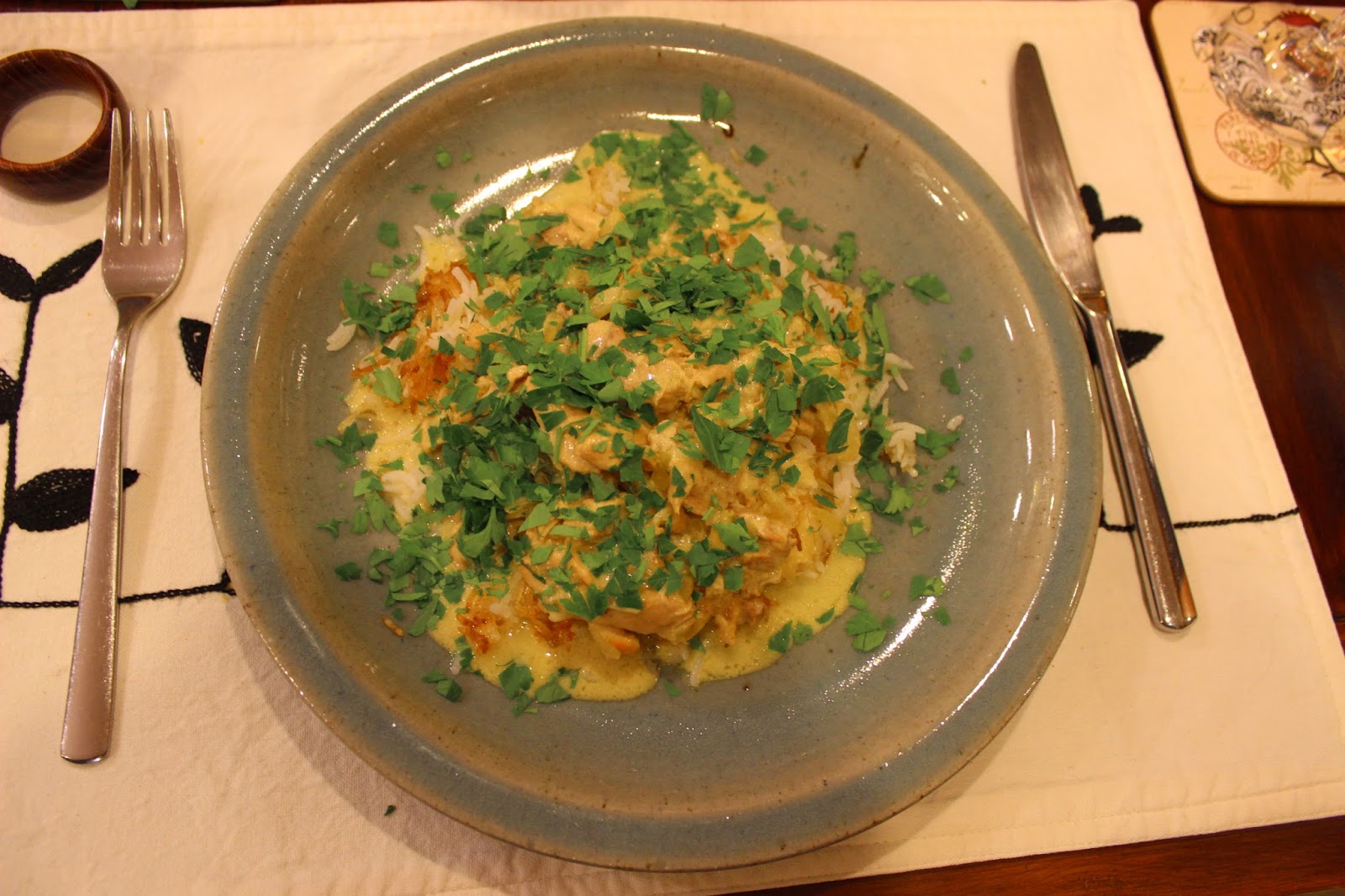
The chicken khoresht is great if you don't have two or three hours to cook the lamb version.  This will only take an hour once you've sweated the onions.  To start, sweat 2 finely chopped onions with 2 finely sliced celery sticks until soft.  Stir through 1 tsp ground cumin, 1/2 tsp  ground ginger, 1/2 tsp ground cardamom, 1/4 tsp cayenne, 1/2 tsp ground black pepper and cook for a few more minutes.  Cut 1 kg of boned chicken thighs into 2 or 3 pieces each.  Add them to the pan and brown briefly over a high-ish heat making sure they are all coated with the spicy onion mix.  Add a bay leaf, 500 ml chicken stock, a few saffron threads, zest and juice of a lime and juice of an orange.  Season with salt and simmer for an hour or so.  While the stew is cooking whisk 350g of Greek yoghurt with an egg.  When the stew is ready, whisk a few tablespoons of the hot broth into the yoghurt and egg mix then pour it all into the stew.  Add 1 tbsp slivered pistachios and cook at a bare simmer for five minutes to thicken.  Stir in one direction only and be sure not to let it boil or it will curdle at this stage.  Now Greg Malouf adds golden raisins but I do not.  It brings back memories of terrible 70s curries and I can't quite do it.  Apricots and prunes, yes but raisins, no.
Now as I mentioned above I feel I have mastered the Persian chelow and I am not sure what I was afraid of.  You need to allow about 80 minutes but most of that time it is looking after itself so it's no effort.  The recipe is for 6 so I just do 1/3 when making for two.
Wash 300g basmati rice and leave to soak in a generous quantity of warm water for 30 mins (30 minutes doing nothing with rice).  Strain the rice and rinse it again with warm water.  Follow these steps and you will be rewarded with perfectly separating grains.  Now boil a large saucepan of water, salt generously and stir in drained rice.  Boil at a rolling boil, uncovered for 5 minutes. I bring the water to the boil while the rice is soaking to save time and I turn it off if necessary so it only takes a minute or two to reboil when needed. Strain and rinse again and drain off as much of the water as you can.  Now is the tricky bit but it's not really tricky at all.  Melt about 40g of unsalted butter with 2 tbsp warm water and set aside.  Heat 1/4 cup oil with 1 tbsp water on a medium high heat in a large saucepan - the one you used to boil the rice.  When the oil begins to sizzle spoon in enough rice to cover the base of the pan in a thin layer - this is going to form a crust.  Spoon in the rest of the rice gradually building it up to a pyramid.  Don't tip it all in because you want it loosely piled to achieve the fluffy separateness.  Use the handle of a wooden spoon to poke a few holes down through the rice to the base of the pan.  This is to help it steam.  Now drizzle the melted butter over the rice.  Wrap the saucepan lid in a tea towel and tightly cover the pan.  Leave it on the medium high heat for a few minutes until you see some steam trying to escape then turn right down and leave for 40 minutes.  Another 40 minutes doing nothing with rice.  Don't peek.  It won't hurt if you leave it for up to an extra 20 minutes.
When you are ready to serve plunge the pan into a few inches of cold water in the sink.  The sudden change in temperature cause the rice to shrink from the sides of the pan loosening the delicious crunchy bottom.  Now invert the pan into a serving dish and it may plop out as one glorious mound with a beautiful golden crust.  Or it may not.  In which case just scoop the crust, known as the tah-deeg, over the top. Once you have mastered this you can do all sorts of variations to the crust with yoghurt, potatoes or bread.
And you can make an complete dish of the rice such as maygoo polow with the addition of herbs and prawns. Wash soak and parboil the rice.  Soak 1 tsp fenugreek seeds for 10 minutes, then gently fry in a frying pan with a small finely chopped onion, 1 tsp ground black pepper, 1 tsp turmeric, 1/2 tsp ground ginger.  Add a chopped deseeded tomato and 200g peeled prawns with tails on.  Don't worry if they're not.  Stir briefly until the prawns just begin to colour.  Remove the pan from the heat and stir through 1/3 cup finely snipped chives, 1/3 cup shredded flat leaf parsley, 1/3 cup shredded dill sprigs.  You can also add coriander if you must.  Now start to prepare your parboiled, drained rice for steaming.  Heat the oil and put the layer of rice in the bottom for the pan.  Scatter a layer of the prawn mix and layer up your pyramid with rice and the prawn mix ending with a layer of rice.  Poke the holes, drizzle over the butter, wrap up the saucepan lid and go off and do something else for 40 minutes.  Don't peek.  When done tip out as described above. 
You can serve all Persian meals with a herb salad and flat bread.  I sometimes serve stews with wilted spinach seasoned with nutmeg.
If you would like to carry the Persian theme through to coffee whisk some mascarpone with a little honey and lemon zest.  Slit some medjool dates to remove the stone, but don't cut in half.  Pipe the mascarpone mix into the dates and sprinkle with pistachios and rose petals.

Saturday, March 22, 2014

Something fishy

A good friend gave me some freshly caught tuna last week and I made two delicious meals.  One of my favourite meals is something I first ate in 1976 while on holiday in Tahiti.  It is Tahiti's signature dish, e'ia ota, known in French as poisson cru.  It is so simple and quick to prepare and unbelievably delicious to eat.  For 2 hungry people you will want 250g very fresh tuna.  Cut the fish into 1-2cm pieces and put into a glass dish.  Squeeze over the juice of 2-3 limes depending on how juicy your limes are.  Refrigerate 10-15 minutes.  No longer.  Mix in some salad vegetables.  I used finely grated carrot, very finely diced red onion, finely diced green capsicum, finely julienned radish, finely sliced spring onion, chopped tomato.  You are aiming for freshness and texture.  Add 80-100 ml coconut milk and season with salt.  Refrigerate briefly & serve on a bed of shredded lettuce.  Tahitians may add sliced hard boiled egg and I might try that on another occasion. You will be amazed at how good this is. 
With the remaining tuna (I had 500g) we turned to the Mediterranean.  First make a paste.  In a pestle & mortar smash up a small piece of fresh or dried red chilli with 11/2 tbsp coriander seeds.  Add a small piece of crushed garlic, a good handful finely chopped basil and parsley, salt& pepper, juice of 1/2 a lemon.  Mix well to make a paste.  Rub on both sides of the piece of tuna.  If you are buying tuna steaks this is enough for 2 steaks.  Sear the tuna in a grill pan which has been lightly rubbed with olive oil.  About 1-2 minutes each side depending on the thickness of the fish.  You want them pink inside.  Serve with grilled courgette and sauteed potato slices.
These meals will make you want to learn to fish if you don't already know.

Sunday, November 10, 2013

Another Culinary World Tour

Not much writing but still plenty of eating.  Back in the film festival I made a meal I have been meaning to share.  Did you see Le Passe at the Film Festival?  There was a scene where Ahmad made a stew for the family.  The dish had some significance as a family tradition, and it looked delicious.  It was a meat stew with a base of fresh herbs.  I looked into it.  It was Ghormeh Sabzi, a traditional Persian herb stew.   I used lamb and at the end added a handful of baby spinach to add a bit of bright green.  we served it with traditional chelow.  If you can get fresh fenugreek leaves, do, otherwise use dried at a pinch.   By chance we had seen the movie at Petone and browsed the shops beforehand.  I found a Middle Eastern supermarket and saw, for the first time in my life, fresh fenugreek but I didn't buy it because I didn't know I was going to need it.  We had to go back for it the following week.  This has replaced Gheimeh as my favourite Persian stew.  And just in case you are thinking I'm a little crazy, I am not the only one.  If you didn't see the movie, do so.
I caught a glimpse of a Norwegian cooking show on the TV and investigated further.  It turned out to be called New Scandinavian Cooking hosted by Andreas Viestad, who is quite a character in a very Norwegian way.  The funniest thing is that he always cooks outside no matter the season.  It can get quite cold in Norway.  It snows.  Picture Andreas grilling fish with snow drifting into the grill and onto the plates.  They have a lot of very interesting ingredients especially fruit with lovely names like cloudberries or lingonberries.  A trip to the library uncovered Scandilicious by Signe Johansen and we were off.  I haven't fully explored the berry fruit because it wasn't the season and I am sure we can't get cloudberries.  Peter did make a boiled egg with anchovy soldiers.
Our masterpiece was Norwegian meatballs with mashed potatoes & swede (neeps & tatties in my world) and spiced lingonberry red cabbage (we had to settle for redcurrant jelly).  It did sound a bit odd in the recipe and I was a little concerned but it was truly delicious.  We did not have brown goat's cheese and to be perfectly honest I suspect it is a little unpleasant.  For the cabbage, simmer a sliced onion, sliced apple, 1/2 a sliced red cabbage with 30 ml cider vinegar, a glass of red wine and 2 tbsp butter for an hour in a covered dish.  Check occasionally to ensure it doesn't stick.  When the cabbage and onion is very tender add 5 tbsp lingonberrey jam, (or cranberry sauce or redcurrant jelly), 2tbsp dark brown sugar, 1 cinnamon stick, 1/2 tsp grated nutmeg and 5 cloves, and cook a further 30 mins.  Add another splosh of red wine before serving.
Peter went away for a couple of weeks to the UK and then to Peru and I had the idea to make one of his favourites for a homecoming lunch.  So I tackled the pork pie.  I just used home made chicken stock and gelatin leaves for the jelly because I didn't have time to be boiling pigs' trotters.  I didn't have a pie dolly - not sure what one is - so I used a drinking glass.  The Home Harvest woman at the market sells a paper pot maker and I think that would do the trick.  The result was that my first attempt was just like a bought one.
And finally Peter came home from Peru enthusing about ceviche.  I found a Peruvian cookbook at the library and  he made Martin Morales' Don Ceviche.   We will be exploring Peruvian cooking further.


Saturday, April 28, 2012

The Big Apple

Tagine Saturday was such a success but now it's over.  Peter bought me a cazuela for my birthday & the second half of my paella book is all about rice in the cazuela, so off  we go with cazuela Saturday.  The cazuela is a beautiful dish & I think would also be perfect for risotto so I am going to try that too.  The book says that the Spanish cook almost everything in the cazuela.  It distributes & retains heat well & is great for simmering & braising and cooking rice on the stove top.  These cazuela dishes are more soupy than paella which is a drier dish with that lovely crust on the bottom.We started with something simple - white rice with herbs.  If you don't have a cazuela do this in your Le Creuset or other Dutch oven style pot.  For 4, bring 4 cups of water to the boil in the cazuela.  Blend 2 cloves garlic & 1 tbsp parsley with 1/2 cup water in the processor.  When the water reaches the boil, add the garlic mix & a pinch salt.  The rice makes a difference here & I would recommend Spanish rice - Bomba or Calasparra.  If you don't have those use a short or medium grain rice - Calrose, Japanese short grain, or any of the Italian rices.  Don't use long grain or Basmati.  Add 2 cups rice with a bay leaf and a stripped thyme stem.  Yes, strip the leaves off the thyme stem!  We used the thyme leaves in the accompanying chicken.  Cook uncovered stirring occasionally for 10 minutes over a medium high heat.  Check the seasoning at this point.  Reduce the heat & cook another 8 minutes or until most of the liquid is absorbed & the rice is al punto - the Spanish equivalent of al dente. You don't want this to be dry & fluffy and it's not quite creamy like risotto but something in between.  You just have to judge.  This was so delicately flavoured that I think you want to serve it with something equally light like chicken or fish.
 We had our old favourite chicken with herbs.  Sprinkle 4 chicken thighs with salt & pepper & brown on both sides in butter with a little oil.  Lower the heat, cover & cook another 8-10 minutes until the chicken is cooked through.  Set the chicken aside & tip away most of the fat from the pan.  Add finely chopped spring onion & when golden add 3/4 cup liquid - a mixture of chicken, stock, white wine, water. Scrape up all the bits on the bottom of the pan & reduce the liquid.  Add a handful of chopped herbs & pour over the chicken.
Sunday we went for a walk at Makara.  It was a lovely afternoon & half of Wellington was there.  We spotted some wild samphire & we had bought a fillet of porae from Yellow Brick Road at the city market, so we picked a little for dinner.  It was the perfect addition to our fish supper with roast potatoes & courgettes.
There was polenta in the cupboard & I thought it should be used up so we had chicken involtini - I think this means rolled up - with polenta.  This seems fiddly but isn't really & is worth the effort.  Make a creamy polenta - for 4, I use 6 cups water or stock to 1 1/2 cups polenta & add Parmesan & a knob of butter at the end.  Heat the oven to 200 & cut 2 large chicken breasts into six slices each including the tenderloin.  Pound them between 2 sheet of baking paper to about 4mm thick.  Lay out each slice, top with a sliver of prosciutto & a slice of mozarella.  You'll want 2 balls of mozarella for four.  Season & roll up, lay a sage leaf on top &  secure with a toothpick.   Brown on each side in a pan with butter.  You'll need to push the stick though when you turn it but it's not nearly as fiddly as it sounds.  Cook in batches so as not to crowd the pan then transfer to an oven proof dish & cook in the oven another 8-10 minutes.  In the pan crisp up a few sage leaves in butter.  Serve the chicken on a bed of polenta topped with crispy sage.
And of course you are wondering what became of the apples.  Well, Anzac Day was Apple Wednesday in our house & the smell of apples wafted through the house.  Try this cake substituting apples for pears.  I made three of these.  I cut the apples in quarters & then sliced them almost through from the fat side of the wedge (like a hasselback potato) before caramelising.
If you find you can't fit all the caramelised apples into the cake, take a break & eat the leftovers with a dollop of vanilla ice cream.  You deserve it.
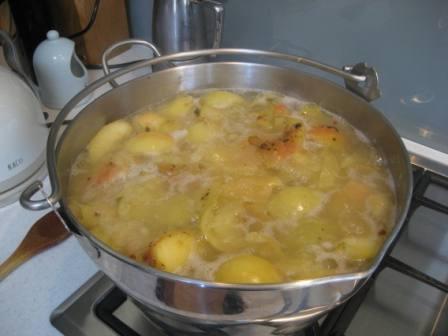
That didn't make much of a dent in the apples and it was Florence White to the rescue with  a Somersetshire recipe for apple butter.  Quarter the apples - don't peel or core & put everything into a preserving pan.  I filled mine to the top - the recipe assumes you are using windfall apples so you just have as many as you bothered to pick up.  Cover the apples with water or water & cider.  I added liquid about 3/4 up the side of the pan.  Stew to a pulp which took about an hour.  Press through a sieve which was a little messy as there was a great deal of pulp & I had to use more than one bowl.
Wash out the pan, measure the pulp, then return the pulp to the pan.  Simmer for about an hour until quite thick.  Add 3/4 lb (330g) sugar for every pint (600ml) of pulp. I actually put much less - I started with a cup per quart (2 pints) then added 1/2 lemon plus peel per quart, then added more sugar and tasted till it seemed right- not losing the appley tartness.  But do remember the sugar is the preservative.  Boil up until it is stiff enough to spread without running.  Use the jam crinkle method to test.  Pour into sterilised jars & "cover in the old fashioned way with a piece of paper dipped in brandy".  That's what she says!  She adds that if properly made this will keep for 2 years.  We'll see.  It is so yummy that I could just spoon it out of the jars.  So far I have had it for breakfast on fruit with yoghurt.  You could certainly serve as apple sauce with pork.
That was not the end of the apples.  I peeled & thinly sliced a few then blanched to stop the discoloration & when cooled bagged up in pie quantities & froze.  We will have 3 or 4 pies over the winter.  The rest were stewed with rhubarb.  And that is the end of apples.


Saturday, March 19, 2011

Persian Feast

It didn't take long for our table to fill up again. We had a guest for a few days and I decided to prepare an Iranian meal from the book we received as a thank you on a previous visit. As I have mentioned previously, Greg Malouf is a favourite middle eastern cookery writer. This latest offering, Saraban, is a culinary journey through Iran. The khoresht was a simple but delicious meal. At least it would have been simple if I had followed my instincts and quickly turned from the polow (pilau/pilaf) described as "a bit of a palaver". But no, once I had chosen my lamb stew, I was seduced by the picture  Shirin polow it was. Don't try this at home if you shy away from a palaver at dinner time. On the other hand, if you want to make it, buy the book or borrow it from the library. It was a worthwhile palaver and I will probably do it again for a special visitor.
Anyway, on to the lamb stew. The Iranian stew or khoresht sits somewhere between sauce & stew and is served with a rice dish. This was really simple and contained a few additions that were new for me. As with any cooking that use spices, you need to make up a spice mix that you can keep in an airtight jar for a few weeks. Thoroughly mix 1 tsp each of ground cinnamon, cumin, coriander, ginger, cardamom, black pepper, freshly grated nutmeg. and ground dried rose petals if you have them. I bought some and they are so pretty & bring an aromatic depth to the spice mix.
In a heavy based casserole, brown about 600g shoulder lamb cut into fairly large chunks and remove from the pan. Add 2 finely diced onions, 1/2 tsp turmeric and 3 tsp of your spice mix and cook until the onion is soft. Stir in 3 tbsp tomato paste and cook for a minute or so before returning the lamb to the pan. Add 200g split yellow peas, 2 dried limes, 2 bay leaves and a good handful of thyme. Pour over 1 litre chicken stock, bring to the boil then simmer on a low heat 1 1/2 hours, until the split peas are soft & soupy & the lamb is very, very tender. At the end add a squeeze of fresh lime juice & season with salt.
Now I haven't found dried limes yet, so I just dropped in a whole fresh lime halved. If you do have dried limes, part way through cooking when they have softened a little, press them against the side of the pan to release the juices.
Aforementioned guest has since posted me a 1/2 dozen from Melbourne & they look truly wonderful. Not at all pretty but very aromatic. I intend to try them out in a fresh herb lamb stew.
Which brings me nicely to our starter. Using any of the following you have at hand - baby beetroot leaves, basil, chervil, chives, coriander, costmary, dill, flat-leaf parsley, French tarragon, mint, radishes, spring onions, summer savory, turnip leaves, watercress - fill a serving plate or basket with about one cup of herbs per person. Greg suggested 4 or 5 herbs you like. I used 11. Serve them with warm flatbreads and a chunk of fresh white cheese such as a creamy feta, buffalo mozzarella, or my personal favourite right now, zickli. Pile some herbs onto a piece of bread, then a chunk of cheese; roll up and munch your way through the leafy goodness. We have had this for lunch a couple of times since and it is so delicious & refreshing.
Now for the rice - if you are steering clear of the palaver polow, I suggest a simple steamed rice enlivened with the addition of some whole aromatic spices which you can remove at the end of the cooking. I saw Nigel Slater do something similar recently. Add any of the things he mentions that take your fancy. At the end sprinkle your rice with pomegranate seeds to serve and grate over some orange peel. It will look as if you have engaged in a palaver.
I made a pudding of roasted dates with coffee syrup. It was delicious but would have been better if I could have bought real fresh-off-the-palm dates. I have never seen them here, have you? Not something my friend can send in the post. Middle Eastern sweets are very sweet and as you know I'm not so keen on making pudding. I would buy Antoinette's baklava or something else from her delicious range of sweets.
And we had leftovers. The stew is in the freezer and we had the rice a couple of days later with left over roast chicken from the day in between.