Wednesday, June 16, 2010

Invalid cooking

Phoebe was recently very ill, as some of you know, and she didn't really want to eat. She lived on soup & smoothies for a week but as she recovered, her appetite improved. She lost about 4 kilos so needed fattening up. She was hungry but nothing tasted very nice so I had to be quite creative to provide meals that were appealing for an invalid. These days we tend not to have prolonged illness and don't often need to provide meals for convalescence.
One of the things Phoebe likes is tinned tomato soup but that didn't seem nourishing enough so I made a version using tinned tomatoes. I softened onion, celery & garlic before adding the tin of tomatoes & enough chicken stock to make a nice consistency. Simmer for 20 minutes or so then add milk and/or cream to serve. I made croutons - Phoebe always eats soup if you add croutons & cheese. To make croutons I cut some white bread into chunks. I use whatever I have lurking in the breadbin -Turkish, French, Italian, potato bread, which I toss in garlic infused oil & bake in the oven (about 180) until crisp (about 15 mins). Put the croutons in an ovenproof soup bowl, pour over the soup, grate over some cheese & grill until cheese melts. Now she chooses my soup over the tinned even without the croutons.
One morning she wanted pancakes for breakfast and I served them with lemon, a dish of mixed berries and both plain & cinnamon sugar as well as some maple syrup. My mother always maintained that presentation contributes to the appetite of the recently ill and I do think that had some effect on Phoebe.
The other meal she ate with enthusiasm was pasta which I cooked, then mixed with homemade tomato sauce (from the freezer) & very small sprigs of steamed broccoli. I topped with grated cheese mixed with panko crumbs & put under the grill until the cheese melted & the crumbs turned golden.
These ideas would also work for a child or any occasion where you need to produce a nutritious meal for one with minimum effort but don't want to resort to a packet.
I kept the fridge stocked with dishes of jelly and I made custard to serve with stewed apple or rhubarb. One day I got quite carried away & made something I remembered from my childhood called Pineapple Bavarian Cream. You will find this on p 138 in your (well, my edition of) Edmonds book - accept no substitute. Soften a packet of pineapple jelly (I couldn't get pineapple & used lemon, for the colour) in 1/2 cup cold water, make a custard with 2 tbsp custard powder & 3/4 cup milk and mix the 2 together. Cool then beat into 150ml whipped cream & fold in 230g tin crushed pineapple. Recipes on the internet just use pineapple, jelly & cream but the custard is essential. Set in individual dishes to serve to your invalid on demand. Phoebe liked this so much she has feigned a relapse on several occasions in the hope of it reappearing on the menu.

Monday, June 14, 2010

We dined on mince & slices of quince

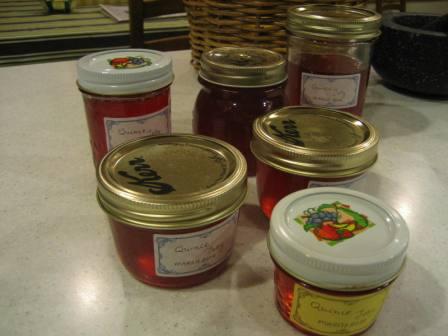
The season is past now so it's a bit late I know, but this year I discovered the joy of quinces. I first bought a couple at Moore Wilson and I poached them in muscat & spices something like this. They were very rich but delicious & the colour was amazing. There was lots of poaching liquor left so I put it in the fridge & thought I'd get some more quinces. Then I noticed that the liquor had jellied in the fridge so we ate it on our toast. From there I just had to make quince jelly especially as we were disappointed by our crabapple trees and there was no jelly coming from that direction.
I found a great recipe for Quince Jelly from the blog I used to make the blueberry jam in summer. I had been led to believe that this would be a mission, but don't listen to the naysayers. It is so easy & the resulting jelly is so pretty & delicious that I will be doing this every year & trying some other jellies as well. I bought a proper jelly bag with stand from Moore Wilson. I was doing this after dinner & it got quite late so I let the pulp strain overnight (step 4) and I now think that is the best way to do it. You're not waiting impatiently for the fruit to strain so you're not tempted to rush. I did stage 2 in the morning before work - it was no effort & I was still out of the house by 8.00 a.m.
From there Membrillo (Spanish quince paste) was the obvious next step and by then I was feeling like an expert. I had some helpful hints from some of you & I ended up making 2 batches. I made this in the evening while we were playing board games at the dining table. That way I was present while the paste was thickening & I could keep an eye on it. We were playing Kingmaker and I used the paste checking times to review my strategy. I left it in the oven overnight for the last stage & I found that gave the best results. I have cut it all up into small squares & wrapped in cling film the stored in a flat plastic container in the freezer. Next year I will be trying other fruit as well but I suspect you can't go past the beautiful rich ruby red of the quince.
For my final turn with quinces I went back to Nigella and a preserve she tantalisingly calls Paradise Chutney. For this you also need fresh cranberries and the new season's cranberries arrived in the shops just as the quinces were coming to an end.
You will need:
500g of quinces peeled, cored & roughly chopped (save the peelings & cores)
500g cooking apples peeled, cored & chopped
a diced onion
250g fresh cranberries & 150g dried
500g white sugar
4 cloves
2 cinnamon sticks
1 tbsp mustard powder
Juice & zest of both an orange & lemon
350ml cider vinegar

First boil the quince peelings in 750ml water until you have about 350ml liquid remaining. Then put all the ingredients plus the strained peelings liquid into a preserving pan, let the sugar dissolve over a low heat then bring to the boil & simmer slowly about 1 hour. Everything will cook down & become slightly pulpy but the quince pieces will still be recognisable.
Ladle into sterilise jars. You'll have about 2 litres. This chutney is great as an accompaniment to cold meats & with potatoes.
All you need now is a runcible spoon.

Sunday, April 11, 2010

Easter Feasting & Fasting

As you can imaging not much actual fasting going on in this house, however, as you all know I am a traditionalist and my Easter follows pretty much a predictable pattern.
Thursday evening I get my Hot Cross Bun dough ready. I use Nigella's recipe from Feast. I always make it the night before and put it in the fridge overnight. Nigella says take it out in the morning and leave it to rise for an hour but this is a little optimistic. I usually take it out around 6.00 a.m. (don't set the alarm or anything, but if you wake up anytime after 4.00 run out to the kitchen & get it out then run back under the covers), then we get up around 7.00 & go for a walk. When we get back it has risen nicely. Then I form the buns & set aside to rise again before I get ready for breakfast. We're usually eating around 9.30 which is a civilised time for breakfast on a holiday. My buns look a little burned in the photo but actually they weren't as my Friday afternoon walking companions can confirm.
Good Friday dinner in our house is always smoked fish pie. This is pretty much as my mother made it. Boil some Agria potatoes & I steam my fish (smoked & some white fish) in the lid of a round casserole in some warm milk on top of the potatoes, covered with the saucepan lid.
Make a white sauce, stir through peas & corn (frozen), a handful of small prawns (I often use frozen), chopped hard boiled eggs and some chopped parsley. Add the flaked fish, pile into a casserole dish & top with your mashed potatoes. This year I added the left over egg wash from the buns to the mash & look how my potato topping puffed up.
Easter Sunday main event is lamb and for a few years now I have been doing Nigella's Slow Cooked Lamb with Beans. We used a leg rather than shoulder this year and it was great. I recommend less beans & less liquid but don't worry if there's too much liquid at the end. Spoon the beans out with a slotted spoon. Cooking lamb in this way is traditional for the Jewish Sabbath. Because it's forbidden to light a fire on the Sabbath Jewish families would prepare this meal the evening before & carry it down to the baker's to cook in their ovens (still hot from baking) overnight. A precursor to the slow cooker. This dish would probably work well in your slow cooker.
We served it with roasted vegetables, spinach, carrots & Brussels sprouts. Try an Easter Monday Bubble & Squeak breakfast by frying up some left over roast veg with sprouts & topping with a poached egg. And the soft melting lamb with beans is perfect in a Shepherd's pie for Monday's dinner.