Showing posts with label jelly. Show all posts

Sunday, March 26, 2017

Rhubarb and Patience

I have never been a fan of rhubarb.  Stringy and bitter with poisonous leaves.  How did it ever end up on anyone's table?  However, Peter loves it and we grow it in the garden.  Every Sunday during the season I stew a few stalks and he has a spoonful every day for breakfast.  This summer we planted an all-year round variety so now we have twice as much.  I don't like to not eat the food we produce so I did a little investigation.  I can tell you now that rhubarb is a vegetable, not a fruit and if you eat it as dinner rather than pudding it is actually very palatable [=delicious (ed.)].
Start with a simple rhubarb and chard dish. I served this with pork sausages.  If you cook the sausages first in a pan and set aside,  you can cook the chard and rhubarb in the same pan. Add 1 finely chopped shallot to the pan and cook over a medium heat for about 5 minutes. Add a little olive oil if required. Stir in 1 1/2 tsp black mustard seeds and 2 finely chopped garlic cloves. Cook 1 minute. Add 1/2 cup thinly sliced rhubarb and 500g rainbow chard leaves, a handful at a time, with a large pinch of salt. You can thinly slice the chard stalks and add some with the rhubarb, but I don't think you want them all.  I always save the stalks if I don't use them straight away and use them up during the week.  Cook until the greens wilt and become tender, about 10 minutes. Season with more salt and pepper. Serve sausages on top of greens.
What about a chicken tagine with rhubarb?  Start by poaching some rhubarb. Combine 1 1/4 cups water and 1 cup sugar in a medium saucepan. Add vanilla seeds and pod. Bring to a boil over medium heat, stir until sugar dissolves and add 2 cups diced rhubarb. Reduce heat to low and gently simmer rhubarb for 5 minutes, or until it can be easily pierced with the tip of a knife but remains intact. Do not overcook or else rhubarb will fall apart. Strain rhubarb over a bowl. Put the syrup aside to use another day.
Now on to the chicken.  I used bone-in leg quarters - what used to be called a Maryland - but you could use boneless thighs if you are delicate about bones. Season the chicken on both sides with salt and pepper. Heat a large Dutch oven over medium-high heat and add 2 tbsp olive oil. When oil is hot, brown chicken pieces, in batches, on both sides until golden, about 3 to 4 minutes per side. Remove and set aside.
Pour off all but 2 tablespoons of fat from the Dutch oven and add 1 finely chopped onion. Reduce heat to medium and cook, stirring and scraping the bottom of the pan to deglaze, until onion begins to soften, 2 to 3 minutes. Add 1 each of finely chopped carrot and leek. Cook, stirring often, for 3 to 4 minutes until vegetables are tender. Add a clove of crushed garlic and cook, stirring, about a minute. Add 1/2 tsp turmeric and 1 tsp sweet paprika and stir.
Return chicken to Dutch oven and add 1 cup chicken stock, 1 cinnamon stick, 1/2 tsp sugar and salt to taste. Bring to a simmer, then reduce heat, cover and simmer 35 minutes. Add 4-6 pitted green olives then cover and simmer another 15 to 20 minutes, or until chicken is falling off the bones. Stir in 1 to 2 tablespoons  of the rhubarb syrup. Season to taste.
Before serving, stir in parsley and 1 cup of the poached rhubarb and heat through over low heat.  Serve with rice or couscous.
You can make a delicate jelly with the leftover poaching liquid.  You need 4 leaves of gelatin for 2 1/4 cups of liquid.  Soften the gelatin in a bowl of cold water.  Make the rhubarb syrup up to the 2 1/4 cups by topping up with soda or prosecco.  Add a tsp of lemon juice.  Bring the liquid to the boil and take off the heat.  Squeeze out the gelatin leaves and stir into the hot liquid.  Pour into a dish and refrigerate to set.  I had made mine too late in the day and it was not quite firm enough so I just spooned into a glass with lemon jelly and lemon sorbet.  If you are prepared, your jelly will have set so that you can cut it into cubes and decoratively arrange on a plate.
Now that I am on a bit of a rhubarb roll, I made another rhubarby pudding.
First I made a rhubarb spoom.  Yes that is a thing. Cut about 4 stalks of rhubarb into 2 cm lengths and put in a saucepan with 1/2 cup water and 1/2 cup sugar (or less according to your taste).  Heat gently until the sugar is dissolved, bring to the boil and simmer covered until the rhubarb is tender about 5 minutes.  Cool and puree until very smooth then chill completely.  Stir in 1 tbsp rosewater. Beat two egg whites until they form soft peaks.  Add 2 tbsp sugar and beat until you have stiff peaks.  Now this is the magic.  Fold the egg white into the puree making sure they are completely mixed.  Transfer to a freezer-proof container and freeze for four hours.  You now have a smooth creamy mixture that contains no fat and has not required churning.
Finally, I roasted some rhubarb. Cut about 8 stalks of  rhubarb into 6 cm pieces and place in a medium bowl. Finely grate the zest of half an orange over the rhubarb and then squeeze the juice of the whole orange into the bowl. Split 2 vanilla beans and scrape out the seeds and place both in the bowl. Add 2 tbsp liquid honey and stir to combine. Pour the rhubarb into a baking dish and arrange the pieces so that they lie flat. Bake at 175 for 15 to 20 minutes. Remove the vanilla pods. Serve the rhubarb and the spoom with the syllabub from October 2014.

Monday, January 20, 2014

Beetroot ... and radishes

It was encouraging to see two new signed up followers and a suggestion for radishes - thank you, readers.  We are still in summer eating mode even though there is a dearth of summer weather. 
We have been working hard on both the beetroot and radishes.  We had end of season asparagus with a lamb fillet and a couscous salad.  For the couscous I mixed a little olive oil and lemon juice through the couscous while it was still warm and then tossed through a selection of salad veg - spring onions, capsicum, parsley, feta and, of course, radishes.  I served it with beetroot relish and yoghurt with mint.  I didn't really need both but the relish needed eating and I love lamb with minty yoghurt so I splurged and it was worth it.  Put lots of mint in the yoghurt.
We have taken a fancy to spring rolls. They are so easy.  Buy a pack of spring roll wrappers and some vermicelli.  Finely slice a selection of fresh vegetables and herbs, including radishes.  Toast and crush some skinned peanuts and/or cashews - maybe add a pinch of cumin.  Make a selection of dipping sauces.  Put a dish of warm water on the table and construct and eat spring rolls until you are replete.  On this occasion I thought we had more wraps in the cupboard than we did, however a squid tube from the freezer came to the rescue.  Salt and pepper squid rings were delicious dipped in the sauces.
We were visiting in Auckland and I thought I would contribute pudding.  Make a jelly by dissolving 2 tbsp sugar in 1/2 cup wine (white or rose, still or sparkling) on the stove.  Don't let it boil.  Remove from the heat and add 4 leaves of softened gelatin, a further 1 3/4 cups of wine and 1 tsp lemon juice.  Pour into a shallow dish and refrigerate around 6 hours.  To serve put a mixture of raspberries, strawberries and blueberries into glasses with diced papaya and top with cubes of jelly.
Back home it was radishes and beetroot.  For a change from lamb we tried rump steak with caper, anchovy and rosemary sauce served with shaved veg with a lemony dressing.
For the meat dressing, pound 4-6 anchovies with a clove of garlic using a mortar and pestle.  Add 2 tsp very finely chopped rosemary and pound again.  Add  2 tsp capers, 2 tbsp lemon juice, 2 tbsp olive oil and mix well with salt and pepper.  Cook the rump steak to your liking and brush both sides with a little of the dressing.  Rest then slice and pour over the remaining dressing.
For the vegetables make a dressing with 1 tsp English mustard, 2 tsp honey, 1 tbsp lemon juice, 4 tbsp rapeseed or olive oil and salt & pepper.  Using a mandoline with care not to slice fingers (we have had mandoline incidents here), very finely slice a selection of raw summer vegetables - radishes, beetroot, kohlrabi, courgette.  Trickle over the dressing.
On the side I served a mix of salad leaves including beetroot leaves with a regular vinaigrette, and some freshly baked thyme-flavoured Turkish-style bread (pide) to mop up the juices.  To make the bread, combine 1/2 cup warm water, 1 tsp honey, 3 tbsp olive oil and add to 1 1/2 cups bread flour, 1/2 tsp salt, 1 tsp instant yeast, 1 tbsp chopped thyme.  Combine and knead for a few minutes until soft and smooth.  Leave to rise for an hour then divide into eight pieces, shape into rounds about 1 cm thick and cover with a teatowel to rise again for 20 minutes.  I only needed half the dough so have frozen the rest for another time.  Cook the breads on a grill 3-4 mins each side until golden and puffy.
Still trying to use up the last of the cranberry sauce, we had venison sausages with roasted beetroot and wilted spinach and beetroot leaves.  I cooked the beetroot, peeled and cut into chunks then put in a roasting dish with some olive oil and salt and pepper and thyme.  When done I splashed over a little vincotto.  I wash and slice spinach then just add in batches to a pan over a medium heat.  As the spinach wilts, push it to the back and add another handful.  When it is done stir in a small knob of butter and seasoning.  I often add nutmeg or cumin but on this occasion used only pepper.  Adding beetroot leaves with the spinach is delicious.  Try it.
Thank you to Jean-Marie for roasted radishes with dukkah. We tried them this evening with our aperitif of saffron gin.  The gin was a Christmas gift and I recommend you try it. It has a unique pizazz. The radishes were very interesting and I really liked them.  I have never eaten a cooked radish and I enjoyed the change in texture and depth of flavour.  The dukkah was brilliant and will become our staple recipe I suspect.

Saturday, April 9, 2011

End of the Golden Weather

The summer crops are winding down and the new season's produce is filling the market stalls. All the brassicas looked irresistible but I settled for broccoli which we just steamed and served with an old favourite beef stew. It's a good idea to make lots and freeze as it is little effort and you'll have a 2nd hearty meal to produce on one of those nights when you don't have time to cook but want something substantial when you finally get in.
Cut 2kg of stewing steak (blade, chuck, skirt) into thick chunks. Finely chop together 4 rashers of bacon, 2 onions, 2 carrots, 2 sticks celery, 4 cloves garlic with a handful of parsley & thyme. Gently cook in a tbsp lard in a heavy casserole (if you don't want to use lard try olive oil instead but lard gives good flavour here) and set aside. Heat a 2nd tbsp lard in a second pan and brown the meat in batches. When it is done sprinkle a handful of flour over the last batch and cook until the flour has browned. Add the meat to the casserole and to the meat pan add 1 cup red wine, 1 tbsp soy sauce, 2 cups water and salt & pepper. Scrape up the meat residue and add to the meat and vegetables. Cover & cook in a low oven about an hour. Take it out and add some vegetables selecting from mushrooms, pickling onions, carrots, potatoes, baby turnips. Just prepare them and chop them into a size you like. Return to the oven and cook for another hour. If you have 2 casseroles you could split them at this stage & put a different set of vegetables in each one.
Now that daylight saving has ended we are back on soup Mondays. We started the season with Egyptian lentil, served with some pita that was in the fridge and had seen better days. For 2 people, heat a small quantity of oil in a pan and soften a finely diced onion, a sliced garlic clove, a small piece of ginger grated and 1/2 a carrot, grated. Stir in a tsp each of cumin, turmeric and paprika and cook for a minute or two. Add a couple of handfuls of red lentils and stir through the spices then add 500ml chicken stock. Simmer until the lentils are cooked. Meanwhile brush a couple of pita breads with oil on both sides then cut into triangles and gently toast in a medium oven for about 8 minutes. You want them crisp but not so crisp that they shatter when you bite them.
On Tuesday I did something I've been thinking about for ages. I love mattar paneer and Zany Zeus have brought out a paneer so I thought I'd have a go. I delved into my trusty Indian Vegetarian Cookery bought in London 30 years ago and it did not disappoint. Cube the paneer (I just bought a pack of paneer that seemed the right amount for 2 people) and fry in ghee until golden. Set aside. In a mortar & pestle grind a small piece of grated ginger, 1 tsp turmeric, 1/2 tsp chilli, 1 tsp cumin seeds, seeds from 2 cardamom pods, a small piece of cinnamon and mix with a little water to form a paste. In a pan fry a finely chopped onion with 1 tsp each mustard seeds & poppy seeds. Add the paste & fry a couple of minutes. Add 2-3 chopped tomatoes and a cup of peas. Gently fry a couple of minutes, add a cup of water & cook until peas are done. Add the paneer and sprinkle with lemon juice. Serve with rice, home made tamarillo chutney and Indian bread.
If it is a cold night, try sausages in a mustardy sauce. I like to keep a pack of the Island Bay Butcher's pork & fennel sausages in the freezer for a rainy day & Wednesday turned out to be that day. Soften (almost caramelise) 1-2 onions in olive oil. Be patient, you want them to cook right down. While the onions are doing, cook some pasta such as penne or giant conchiglie and set aside. Skin the sausages and break into chunks - you can use any sausages you like. Add to the onion and cook through. Stir through a good dollop each of creamy Dijon and grainy mustard and a handful of chopped Italian parsley. Stir in about 1/2 cup cream and the cooked pasta.
We did a delicious creamy risotto topped with lemony chicken. In a baking dish, combine chopped rosemary and parsley with 2 cloves of crushed garlic, 1/4 cup olive oil and juice of a lemon. Add a couple of chicken thighs - skin on (and skin side up) if you can get them. Put in the oven at 180 and roast 30-40 minutes, basting once. Cover & set aside to rest.
While the chicken is cooking make a basic risotto adding lemon zest and 2 tbsp chopped sage with the rice. Serve with the chicken sliced on top andif you want to be fancy cook a few sage leaves in hot olive oil until crisp. I did the sage leaves in the leftover oil and fat the chicken cooked in - okay if you used a pan that can be used on the stove top.
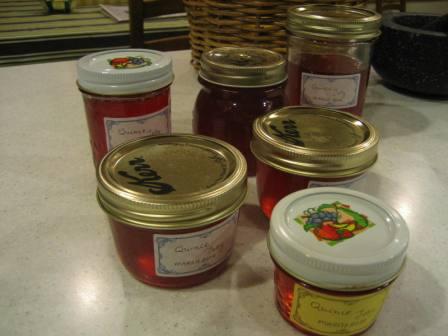
In the weekend I made a batch of quince jelly. Yell out if you would like a jar. I used to be scared of jelly because people suggest it is complicated but it really is not. Wash & quarter 5-6 quinces. Put them in a large pan (skin, cores and all) covered with water and simmer covered until quinces are soft. Mash the quinces & water until you have a liquidy mush. Spoon the mush into a jelly bag suspended over a large bowl. You have a lot of liquid so I spooned in the solids using a slotted spoon & then poured the liquid over in batches, transferring the resulting pink liquid to the preserving pan so the bowl didn't overflow. Leave the last batch to drip for hours making sure you have eked out every last drop of liquid from the quinces. Measure the liquid as you go because you want to add 7 cups of sugar to 8 cups of juice. That's 7/8 cup of sugar per cup of juice. Don't be precise but you don't want as much as a whole cup. Bring the juice to the boil then add the sugar. Boil until it is ready, skimming off any foam that appears. You want the liquid to reach about 220F and you can use a cooking thermometer to measure this. Don't rely on it though. When your jelly has been at a rolling boil for 10 minutes or so test it by putting about 1/2 tsp on a dish you have had in the freezer. If after a few seconds, when you push it with your finger it wrinkles a little it is done. Don't worry if it isn't perfect. You'll just have jars of delicious quince sauce to pour over ice cream.
I also pulled the basil plants and
made a batch of pesto. The plan for this weekend is to get all those tomatoes that didn't ripen into a batch of green tomato chutney. 

Monday, June 14, 2010

We dined on mince & slices of quince

The season is past now so it's a bit late I know, but this year I discovered the joy of quinces. I first bought a couple at Moore Wilson and I poached them in muscat & spices something like this. They were very rich but delicious & the colour was amazing. There was lots of poaching liquor left so I put it in the fridge & thought I'd get some more quinces. Then I noticed that the liquor had jellied in the fridge so we ate it on our toast. From there I just had to make quince jelly especially as we were disappointed by our crabapple trees and there was no jelly coming from that direction.
I found a great recipe for Quince Jelly from the blog I used to make the blueberry jam in summer. I had been led to believe that this would be a mission, but don't listen to the naysayers. It is so easy & the resulting jelly is so pretty & delicious that I will be doing this every year & trying some other jellies as well. I bought a proper jelly bag with stand from Moore Wilson. I was doing this after dinner & it got quite late so I let the pulp strain overnight (step 4) and I now think that is the best way to do it. You're not waiting impatiently for the fruit to strain so you're not tempted to rush. I did stage 2 in the morning before work - it was no effort & I was still out of the house by 8.00 a.m.
From there Membrillo (Spanish quince paste) was the obvious next step and by then I was feeling like an expert. I had some helpful hints from some of you & I ended up making 2 batches. I made this in the evening while we were playing board games at the dining table. That way I was present while the paste was thickening & I could keep an eye on it. We were playing Kingmaker and I used the paste checking times to review my strategy. I left it in the oven overnight for the last stage & I found that gave the best results. I have cut it all up into small squares & wrapped in cling film the stored in a flat plastic container in the freezer. Next year I will be trying other fruit as well but I suspect you can't go past the beautiful rich ruby red of the quince.
For my final turn with quinces I went back to Nigella and a preserve she tantalisingly calls Paradise Chutney. For this you also need fresh cranberries and the new season's cranberries arrived in the shops just as the quinces were coming to an end.
You will need:
500g of quinces peeled, cored & roughly chopped (save the peelings & cores)
500g cooking apples peeled, cored & chopped
a diced onion
250g fresh cranberries & 150g dried
500g white sugar
4 cloves
2 cinnamon sticks
1 tbsp mustard powder
Juice & zest of both an orange & lemon
350ml cider vinegar

First boil the quince peelings in 750ml water until you have about 350ml liquid remaining. Then put all the ingredients plus the strained peelings liquid into a preserving pan, let the sugar dissolve over a low heat then bring to the boil & simmer slowly about 1 hour. Everything will cook down & become slightly pulpy but the quince pieces will still be recognisable.
Ladle into sterilise jars. You'll have about 2 litres. This chutney is great as an accompaniment to cold meats & with potatoes.
All you need now is a runcible spoon.