Showing posts with label lamb. Show all posts

Sunday, November 15, 2015

Winning ways with chard

We eat seasonally and often from the garden.  It's not large but there are only two of us and it can feed us well.  You know how you look forward to the first crop and sometimes enthusiasm wanes at the end.  We've been enjoying chard over winter picking a few leaves to make a delicious chard meal each week, sometimes twice a week. And then it turns on you.  Suddenly you have the Karori chard monster growing so fast and tall and threatening to go to seed.  Meanwhile you are trying to consume the kale and cavalo nero before that too bolts and you know you really have to eat the last of the broccoli this week. I knew things were serious when I mentioned to Peter that a friend who kindly took some chard off my hands this week said how much she had enjoyed her three chard meals.  Peter's response - "well that's three chard meals we don't have to eat".  If you have your own chard dilemma I have a few suggestions.
Chard works really well with grains such as barley, farro or freekeh.  For a great pilaf, saute a finely diced red onion in olive oil.  Add 2 tbsp coarsely chopped pistachios, grated zest of a lemon and a cup hot chicken stock - you may need different quantities of liquid depending on which grain you use so top it up with hot water if it is drying out. Mix and cover with a lid.  Simmer gently for around 20-30 minutes until the water has evaporated and the grains are cooked.  Season and stir through about 250g roughly chopped chard.  When the chard has wilted, add about 150g crumbled feta and stir through a little olive oil and the juice from the lemon.  You can serve on its own for a light weeknight supper or with lamb.  Use fillets, backstraps or rump.  Rub the lamb with a mix of ground cumin, cardamom and coriander and then briefly sear the lamb in a hot pan and finish in a hot oven.  Slice the lamb and serve on the pilaf topped with mint leaves and a sprinkling of sumac.
I made a great a great Iranian style stew with yellow split peas.  Saute an onion until soft then add 2 cloves crushed garlic with a cinnamon stick, a tsp ground cumin, 1/2 tsp fenugreek and a pinch of saffron strands.  Add 100g yellow split peas and 500g chicken or vegetable stock and cook until the peas are nearly done.  Add more hot stock or water if they are sticking.  Add 100g brown basmati rice and cook a further 20 minutes or until the rice is cooked.  Add more liquid if necessary.  Stir through 250g roughly chopped chard and let wilt a little.  Finish with 2 sliced spring onions, 1tbsp lemon juice, 1 tbsp pomegranate molasses.  Scatter with chopped mint leaves and pomegranate seeds to serve.
Try a chard gratin served with a crisp green salad. Heat a crushed garlic clove gently in a frying pan then stir in a tsp each of chopped rosemary and thyme and 250g roughly chopped chard. Season and stir over a medium heat for a couple of minutes.  In a large bowl beat together two eggs, 1/4 cup milk and salt and pepper. Stir in chard mixture and about 50g Gruyère. Stir in a cup of sweetcorn and mix well. I usually use frozen corn out of season but you could just as easily use canned if you prefer.  Pour into a greased baking dish, sprinkle parmesan on top and drizzle over a little olive oil.  Bake at 180 for 35-40 mins until nicely browned.  Rest 10 minutes before serving.
We had chard with chickpeas and tamarind. Saute a sliced onion with 1 tsp each of ground coriander and 2 tsp caraway seeds.  Add a tsp tomato paste, a can of chopped tomatoes, 300mls chicken stock, a can of chickpeas, 4 tbsp tamarind paste and 400g roughly chopped chard with stalks. Season and bring to the boil then cover and simmer 30 minutes.  When done it will be a thick soupy consistency.  Finish with a little lemon juice and serve with rice and a dollop of yoghurt and a drizzle of olive oil.
Don't forget our old favourite, Floriditas' chard risotto, which has had a few outings.
Our final chard meal of this crop was the pilaf with lamb.  Now we move on to the broccoli, starting with a broccoli and blue cheese salad.


Sunday, August 2, 2015

Persian delights

In March 2011, I first made khoresht-e gheimeh then in November 2013 I discovered khoresht-e ghormeh sabzi.  I revisited both of them this winter and went on to make khoresht-e mast with chicken and maygoo polow with prawns and herbs.  Most satisfying, I mastered chelow, the classic Persian rice dish and this is now my go-to rice dish.  I am also working my way through the variations.  If you want to know more about Persian cooking borrow the book, Saraban, from the library.  If you just want to make a delicious meal let me tell you how.  I always make these dishes for six because they freeze well and then there is always something delicious in the freezer during the film festival when there may not be time to cook after a movie.
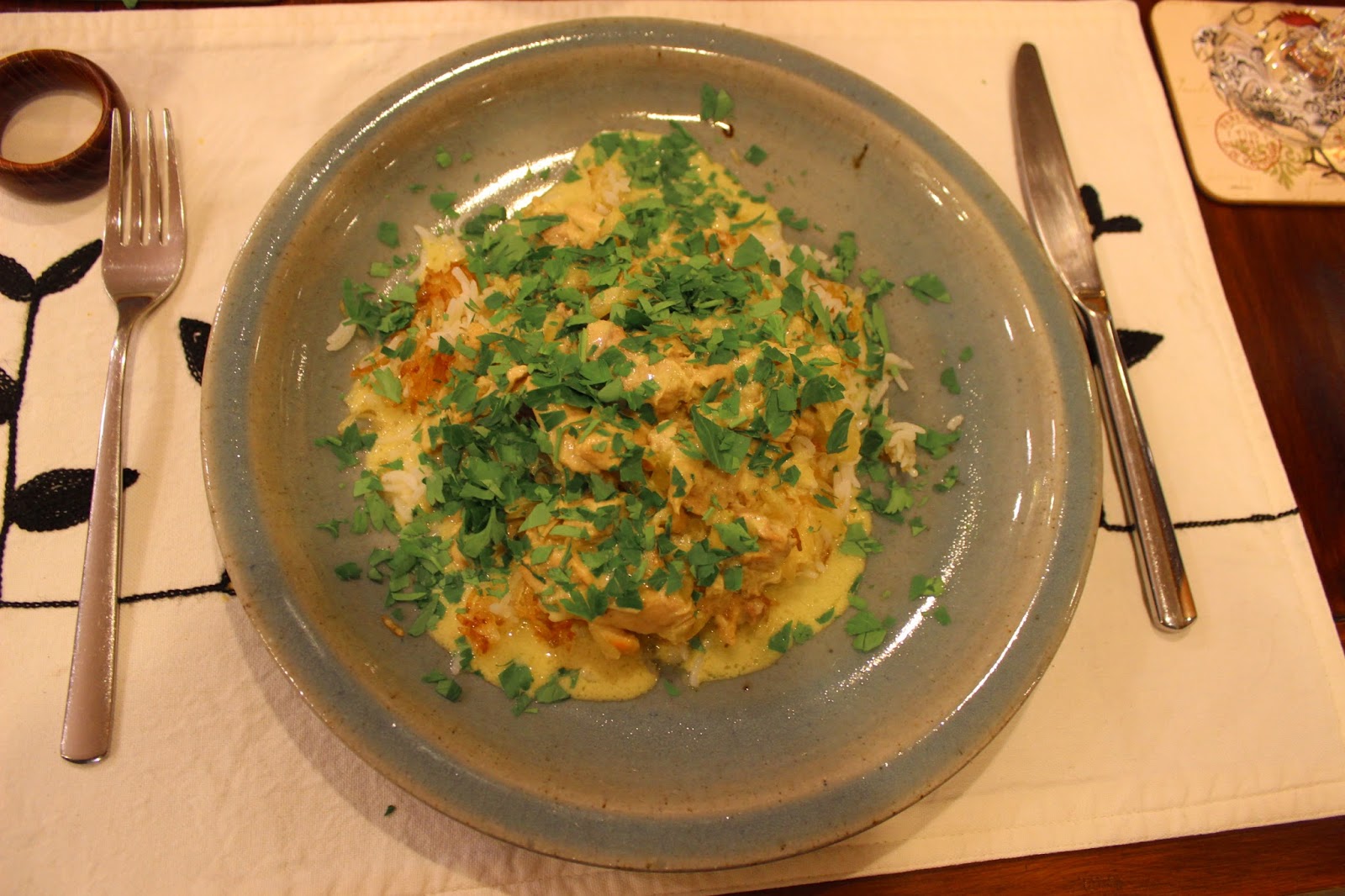
The chicken khoresht is great if you don't have two or three hours to cook the lamb version.  This will only take an hour once you've sweated the onions.  To start, sweat 2 finely chopped onions with 2 finely sliced celery sticks until soft.  Stir through 1 tsp ground cumin, 1/2 tsp  ground ginger, 1/2 tsp ground cardamom, 1/4 tsp cayenne, 1/2 tsp ground black pepper and cook for a few more minutes.  Cut 1 kg of boned chicken thighs into 2 or 3 pieces each.  Add them to the pan and brown briefly over a high-ish heat making sure they are all coated with the spicy onion mix.  Add a bay leaf, 500 ml chicken stock, a few saffron threads, zest and juice of a lime and juice of an orange.  Season with salt and simmer for an hour or so.  While the stew is cooking whisk 350g of Greek yoghurt with an egg.  When the stew is ready, whisk a few tablespoons of the hot broth into the yoghurt and egg mix then pour it all into the stew.  Add 1 tbsp slivered pistachios and cook at a bare simmer for five minutes to thicken.  Stir in one direction only and be sure not to let it boil or it will curdle at this stage.  Now Greg Malouf adds golden raisins but I do not.  It brings back memories of terrible 70s curries and I can't quite do it.  Apricots and prunes, yes but raisins, no.
Now as I mentioned above I feel I have mastered the Persian chelow and I am not sure what I was afraid of.  You need to allow about 80 minutes but most of that time it is looking after itself so it's no effort.  The recipe is for 6 so I just do 1/3 when making for two.
Wash 300g basmati rice and leave to soak in a generous quantity of warm water for 30 mins (30 minutes doing nothing with rice).  Strain the rice and rinse it again with warm water.  Follow these steps and you will be rewarded with perfectly separating grains.  Now boil a large saucepan of water, salt generously and stir in drained rice.  Boil at a rolling boil, uncovered for 5 minutes. I bring the water to the boil while the rice is soaking to save time and I turn it off if necessary so it only takes a minute or two to reboil when needed. Strain and rinse again and drain off as much of the water as you can.  Now is the tricky bit but it's not really tricky at all.  Melt about 40g of unsalted butter with 2 tbsp warm water and set aside.  Heat 1/4 cup oil with 1 tbsp water on a medium high heat in a large saucepan - the one you used to boil the rice.  When the oil begins to sizzle spoon in enough rice to cover the base of the pan in a thin layer - this is going to form a crust.  Spoon in the rest of the rice gradually building it up to a pyramid.  Don't tip it all in because you want it loosely piled to achieve the fluffy separateness.  Use the handle of a wooden spoon to poke a few holes down through the rice to the base of the pan.  This is to help it steam.  Now drizzle the melted butter over the rice.  Wrap the saucepan lid in a tea towel and tightly cover the pan.  Leave it on the medium high heat for a few minutes until you see some steam trying to escape then turn right down and leave for 40 minutes.  Another 40 minutes doing nothing with rice.  Don't peek.  It won't hurt if you leave it for up to an extra 20 minutes.
When you are ready to serve plunge the pan into a few inches of cold water in the sink.  The sudden change in temperature cause the rice to shrink from the sides of the pan loosening the delicious crunchy bottom.  Now invert the pan into a serving dish and it may plop out as one glorious mound with a beautiful golden crust.  Or it may not.  In which case just scoop the crust, known as the tah-deeg, over the top. Once you have mastered this you can do all sorts of variations to the crust with yoghurt, potatoes or bread.
And you can make an complete dish of the rice such as maygoo polow with the addition of herbs and prawns. Wash soak and parboil the rice.  Soak 1 tsp fenugreek seeds for 10 minutes, then gently fry in a frying pan with a small finely chopped onion, 1 tsp ground black pepper, 1 tsp turmeric, 1/2 tsp ground ginger.  Add a chopped deseeded tomato and 200g peeled prawns with tails on.  Don't worry if they're not.  Stir briefly until the prawns just begin to colour.  Remove the pan from the heat and stir through 1/3 cup finely snipped chives, 1/3 cup shredded flat leaf parsley, 1/3 cup shredded dill sprigs.  You can also add coriander if you must.  Now start to prepare your parboiled, drained rice for steaming.  Heat the oil and put the layer of rice in the bottom for the pan.  Scatter a layer of the prawn mix and layer up your pyramid with rice and the prawn mix ending with a layer of rice.  Poke the holes, drizzle over the butter, wrap up the saucepan lid and go off and do something else for 40 minutes.  Don't peek.  When done tip out as described above. 
You can serve all Persian meals with a herb salad and flat bread.  I sometimes serve stews with wilted spinach seasoned with nutmeg.
If you would like to carry the Persian theme through to coffee whisk some mascarpone with a little honey and lemon zest.  Slit some medjool dates to remove the stone, but don't cut in half.  Pipe the mascarpone mix into the dates and sprinkle with pistachios and rose petals.

Sunday, April 12, 2015

Easter traditions

As you know Easter is always a favourite time in my culinary year.  There are traditional favourites we have every year and there is always the time to try something new.
I have been making Nigella Lawson's hot cross buns from Feast for many years but this year I thought I would try Cuisine's proclaimed best-ever hot cross buns.
These will be my go to recipe for the next few years.  They were spicy perfection.  The only improvement could be my crosses which were a bit too runny and elicited the following from Phoebe - "I don't think Jesus died on a blob".  It didn't stop her from eating them on Friday and Saturday and taking some home.  I used to try and make these for breakfast but it was always a bit pressured so I now go for a late morning brunch which carries us through to an early supper.  We can reheat what's left for breakfast on Saturday...and Sunday if necessary. They kept very well.
Our Good Friday supper was, as usual, smoked fish pie.  I don't really vary the recipe although I might vary the type of fish.  This year we used smoked hoki and warehou.  Both were perfectly flaky.
I used to make this regularly as a family meal and it was once a great favourite with the children but alas they all outgrew it and it has been relegated to Good Friday.  Much as I enjoy both making it and eating it, I don't mind that it has become only an annual event.  We all look forward to the meal, enjoy it and then put it aside until next year. 
Easter Sunday is always a good opportunity to have friends over and share some kind of slow cooked lamb.  We have usually enjoyed a leisurely but also industrious three days and we can still enjoy an evening with friends and a sleep-in the next day.
We started the meal with some Pascal's smoked paprika pate served with a selection of cheeses - tome de savoir, manchego and a Waimate brie, on grilled slices of  home-made sourdough. The pate is excellent - Pascal's grandmother's recipe, he tells me.  We got it at the City Market.  Try it.  I had just read about serving torn pieces of very ripe figs with rocket so we had that to accompany and I recommend it.
I often go for the middle eastern-style lamb but this year we looked to Jamie Oliver and a very British approach with a slow roasted shoulder of lamb and smashed root vegetables and greens.   Earlier in the day we had been tidying up the garden to get in some winter crops and came across the last of the agrias that had been missed.  That went in our mash along with the last of the garden carrots.  I have to mention here that it has been an outstanding year for carrots.  We have had a bumper crop with the largest carrot weighing in at 750g.  It was still sweet and delicious, not at all woody.  A bit like last years giant radishes which definitely didn't perform as well this year.
I also love swede in a mash.  It brings a lovely creaminess and a little goes a long way.  I often add swede to pumpkin soup as well.  For our greens we had red kale, cavalo nero and savoy cabbage.  There is a stall at the vege market that sells incredible kale and cavalo and can usually be relied on for outstanding cabbages and leeks.
As usual I thought we needed something else but in the end I refrained and I am glad because we had a delicious meal with very little effort.  There was enough to feed the seven of us at the table and on Monday I turned what was left into a delicious hash/bubble and squeak.
At Easter I like something apple-y to herald autumn.  I enjoyed the seasonal aspect of Easter in the northern hemisphere and I was thinking of Harriet, Max and Jasper  heralding the arrival of spring in their respective locations.  Here I like my Easter meal to represent the autumn bounty. I made an apple and blackberry crumble.  It is only recently we have been able to buy fresh blackberries and I am making the most of them.  Lightly stew 1/2 dozen apples in butter and three tbsp golden caster sugar, or any caster sugar, covered for 15 mins.  I used Cox's Orange plus a couple of windfalls off our tree.  Add about three punnets of blackberries and simmer with the lid off for five mins.  Strain the fruit, retaining the liquid.  Layer the fruit in a dish and top with a crumble mix.  I often add spices but on this occasion I simply rubbed butter into flour, added caster sugar and a little Demerara along with a handful of rolled oats.  Keep the crumble in the fridge until you need to top the fruit and bake.  I poured a little of the reserved juice over the fruit just before baking.  I served this with home made vanilla ice cream.
We had another success this Easter.  For the first time we had enough crabapples to make crabapple jelly.  Not a lot but enough to make 1/2 a dozen jars.  For the first few years of the life of the tress I was reduced to improvising cranbapple chutney. This was nice enough but does not compare to jars of delicious fruity jelly.  My Grandma always made crabapple jelly and I can't eat it without thinking of here which is an excellent reason to make it.


Saturday, February 14, 2015

A cultural exchange

The weekend following the family meals we had another kind of sharing meal.  This time a sharing of recipes and ingredients.  We have visited the home of Georgian friends and we are always served  this amazing Georgian bread called khachapuri.  I wanted to try this at home so our friend came over to teach me and in return I gave her my sourdough culture and the instructions to make bread.  I have had this culture now for four years and I have nurtured it through extended holidays.  It provides me with one or two loaves of delicious bread every week.  I have shared this culture with some of you and it has not ended well   Hands up who still has the culture.  No, I thought as much.
I digress. Khachapuri.  This is a delicious Georgian cheese bread which will be served at any Georgian festive table.  It is not a precise recipe so if you want to try it let me know and I can talk you through what I know.  Essentially make a dough with yoghurt, eggs, a pinch of soda, a little oil and as much flour as you need to make a soft elastic dough. Once you have such a dough you could refrigerate for an hour or so and prepare the filling.  In Georgia they usually use a Georgian cheese called suluguni.  We used 50/50 mozzarella and cottage cheese and a beaten egg.
Take a fist sized chunk of dough and roll on a floured surface into a round that will fit in a 30cm non stick frying pan.  Put the cheese in the centre and bring the edges to the centre in a magical way that you need to see. Fry on both sides until it is done. 
We had another couple for dinner as well and for aperitif I made a delicious smoked fish pate served with thinly sliced grilled sourdough. We did the lamb leg again but this time in the kettle barbeque which was wonderful.  Sear directly over the charcoal on both sides for 5 minutes then cook indirectly for up to an hour or till done to your liking.  I then realised that our other guests were Greek and I did not want to present Greek style food that wasn't really.  I didn't bother with the tzatziki and served the quinoa salad instead of the Greek salad but I thought the skordalia went so well with the lamb that we did that and were not going to mention the word.  The guests did however recognise it as skordalia so I think we got that one right.  I'm afraid we had the granita again too.  When you find a meal which is perfect for the season just keep eating it.
As a result of this evening I am now the owner of The Georgian Feast and am planning my own Georgian themed meal.  As part of this cultural exchange I also have a container of kefir grains.  I had heard of this but wasn't sure what it was.  I am still unsure but it is very good.  Similar to yoghurt but not.  Delicious - kind of sharp and sour but refreshing.  You just add milk to the grains and leave on the bench until it thickens then strain off the yoghurt-like substance to eat, rinse the grains and start again.  No heating milk to a precise temperature, no leaving in a hot water cupboard until set.  Apparently the grains multiply so I will have some to pass on shortly if you think you can keep them alive.
You need to strain off the whey and I used this to make another recipe I encountered recently.  Carrots cooked in whey. I didn't make the whole recipe, just the carrots, which I served with rump steak and other vegetables from the garden. I may try the entire recipe some time.

Tuesday, February 10, 2015

Feeding hungry hordes

We had young relatives visiting from the UK and it seemed the perfect opportunity for some summer family meals.  Unfortunately Wellington did not turn on barbeque weather but we made the best of it.  We started the weekend with an extended family dinner and I couldn't go past a leg of lamb which we had the butcher butterfly for us.  Ideally we would have cooked this on the barbeque but it does just as well on the flat grill on the stove top.  Marinade the lamb for an hour in a blend of 3 tbsp Greek yoghurt, juice of a lemon, 4 crushed cloves of garlic and 2 tbsp dried oregano.  When the grill is very hot, lift the lamb from the marinade, shake off any liquid then lay it on the grill skin-side down.  Cook for about 10 minutes until crisp on the outside.  Turn and brush with the remaining marinade, then continue to cook for around 20 minutes until crisp on the outside and slightly pink within or of you prefer, grill a shorter time and finish in the oven at 200.  Season with salt while cooking.  Rest for around 10 minutes before serving.  Peter does all this because, as you know, I don't really cook large pieces of meat. 
I served this with a classic Greek salad and tzatziki. I also decided to make skordalia for the first time and it was a hugely popular.  For 6-8 people, boil about 150g Agria potatoes or another excellent mashing variety.  It doesn't seem like a lot of potatoes for the hungry hordes but it will be sufficient.  Drain immediately.  Pound three cloves of garlic with salt in a mortar and sieve the potatoes through a very fine sieve or potato ricer.  Mix in the garlic until you have a smooth puree.  Don't use the food processor unless you are planning to hang wallpaper, in which case you will have a lovely garlic infused paste. Beat in 100ml olive oil a little at a time, as if you were making mayonnaise.  You are looking for an emulsion.  Add juice of half a lemon and a little water if you need to loosen the mix.  Serve as a sauce with the lamb.
And then for pudding we had a strawberry and rose wine granita.  So easy.  Blend 500g strawberries, 3 tbsp honey, 2 tbsp of any berry liqueur and 1 tbsp lime juice.  Add a cup of the rose and blend again.  Either still or sparkling wine will be good.  I used sparkling. Pour into a shallow freezer-proof container and freeze.  Two or three times before serving take the tray out and mix through any big chunks of ice, pulling the frozen side edges towards the centre with a fork.  Fluff up the granules and serve in tall glasses on top of mixed berries.  You will need long spoons or long tongues to get the berries from the bottom of the glass.
On Saturday night I decided to do chicken with a quinoa salad.  I  chopped and changed for ages. Quinoa or couscous? At the very last minute I plumped for quinoa.  It was the best decision.  It is actually like a quinoa tabouleh but lighter.  For 4, cook 1 cup quinoa according to the instructions on the packet.  Make a vinaigrette with oil, red wine vinegar and garlic and 1/4 tsp each ground ginger and cinnamon and stir through the cooled quinoa.  Fold in 1 cup diced cucumber, 10 or so roughly chopped cherry tomatoes, 2 thinly sliced spring onions, 1/4 cup sunflower seeds, a good handful or mint or parsley or both and season with salt and pepper.  Serve with grilled chicken.  Season boned chicken breast, skin on with Moroccan style spices  - ras el hanout or whatever you have in the cupboard.  Use as many chicken breasts as you need for your diners.  I tend to think 120g per person and chicken breasts can vary hugely in size.  Cook the chicken on the barbeque grill or if it is windy at your house in a saute pan with a little oil.  Rest then slice and serve with the salad, a dollop of cottage cheese and a drizzle of olive oil. 
For pudding, Phoebe made  chocolate mousse using our secret family recipe.  She used an additional secret ingredient so even if you thought you knew the recipe you don't now.  Only Phoebe and I hold the secret.
On Sunday I returned to an old favourite, beef with yellow split peas.  This has the delicious pumpkin seed dressing.  I also served julienne of carrot and courgette with a pesto dressing. Mix 2 tbsp pesto with 3 tbsp olive oil and one of lemon juice. Season with salt and pepper.
For pudding, I did an old Peter Gordon recipe of marinated strawberries and pawpaw.  Marinade about 500g halved strawberries in 75 ml dessert wine in the fridge for a couple of hours.  Separately marinade 1/2 a peeled and seeded chopped pawpaw in 1 tbsp lime juice.  When ready, gently toss together with a few mint leaves and splash over the juice.
You may notice that we are a bit short of photos.  That sometime happens when we have a crowd.  You'll have to imagine the lamb.

Monday, January 20, 2014

Beetroot ... and radishes

It was encouraging to see two new signed up followers and a suggestion for radishes - thank you, readers.  We are still in summer eating mode even though there is a dearth of summer weather. 
We have been working hard on both the beetroot and radishes.  We had end of season asparagus with a lamb fillet and a couscous salad.  For the couscous I mixed a little olive oil and lemon juice through the couscous while it was still warm and then tossed through a selection of salad veg - spring onions, capsicum, parsley, feta and, of course, radishes.  I served it with beetroot relish and yoghurt with mint.  I didn't really need both but the relish needed eating and I love lamb with minty yoghurt so I splurged and it was worth it.  Put lots of mint in the yoghurt.
We have taken a fancy to spring rolls. They are so easy.  Buy a pack of spring roll wrappers and some vermicelli.  Finely slice a selection of fresh vegetables and herbs, including radishes.  Toast and crush some skinned peanuts and/or cashews - maybe add a pinch of cumin.  Make a selection of dipping sauces.  Put a dish of warm water on the table and construct and eat spring rolls until you are replete.  On this occasion I thought we had more wraps in the cupboard than we did, however a squid tube from the freezer came to the rescue.  Salt and pepper squid rings were delicious dipped in the sauces.
We were visiting in Auckland and I thought I would contribute pudding.  Make a jelly by dissolving 2 tbsp sugar in 1/2 cup wine (white or rose, still or sparkling) on the stove.  Don't let it boil.  Remove from the heat and add 4 leaves of softened gelatin, a further 1 3/4 cups of wine and 1 tsp lemon juice.  Pour into a shallow dish and refrigerate around 6 hours.  To serve put a mixture of raspberries, strawberries and blueberries into glasses with diced papaya and top with cubes of jelly.
Back home it was radishes and beetroot.  For a change from lamb we tried rump steak with caper, anchovy and rosemary sauce served with shaved veg with a lemony dressing.
For the meat dressing, pound 4-6 anchovies with a clove of garlic using a mortar and pestle.  Add 2 tsp very finely chopped rosemary and pound again.  Add  2 tsp capers, 2 tbsp lemon juice, 2 tbsp olive oil and mix well with salt and pepper.  Cook the rump steak to your liking and brush both sides with a little of the dressing.  Rest then slice and pour over the remaining dressing.
For the vegetables make a dressing with 1 tsp English mustard, 2 tsp honey, 1 tbsp lemon juice, 4 tbsp rapeseed or olive oil and salt & pepper.  Using a mandoline with care not to slice fingers (we have had mandoline incidents here), very finely slice a selection of raw summer vegetables - radishes, beetroot, kohlrabi, courgette.  Trickle over the dressing.
On the side I served a mix of salad leaves including beetroot leaves with a regular vinaigrette, and some freshly baked thyme-flavoured Turkish-style bread (pide) to mop up the juices.  To make the bread, combine 1/2 cup warm water, 1 tsp honey, 3 tbsp olive oil and add to 1 1/2 cups bread flour, 1/2 tsp salt, 1 tsp instant yeast, 1 tbsp chopped thyme.  Combine and knead for a few minutes until soft and smooth.  Leave to rise for an hour then divide into eight pieces, shape into rounds about 1 cm thick and cover with a teatowel to rise again for 20 minutes.  I only needed half the dough so have frozen the rest for another time.  Cook the breads on a grill 3-4 mins each side until golden and puffy.
Still trying to use up the last of the cranberry sauce, we had venison sausages with roasted beetroot and wilted spinach and beetroot leaves.  I cooked the beetroot, peeled and cut into chunks then put in a roasting dish with some olive oil and salt and pepper and thyme.  When done I splashed over a little vincotto.  I wash and slice spinach then just add in batches to a pan over a medium heat.  As the spinach wilts, push it to the back and add another handful.  When it is done stir in a small knob of butter and seasoning.  I often add nutmeg or cumin but on this occasion used only pepper.  Adding beetroot leaves with the spinach is delicious.  Try it.
Thank you to Jean-Marie for roasted radishes with dukkah. We tried them this evening with our aperitif of saffron gin.  The gin was a Christmas gift and I recommend you try it. It has a unique pizazz. The radishes were very interesting and I really liked them.  I have never eaten a cooked radish and I enjoyed the change in texture and depth of flavour.  The dukkah was brilliant and will become our staple recipe I suspect.

Sunday, November 10, 2013

Another Culinary World Tour

Not much writing but still plenty of eating.  Back in the film festival I made a meal I have been meaning to share.  Did you see Le Passe at the Film Festival?  There was a scene where Ahmad made a stew for the family.  The dish had some significance as a family tradition, and it looked delicious.  It was a meat stew with a base of fresh herbs.  I looked into it.  It was Ghormeh Sabzi, a traditional Persian herb stew.   I used lamb and at the end added a handful of baby spinach to add a bit of bright green.  we served it with traditional chelow.  If you can get fresh fenugreek leaves, do, otherwise use dried at a pinch.   By chance we had seen the movie at Petone and browsed the shops beforehand.  I found a Middle Eastern supermarket and saw, for the first time in my life, fresh fenugreek but I didn't buy it because I didn't know I was going to need it.  We had to go back for it the following week.  This has replaced Gheimeh as my favourite Persian stew.  And just in case you are thinking I'm a little crazy, I am not the only one.  If you didn't see the movie, do so.
I caught a glimpse of a Norwegian cooking show on the TV and investigated further.  It turned out to be called New Scandinavian Cooking hosted by Andreas Viestad, who is quite a character in a very Norwegian way.  The funniest thing is that he always cooks outside no matter the season.  It can get quite cold in Norway.  It snows.  Picture Andreas grilling fish with snow drifting into the grill and onto the plates.  They have a lot of very interesting ingredients especially fruit with lovely names like cloudberries or lingonberries.  A trip to the library uncovered Scandilicious by Signe Johansen and we were off.  I haven't fully explored the berry fruit because it wasn't the season and I am sure we can't get cloudberries.  Peter did make a boiled egg with anchovy soldiers.
Our masterpiece was Norwegian meatballs with mashed potatoes & swede (neeps & tatties in my world) and spiced lingonberry red cabbage (we had to settle for redcurrant jelly).  It did sound a bit odd in the recipe and I was a little concerned but it was truly delicious.  We did not have brown goat's cheese and to be perfectly honest I suspect it is a little unpleasant.  For the cabbage, simmer a sliced onion, sliced apple, 1/2 a sliced red cabbage with 30 ml cider vinegar, a glass of red wine and 2 tbsp butter for an hour in a covered dish.  Check occasionally to ensure it doesn't stick.  When the cabbage and onion is very tender add 5 tbsp lingonberrey jam, (or cranberry sauce or redcurrant jelly), 2tbsp dark brown sugar, 1 cinnamon stick, 1/2 tsp grated nutmeg and 5 cloves, and cook a further 30 mins.  Add another splosh of red wine before serving.
Peter went away for a couple of weeks to the UK and then to Peru and I had the idea to make one of his favourites for a homecoming lunch.  So I tackled the pork pie.  I just used home made chicken stock and gelatin leaves for the jelly because I didn't have time to be boiling pigs' trotters.  I didn't have a pie dolly - not sure what one is - so I used a drinking glass.  The Home Harvest woman at the market sells a paper pot maker and I think that would do the trick.  The result was that my first attempt was just like a bought one.
And finally Peter came home from Peru enthusing about ceviche.  I found a Peruvian cookbook at the library and  he made Martin Morales' Don Ceviche.   We will be exploring Peruvian cooking further.


Sunday, June 16, 2013

The $21 challenge

We took the $21 challenge and actually spent $14.60 for the week.   We bought mushrooms, oranges, mandarins, beetroot, lettuce and a capsicum at the market and later in the week we bought milk.  For the rest, we used what we had at hand in the freezer, the pantry and the garden and we ate a lot better than you might expect. 
If you are going to try this - and you should - start with a meal plan and focus on using the things you've had tucked away for a while and haven't got around to using.  You might find some interesting things!  For Sunday lunch we ate some corn muffins from the freezer while for dinner we had mushrooms and chard with pearl barley.  This was another great find from the New York Times in the 'recipes for health' section, so it has to be good.  We bought the mushrooms from our allowance and everything else we had in the cupboard or garden.     
We certainly had most things on hand for lunches, including a lamb backstrap in the freezer. We have some lamb's lettuce in the garden & a few remnants of rocket plus sorrel & herbs so we were able to rustle up a salad every day.  When the lamb ran out we had falafels from the freezer. 
Day two was the last of the pea & ham soup from the freezer.  This was the soup we made with the end of the Christmas ham. Accompanied of course, by a slice of trusty sourdough, lightly toasted. Mmmm.
Day three was spicy bean stew from the freezer.  We had planned to make this fresh because it mostly uses beans & vegetables we already had in the fridge or pantry, but then I discovered we had some in the freezer from a previous week so used that instead.  This is a meal that always has left overs when we we make it for two and it freezes well.  This used to be a family standby and it's quick to make, so I often did it when we had to go to an event at school in the evening.  Phoebe said that this was the meal we always had when she was going to perform in a musical recital and so she associated it with butterflies in her stomach.  I hope she likes it better now.  You can make it go further by adding a chopped chorizo.  We always keep some in the freezer. The stew calls for a dollop of pesto  but we didn't have any so I used some zhoug left over from another meal at the weekend.  Note I make my zhoug from parsley because of that coriander thing. 
Day four we used one of the pumpkins from my autumn display and made a pumpkin risotto.  I roasted the  peeled, diced pumpkin at 180 for 1/2 an hour.  Just toss it in a little olive oil, salt & pepper & grate on some nutmeg.  I made a basic risotto using a leek from the garden.  At the end I folded through the roasted pumpkin, some Serrano ham (that I had bought for another meal the week before and not used) & some Parmesan.  There were a few roasted almond slivers in a small container so I sprinkled them on top.
Day five, we had a khoresht from the freezer.  I added some frozen peas and served on rice.  There was a small container of chopped pistachios & rose petals in the pantry so I sprinkled them on the top.
On Friday we usually have an omelette and we had saved the eggs left from the previous week for this.  We were really low on cheese but had just enough for the omelette & used up the last of the Serrano ham.  We also still had enough fresh veg and some buche zickli (that was for the same meal as the ham...) for a salad.
Saturday lunch we had some toast with the last few slices of cheese - sliced very thinly, and some lemon chutney. 
But I felt day seven's dinner was the master stroke.  We had had a shoulder of lamb earlier in the year when we had guests & the left overs weren't going to get used at the time, so I just shredded the meat & froze it.  Perfect for a delicious pie, perhaps?  I sauteed a leek & carrot from the garden with half an onion from the fridge & some garlic.  I added some rosemary & bay leaves & the last of the lentils I'd cooked for the lunches.  There was a jar of artichoke hearts in the pantry (naturally) so I added a couple of those, a dash of quince splash, some grated lemon rind & juice, the end of a bottle of white wine from the fridge & the lamb.  I put the mix into individual ramekins and covered with the last lonely sheet of puff pastry languishing in the freezer & brushed with milk.  I would normally have used an egg but that seemed like an extravagance.  I baked the pies at 180 for 1/2 an hour and they were truly delicious.
A friend had given is some windfall Granny Smith's for juicing and we used a couple of those to make an apple crumble which we served with the last of the feijoa ice cream from the freezer.
So, we ate really well on our budget and even had $6 left at the end of the week.  I definitely plan to do this again - possibly once a month.  It was a great idea to get things used up and we did have to think a bit more carefully about what we were eating - no coffees at work, except what's provided, for example.  The toughest thing was fruit.  Peter went without bananas because they are expensive and we didn't buy feijoas & passionfruit.  Using up freezer stock was great.  We just used what had been there the longest.  The other thing I will do next time is look more carefully in the pantry and use the things that I don't usually think of. Harriet did well too and like us found it easier than she expected.  Next time I am hoping more people will join us.

Saturday, September 15, 2012

Sunday Curry

We recently had an old favourite curry with some new additions.  I may have mentioned it before but I am going to tell you again.  This has been a family favourite since 2001.  It is known as Malcolm's Curry and is named after the person who first  made it in our kitchen. 
You first need to make a garam masala mix. Take 1 tbsp black peppercorns, 6 cloves, 2 tbsp coriander seeds, 1 tbsp fenugreek seeds, 1 tsp black mustard seeds.  Heat a heavy based frying pan over a medium flame.  Put the peppercorns in first.  After a couple of minutes add the cloves.  After another 2 minutes add the coriander seeds.  Shake the pan gently as the spices roast.  After a couple more minutes a fragrant smell will waft into the kitchen.  Add the cumin & fenugreek seeds.  When the mustard seeds start to pop remove from the heat & pour into a bowl to cool.  Grind with a pestle & mortar.  You can store in an airtight jar for several weeks.  I always keep a quantity on hand.
Now you are ready to make the curry.  Do a good quantity.  You can always freeze or reheat later in the week. For 1 kg meat, in a food processor blend 2 roughly chopped onions, 4 cloves garlic,1 inch piece of ginger until you have a smooth paste.  Add 2 tbsp of the garam masala, 1/2 tsp turmeric & 1 tsp paprika & mix well.
In a heavy based pan add a little vegetable oil and add the spice paste.  It will sizzle & smell quite strong.  Malcolm recommends changing into your gardening clothes and his wife suggests you remove all laundry, coats & bags from the kitchen at this stage, unless you want to smell like a curry house.  I also recommend opening windows because the smell is lovely while cooking but not so much 3 days later. After a couple of minutes add the meat.  You can use any meat you like including chicken, on the bone or off.  On this occasion I used lamb shoulder cut into largish chunks.  This cooks beautifully.  Brown the meat on a high heat and add just enough water to cover.  When the water is simmering, cover and cook until tender.  We cooked the lamb for about two hours. It might take longer if your meat is on the bone.  Less for chicken.  Add water during cooking if it looks dry.  Serve with rice and dhal plus vegetables.
Malcolm also provided a dhal recipe but I prefer mine. Melt ghee or vegetable oil in a heavy bottomed pan and add 1 finely chopped onion with 3 cloves crushed garlic.  Sautee until onion is soft then add 2 tsp ground coriander, 1 tsp ground cumin, 1 tsp turmeric, 1/2 tsp chili powder, pinch of salt & a few grinds of black pepper. and sautee 1-2 minutes.  Add 1 cup red lentils. juice of half a lemon & 3 cups water.  Bring to the boil & simmer uncovered until lentils are cooked - about 15-20 minutes.
I served this Nigella Tomato Curry sans coconut rice, because it looks so pretty in the picture.  It tastes as good as it looks.  Nigella is a fan of English mustard powder and it really is a good addition to many things.  I always put a pinch in the cheese sauce for cauliflower cheese.  Do you?
 I wanted an Indian type pudding and I had eaten a yoghurty thing at Moore Wilson's producer day a few weeks ago but couldn't buy it.  Jack Santa Maria came to the rescue.  It's called Shrikand.  Take 600ml thick yoghurt - you could strain it overnight, but it's fine without.  Dissolve a pinch of saffron in 1 dsp rosewater, then whisk into the yoghurt. Mix in about 1 tsp ground cardamom and chill.  Jack noted that in Nepal, cloves, cinnamon & pepper are added with the cardamom so I did that.  He didn't say how much so I did similar quantities.  Adjust to your taste.  Jack mixes though chopped almonds & pistachios before chilling but I added them just before serving with a tsp rose petals.