 In March 2011, I first made khoresht-e gheimeh then in November 2013 I discovered khoresht-e ghormeh sabzi. I revisited both of them this winter and went on to make khoresht-e mast with chicken and maygoo polow with prawns and herbs. Most satisfying, I mastered chelow, the classic Persian rice dish and this is now my go-to rice dish. I am also working my way through the variations. If you want to know more about Persian cooking borrow the book, Saraban, from the library. If you just want to make a delicious meal let me tell you how. I always make these dishes for six because they freeze well and then there is always something delicious in the freezer during the film festival when there may not be time to cook after a movie.
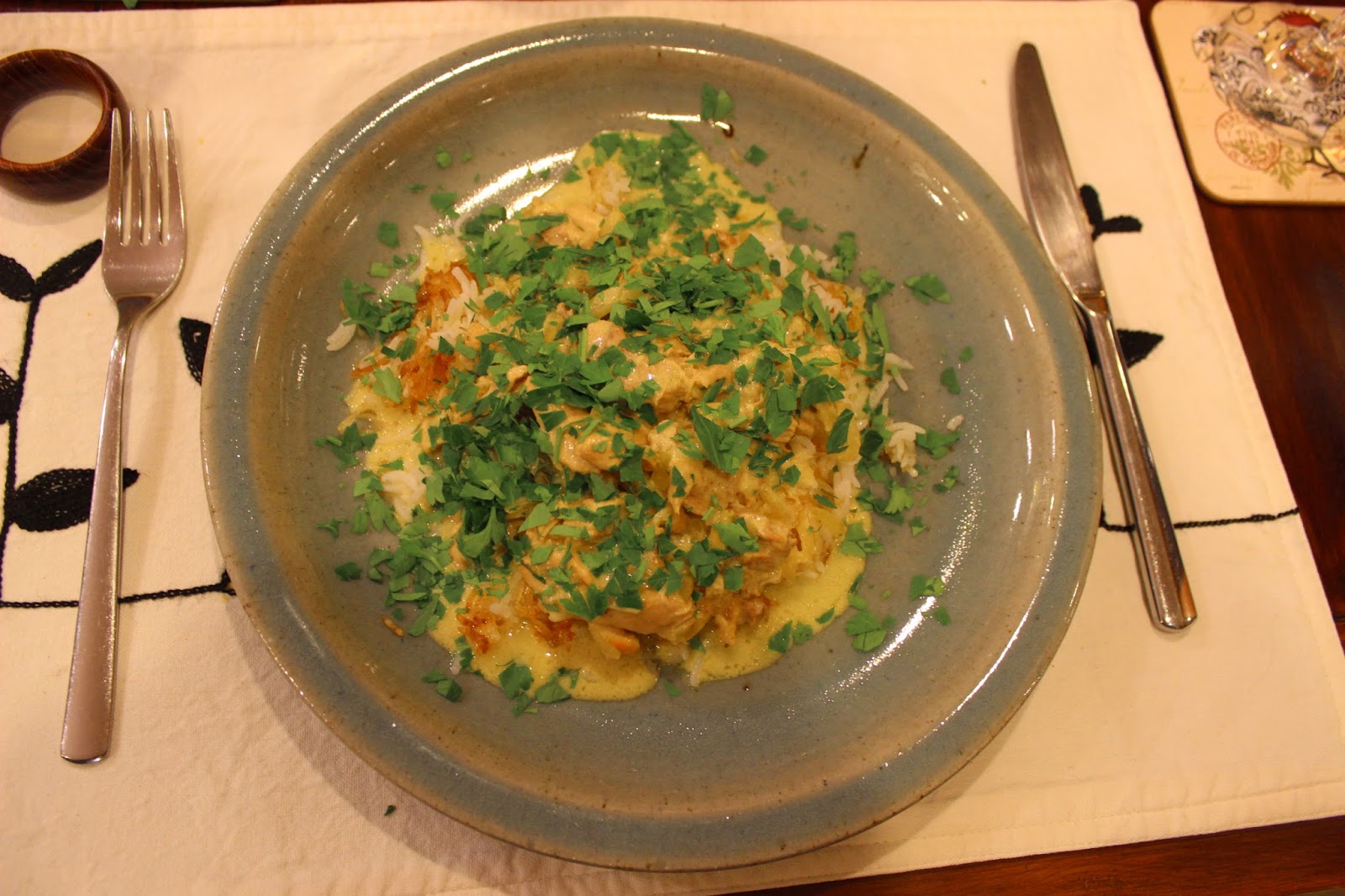 The chicken khoresht is great if you don't have two or three hours to cook the lamb version. This will only take an hour once you've sweated the onions. To start, sweat 2 finely chopped onions with 2 finely sliced celery sticks until soft. Stir through 1 tsp ground cumin, 1/2 tsp ground ginger, 1/2 tsp ground cardamom, 1/4 tsp cayenne, 1/2 tsp ground black pepper and cook for a few more minutes. Cut 1 kg of boned chicken thighs into 2 or 3 pieces each. Add them to the pan and brown briefly over a high-ish heat making sure they are all coated with the spicy onion mix. Add a bay leaf, 500 ml chicken stock, a few saffron threads, zest and juice of a lime and juice of an orange. Season with salt and simmer for an hour or so. While the stew is cooking whisk 350g of Greek yoghurt with an egg. When the stew is ready, whisk a few tablespoons of the hot broth into the yoghurt and egg mix then pour it all into the stew. Add 1 tbsp slivered pistachios and cook at a bare simmer for five minutes to thicken. Stir in one direction only and be sure not to let it boil or it will curdle at this stage. Now Greg Malouf adds golden raisins but I do not. It brings back memories of terrible 70s curries and I can't quite do it. Apricots and prunes, yes but raisins, no.
 Now as I mentioned above I feel I have mastered the Persian chelow and I am not sure what I was afraid of. You need to allow about 80 minutes but most of that time it is looking after itself so it's no effort. The recipe is for 6 so I just do 1/3 when making for two.
 Wash 300g basmati rice and leave to soak in a generous quantity of warm water for 30 mins (30 minutes doing nothing with rice). Strain the rice and rinse it again with warm water. Follow these steps and you will be rewarded with perfectly separating grains. Now boil a large saucepan of water, salt generously and stir in drained rice. Boil at a rolling boil, uncovered for 5 minutes. I bring the water to the boil while the rice is soaking to save time and I turn it off if necessary so it only takes a minute or two to reboil when needed. Strain and rinse again and drain off as much of the water as you can. Now is the tricky bit but it's not really tricky at all. Melt about 40g of unsalted butter with 2 tbsp warm water and set aside. Heat 1/4 cup oil with 1 tbsp water on a medium high heat in a large saucepan - the one you used to boil the rice. When the oil begins to sizzle spoon in enough rice to cover the base of the pan in a thin layer - this is going to form a crust. Spoon in the rest of the rice gradually building it up to a pyramid. Don't tip it all in because you want it loosely piled to achieve the fluffy separateness. Use the handle of a wooden spoon to poke a few holes down through the rice to the base of the pan. This is to help it steam. Now drizzle the melted butter over the rice. Wrap the saucepan lid in a tea towel and tightly cover the pan. Leave it on the medium high heat for a few minutes until you see some steam trying to escape then turn right down and leave for 40 minutes. Another 40 minutes doing nothing with rice. Don't peek. It won't hurt if you leave it for up to an extra 20 minutes.
When you are ready to serve plunge the pan into a few inches of cold water in the sink. The sudden change in temperature cause the rice to shrink from the sides of the pan loosening the delicious crunchy bottom. Now invert the pan into a serving dish and it may plop out as one glorious mound with a beautiful golden crust. Or it may not. In which case just scoop the crust, known as the tah-deeg, over the top. Once you have mastered this you can do all sorts of variations to the crust with yoghurt, potatoes or bread.
 And you can make an complete dish of the rice such as maygoo polow with the addition of herbs and prawns. Wash soak and parboil the rice. Soak 1 tsp fenugreek seeds for 10 minutes, then gently fry in a frying pan with a small finely chopped onion, 1 tsp ground black pepper, 1 tsp turmeric, 1/2 tsp ground ginger. Add a chopped deseeded tomato and 200g peeled prawns with tails on. Don't worry if they're not. Stir briefly until the prawns just begin to colour. Remove the pan from the heat and stir through 1/3 cup finely snipped chives, 1/3 cup shredded flat leaf parsley, 1/3 cup shredded dill sprigs. You can also add coriander if you must. Now start to prepare your parboiled, drained rice for steaming. Heat the oil and put the layer of rice in the bottom for the pan. Scatter a layer of the prawn mix and layer up your pyramid with rice and the prawn mix ending with a layer of rice. Poke the holes, drizzle over the butter, wrap up the saucepan lid and go off and do something else for 40 minutes. Don't peek. When done tip out as described above.
  You can serve all Persian meals with a herb salad and flat bread. I sometimes serve stews with wilted spinach seasoned with nutmeg.
If you would like to carry the Persian theme through to coffee whisk some mascarpone with a little honey and lemon zest. Slit some medjool dates to remove the stone, but don't cut in half. Pipe the mascarpone mix into the dates and sprinkle with pistachios and rose petals.


