Sunday, October 1, 2017

Itadakimasu Part One

We recently spent two weeks in Japan mostly eating traditional Japanese food in ryokan and minshuku.  As you know I love food and I especially love food from the sea which is the mainstay of the Japanese table.  However I was a little anxious because I was not fond of noodles, tofu or miso soup which I knew would also be on the table.  It was with some trepidation that I approached our initial meals however I found the food absolutely wonderful.  I am not really any fonder of noodles but made so many new food friends and I have even been experimenting with Japanese food at home.   But that is another story.  First I want to tell you about eating in Japan - traditional and modern.
The first two meals we ate in Tokyo were sushi.  We then didn't really come across sushi again until our last day in Arashiyama, a short train journey from Kyoto.
When we arrived in Tokyo early evening, tired and overwhelmed by the heat and humidity we found our way to Tsukiji Tama Sushi a few minutes from our hotel.  We could not have made a better choice.  We ordered a dinner sushi set which came with a bowl of miso soup and a mysterious dish of something which I later discovered was chawanmushi.  The chawanmushi became my new favourite food and all my anxieties evaporated.  I knew I was going to enjoy this culinary adventure.
Then breakfast.  We didn't want to eat meals at inflated prices in a hotel restaurant so we set out to find out what Japanese eat for breakfast.  Well they don't eat out.  There was nothing open that appeared to serve any kind of food or beverage.  But there was a 711 (convenience store) with a huge array of packaged sandwiches.  Delicious egg club sandwiches and salad became our go-to option for on the move dining.

We had lunch with Harriet's school friend Hiromi, who some of you will remember, and her mother, Ikuko. They took us to an amazing sushi bar, Umegaoka Sushi no Midori in Shibuya.  If you are planning to eat sushi in Japan, go here.  You have to be prepared to wait for a long time but you can put your name down and they will text you when a table is coming up.  They had an ipad at the table and you just send your order straight to the kitchen.

We ate so much sushi along with fresh pickles, miso soup and that delicious chawanmushi, I didn't think I would be able to move from the table. I felt I could eat like this forever. However after that sushi extravaganza I did not want to eat again that day.
In the Tokyu department store foodhall in Shibuya we found dorayaki which featured in one of our favourite Japanese movies, An. These were delicious. 

We made a day excursion from Tokyo to Kamakura, again inspired by a favourite movie, Umimachi Diary


There were some pretty interesting sweet food options available at street stalls. I wasn't sure what to make of a combination waffle-ice cream-chesecake?
The most popular flavour for sweet treats seems to be matcha followed closely in popularity by purple sweet potato, which more closely resembles kumara than any sweet potato I have ever seen outside NZ.  But sweet potato and matcha ice cream?  Just no!
We took an electric train to Enoshima, a seaside village where there were amazing seafood stalls and even more disturbing culinary offerings.  I can assure you that none of these alarming concoctions were consumed by me.
We travelled from Tokyo to Hakone via Mt Fuji.  Hakone was my first taste of village Japan and I was captivated from the moment we set off from the station to our hotel, Pax Yoshino.  From the outside Pax Yoshino looked like a regular hotel but on the inside it was most definitely Japanese. Tatami mats, cedar bathtub, low beds. We were provided with yakuta and Japanese socks, indoor slippers and outdoor sandals. We also had very stylish jackets to wear over the yakuta in case we ventured out in the cool night air.


We ate our first washoku meal.  Some of the food items were unfamiliar and sometimes surprising.
There was something called "favored cooked spirally coiled shell"  which may or may not have been a snail but turned out to be delicious.
I was bewildered by the item in the soup which appeared to be crisp stalks coated in a gelatinous
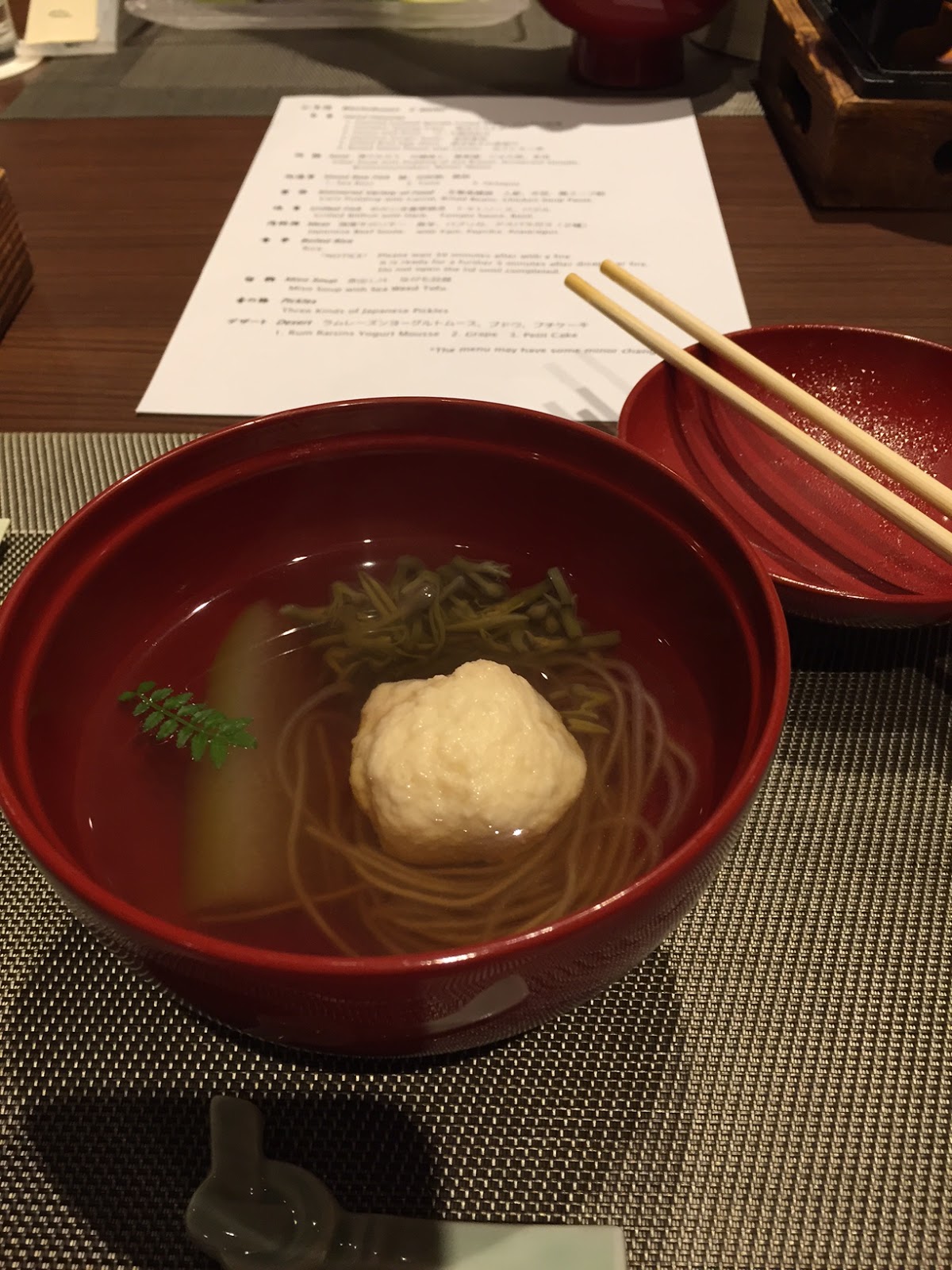
substance.  Research revealed this to be the braseniaschreberi, a type of water shield plant whose "young curled leaf tips, which are coated with a thick transparent mucilage, are eaten as a salad with vinegar, sake and soy sauce, or they added to soups as a thickener"  Also delicious.


We had to take an early train to get to Magome to start our walk.  I say train, but this journey involved a train from Hakone to Odewara, then a bullet train to Nagoya, another train to Nakatsugawa and finally a bus to Magome.  We had to leave before breakfast was served and our hostess offered to make us a bento breakfast to eat enroute. This was waiting for us when we checked out at reception.  Rice and pickles she said, so imagine our surprise and delight at Odewara station when we tucked into rice balls stuffed with sour plums, salmon, fried potato, sausage, tonkatsu pork and a piece of rolled omelette.

Sunday, March 26, 2017

Rhubarb and Patience

I have never been a fan of rhubarb.  Stringy and bitter with poisonous leaves.  How did it ever end up on anyone's table?  However, Peter loves it and we grow it in the garden.  Every Sunday during the season I stew a few stalks and he has a spoonful every day for breakfast.  This summer we planted an all-year round variety so now we have twice as much.  I don't like to not eat the food we produce so I did a little investigation.  I can tell you now that rhubarb is a vegetable, not a fruit and if you eat it as dinner rather than pudding it is actually very palatable [=delicious (ed.)].
Start with a simple rhubarb and chard dish. I served this with pork sausages.  If you cook the sausages first in a pan and set aside,  you can cook the chard and rhubarb in the same pan. Add 1 finely chopped shallot to the pan and cook over a medium heat for about 5 minutes. Add a little olive oil if required. Stir in 1 1/2 tsp black mustard seeds and 2 finely chopped garlic cloves. Cook 1 minute. Add 1/2 cup thinly sliced rhubarb and 500g rainbow chard leaves, a handful at a time, with a large pinch of salt. You can thinly slice the chard stalks and add some with the rhubarb, but I don't think you want them all.  I always save the stalks if I don't use them straight away and use them up during the week.  Cook until the greens wilt and become tender, about 10 minutes. Season with more salt and pepper. Serve sausages on top of greens.
What about a chicken tagine with rhubarb?  Start by poaching some rhubarb. Combine 1 1/4 cups water and 1 cup sugar in a medium saucepan. Add vanilla seeds and pod. Bring to a boil over medium heat, stir until sugar dissolves and add 2 cups diced rhubarb. Reduce heat to low and gently simmer rhubarb for 5 minutes, or until it can be easily pierced with the tip of a knife but remains intact. Do not overcook or else rhubarb will fall apart. Strain rhubarb over a bowl. Put the syrup aside to use another day.
Now on to the chicken.  I used bone-in leg quarters - what used to be called a Maryland - but you could use boneless thighs if you are delicate about bones. Season the chicken on both sides with salt and pepper. Heat a large Dutch oven over medium-high heat and add 2 tbsp olive oil. When oil is hot, brown chicken pieces, in batches, on both sides until golden, about 3 to 4 minutes per side. Remove and set aside.
Pour off all but 2 tablespoons of fat from the Dutch oven and add 1 finely chopped onion. Reduce heat to medium and cook, stirring and scraping the bottom of the pan to deglaze, until onion begins to soften, 2 to 3 minutes. Add 1 each of finely chopped carrot and leek. Cook, stirring often, for 3 to 4 minutes until vegetables are tender. Add a clove of crushed garlic and cook, stirring, about a minute. Add 1/2 tsp turmeric and 1 tsp sweet paprika and stir.
Return chicken to Dutch oven and add 1 cup chicken stock, 1 cinnamon stick, 1/2 tsp sugar and salt to taste. Bring to a simmer, then reduce heat, cover and simmer 35 minutes. Add 4-6 pitted green olives then cover and simmer another 15 to 20 minutes, or until chicken is falling off the bones. Stir in 1 to 2 tablespoons  of the rhubarb syrup. Season to taste.
Before serving, stir in parsley and 1 cup of the poached rhubarb and heat through over low heat.  Serve with rice or couscous.
You can make a delicate jelly with the leftover poaching liquid.  You need 4 leaves of gelatin for 2 1/4 cups of liquid.  Soften the gelatin in a bowl of cold water.  Make the rhubarb syrup up to the 2 1/4 cups by topping up with soda or prosecco.  Add a tsp of lemon juice.  Bring the liquid to the boil and take off the heat.  Squeeze out the gelatin leaves and stir into the hot liquid.  Pour into a dish and refrigerate to set.  I had made mine too late in the day and it was not quite firm enough so I just spooned into a glass with lemon jelly and lemon sorbet.  If you are prepared, your jelly will have set so that you can cut it into cubes and decoratively arrange on a plate.
Now that I am on a bit of a rhubarb roll, I made another rhubarby pudding.
First I made a rhubarb spoom.  Yes that is a thing. Cut about 4 stalks of rhubarb into 2 cm lengths and put in a saucepan with 1/2 cup water and 1/2 cup sugar (or less according to your taste).  Heat gently until the sugar is dissolved, bring to the boil and simmer covered until the rhubarb is tender about 5 minutes.  Cool and puree until very smooth then chill completely.  Stir in 1 tbsp rosewater. Beat two egg whites until they form soft peaks.  Add 2 tbsp sugar and beat until you have stiff peaks.  Now this is the magic.  Fold the egg white into the puree making sure they are completely mixed.  Transfer to a freezer-proof container and freeze for four hours.  You now have a smooth creamy mixture that contains no fat and has not required churning.
Finally, I roasted some rhubarb. Cut about 8 stalks of  rhubarb into 6 cm pieces and place in a medium bowl. Finely grate the zest of half an orange over the rhubarb and then squeeze the juice of the whole orange into the bowl. Split 2 vanilla beans and scrape out the seeds and place both in the bowl. Add 2 tbsp liquid honey and stir to combine. Pour the rhubarb into a baking dish and arrange the pieces so that they lie flat. Bake at 175 for 15 to 20 minutes. Remove the vanilla pods. Serve the rhubarb and the spoom with the syllabub from October 2014.

Wednesday, January 4, 2017

Welcome 2017

Happy New Year.  2016 was a fairly hectic year and although we did eat many delicious and healthy meals, I didn't find the time to write about any of them.  But I'm back and ready to share what goes on our table in 2017.
Having welcomed in the year with some home-baked shortbread and a fine single malt, courtesy of our house guests, we celebrated New Year with a festive dinner of beef fillet with a pomegranate salsa, accompanied by freshly dug potatoes and a tomato and pomegranate salad.  This meal was low on effort and high on impact.
For six people you will need a 1kg fillet of beef - or you might want a bit more because they will definitely want seconds. Tie up the fillet so that it is an even thickness ensuring it will cook evenly or ask your butcher to do this for you. Heat the oven to 250. Combine 1 tbsp mustard with 1 tbsp olive oil and 1 tsp each cumin and smoked paprika. Put the beef on a lined baking tray and spread all over with the mustard mix and season with sea salt flakes and a good grind of pepper.  Put in the oven and roast about 25 mins for medium rare. These days we use a meat thermometer to guide the cooking time.  I bought one back when I made the Beef Wellington because you can't judge a Wellington by looking or touching. Turn the fillet over half way through cooking. Rest for 15 mins and slice thickly.
While the beef is cooking prepare the accompaniments. For the salsa whisk 3 tbsp olive oil with 1 tbsp sherry vinegar and 2 cloves garlic.  Add 1/2 cup toasted pinenuts and the seeds of half a pomegranate and season to taste.  If you don't make the tomato salad use the whole pomegranate but I reserved half for the salad.  Add 1/4 cup each finely chopped mint and parsley while the meat is resting. To serve put the sliced beef on a serving plate and top with sliced roasted red pepper  - I use the jars because it is easier and they taste great. Spoon over the pomegranate salsa and some microgreens.
For the salad cut up a variety of tomatoes (roughly a handful per person), so they are about the same size.  Mix 2 tsp za'atar with 1 1/2 tbsp olive oil and set aside.  Add the other half of your pomegranate (if you are not making the salsa use the whole fruit), 1/2 a thinly sliced yellow capsicum, 1/2 a thinly sliced red onion, 1/3 cup torn basil, 1/3 cup torn mint, 1-2 tsp lemon juice and some sea salt.  Gently mix through and drizzle over the za'atar mix.
For the festive pudding I made a strawberry granita.  You'll need to do this in the morning or the day before.  I made a quantity for 12 because it seemed easier but you could just as easily halve it.
Combine 1/4 cup caster sugar with 1/2 cup water and bring it to the boil stirring to dissolve the sugar.  Take it off the heat and add a dozen roughly chopped strawberries, 1 tbsp each rosewater and lime juice.  Leave for 10 mins to cool and process in the blender until you have a smooth puree. Add 2 cups Prosecco and pour into a shallow metal dish and freeze until it is firm around the edges.  My dish was about 20cm x 30cm. Use a fork to scrape through the ice crystals a couple of times during the freezing process. To serve, put a layer of fresh berries in the base of a serving glass then a layer of whipped cream.  Scrape the granita again with a fork and spoon on top of the cream.
While we're talking pomegranates, I have discovered a wonderfully simple fish dish with pomegranate. We use fillets of a firm flaky fish such as purse seine caught trevally or kingfish. Use the Forest and Bird Best Fish Guide 2017 to ascertain a sustainable fish.
Mix the seeds of a pomegranate with 1 tbsp lemon juice and a pinch of salt.  Just before serving add 1/2 cup finely chopped parsley (or coriander if you must). Mix 1/4 cup lemon juice with 2 tbsp finely chopped dill, 1/2 tsp sea salt, 1 tbsp olive oil, and marinade the fish around 30 mins. Pan fry the fish or cook an a large grill plate on the stove top or barbecue.  Transfer the fish to a platter and garnish with thinly sliced red onion and spring onions, and some think slices of tomato.  Spoon over the pomegranate mix and then sprinkle over some sea salt and sumac powder.
These meals are really quick and easy to prepare and will get your New Year off to an excellent start.

Sunday, November 15, 2015

Winning ways with chard

We eat seasonally and often from the garden.  It's not large but there are only two of us and it can feed us well.  You know how you look forward to the first crop and sometimes enthusiasm wanes at the end.  We've been enjoying chard over winter picking a few leaves to make a delicious chard meal each week, sometimes twice a week. And then it turns on you.  Suddenly you have the Karori chard monster growing so fast and tall and threatening to go to seed.  Meanwhile you are trying to consume the kale and cavalo nero before that too bolts and you know you really have to eat the last of the broccoli this week. I knew things were serious when I mentioned to Peter that a friend who kindly took some chard off my hands this week said how much she had enjoyed her three chard meals.  Peter's response - "well that's three chard meals we don't have to eat".  If you have your own chard dilemma I have a few suggestions.
Chard works really well with grains such as barley, farro or freekeh.  For a great pilaf, saute a finely diced red onion in olive oil.  Add 2 tbsp coarsely chopped pistachios, grated zest of a lemon and a cup hot chicken stock - you may need different quantities of liquid depending on which grain you use so top it up with hot water if it is drying out. Mix and cover with a lid.  Simmer gently for around 20-30 minutes until the water has evaporated and the grains are cooked.  Season and stir through about 250g roughly chopped chard.  When the chard has wilted, add about 150g crumbled feta and stir through a little olive oil and the juice from the lemon.  You can serve on its own for a light weeknight supper or with lamb.  Use fillets, backstraps or rump.  Rub the lamb with a mix of ground cumin, cardamom and coriander and then briefly sear the lamb in a hot pan and finish in a hot oven.  Slice the lamb and serve on the pilaf topped with mint leaves and a sprinkling of sumac.
I made a great a great Iranian style stew with yellow split peas.  Saute an onion until soft then add 2 cloves crushed garlic with a cinnamon stick, a tsp ground cumin, 1/2 tsp fenugreek and a pinch of saffron strands.  Add 100g yellow split peas and 500g chicken or vegetable stock and cook until the peas are nearly done.  Add more hot stock or water if they are sticking.  Add 100g brown basmati rice and cook a further 20 minutes or until the rice is cooked.  Add more liquid if necessary.  Stir through 250g roughly chopped chard and let wilt a little.  Finish with 2 sliced spring onions, 1tbsp lemon juice, 1 tbsp pomegranate molasses.  Scatter with chopped mint leaves and pomegranate seeds to serve.
Try a chard gratin served with a crisp green salad. Heat a crushed garlic clove gently in a frying pan then stir in a tsp each of chopped rosemary and thyme and 250g roughly chopped chard. Season and stir over a medium heat for a couple of minutes.  In a large bowl beat together two eggs, 1/4 cup milk and salt and pepper. Stir in chard mixture and about 50g Gruyère. Stir in a cup of sweetcorn and mix well. I usually use frozen corn out of season but you could just as easily use canned if you prefer.  Pour into a greased baking dish, sprinkle parmesan on top and drizzle over a little olive oil.  Bake at 180 for 35-40 mins until nicely browned.  Rest 10 minutes before serving.
We had chard with chickpeas and tamarind. Saute a sliced onion with 1 tsp each of ground coriander and 2 tsp caraway seeds.  Add a tsp tomato paste, a can of chopped tomatoes, 300mls chicken stock, a can of chickpeas, 4 tbsp tamarind paste and 400g roughly chopped chard with stalks. Season and bring to the boil then cover and simmer 30 minutes.  When done it will be a thick soupy consistency.  Finish with a little lemon juice and serve with rice and a dollop of yoghurt and a drizzle of olive oil.
Don't forget our old favourite, Floriditas' chard risotto, which has had a few outings.
Our final chard meal of this crop was the pilaf with lamb.  Now we move on to the broccoli, starting with a broccoli and blue cheese salad.


Thursday, November 12, 2015

Birthday pork

The birthday season is upon us, although this year I only have two birthdays to cater and someone has to do one for me. It's an opportunity to do something special and with usually only Peter and me at home an opportunity to cook something we can't easily do for two. Isabel chose pulled pork - good choice. 
This is pretty simple.  Combine a tsp each of smoked paprika, English mustard powder and 1/2 tsp ground cloves with salt and pepper and rub into the flesh side of a piece of skin-on pork shoulder. We added a bit of Culley's hickory sauce for extra flavour. Our piece was around 2 kg. Rub olive oil and salt into the skin.  Pour 1/2 cm water into a roasting tin and add the pork skin side up.  Roast at 140 for about 6 hours or until the meat is perfectly tender.  Add a little more water if necessary.  When it is done turn the grill to it's highest setting and grill the pork until the skin is crackled and golden - it doesn't take long so don't let it catch.
I made an apple and broad bean salsa to serve.  Our broad beans are a few weeks away so I had to resort to frozen.  Combine 1/4 cup olive oil, 2 cloves crushed garlic, 2 tbsp each orange and lemon juice, 1/2 tsp each dried oregano and cumin, 1 tsp Dijon mustard, salt and pepper in a jar and give it a good shake. Pour into a serving dish.  Add 2 cups blanched and peeled broad beans, 1 julienned Granny Smith apple, 1 tbsp chopped capers, 2 tbsp chopped parsley. Gently combine.
We also had crispy roasted potatoes.  I sprinkled the par-boiled potatoes with a little polenta before roasting which crisped up the skin.
We also had leeks and cavalo nero because all meals right now MUST include chard or cavalo nero before these go completely to seed. Slice a couple of leeks and cook in olive oil and a little butter with salt until soft and sweet.  Take the tough stalks out of the cavalo nero and roughly chop then add to the pan, cover and cook a few minutes until the greens are wilted.  Season and add another small knob of butter.  Lost of recipes tell you to cook the greens in water then press out all the water with a tea towel and then chop the greens before adding to the pan.  I don't usually bother - it seems like far too much work and stains the tea towels green. My way seems to work fine.
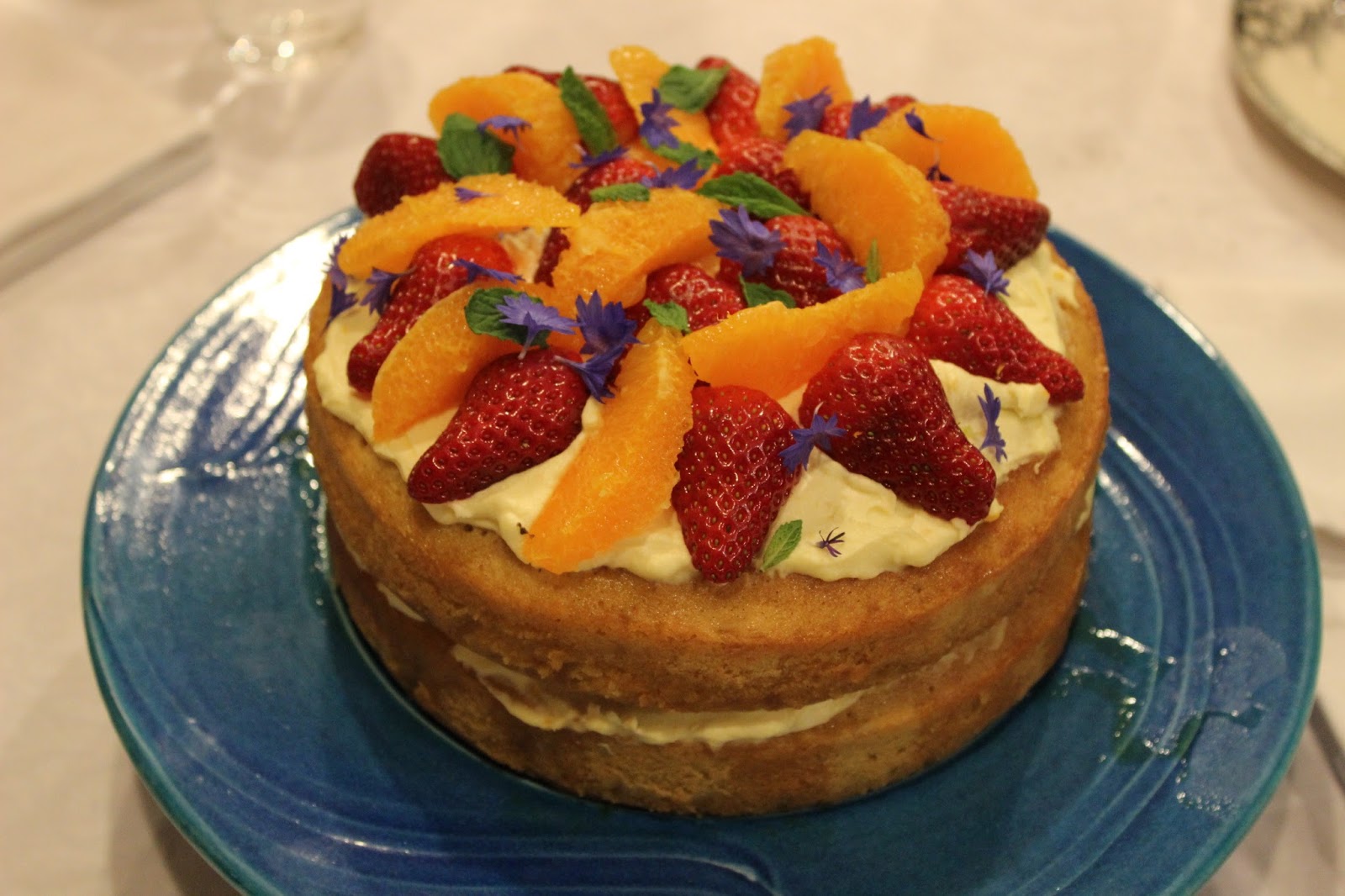
We had the summer Pimms cake for pudding and once again this cake was the star of the show.  This cake is super easy and a bit of a show stopper. These were our first strawberries of the season - not home grown I'm afraid although ours will be ready shortly if we ever get any sun. The borage isn't flowering either so I used cornflowers for the blue.
What better way to use up pulled pork than Monday night tortillas?  To make flour tortillas gently mix 1 1/2 cups plain flour in a bowl with 1 tsp baking powder and a pinch of salt.  Warm 1/2 cup milk in a small saucepan and pour into the dry ingredients.  Mix with your hands into a soft dough and rest in cling film 15 mins.   Then divide into 6 balls, roll out on a floured surface as thinly as you can and layer them between sheets of greaseproof paper with a light dusting of flour as you go. Cook them on a hot grill or cast iron pan - 40 seconds on the first side and 10 on the second.  Heat the pork in a pan with a little water and some smoky tomato sauce you have in the fridge.  Pile the pork on the tortillas and top with left over apple salsa.


Saturday, October 17, 2015

Versatile vegetables

Phoebe is always doing interesting things with cauliflower but I've never done much other than cauliflower cheese, curry or soup until now. This week I branched out with two new cauliflower ideas.
On Sunday we had lamb kofte with cauliflower "couscous".  To make the kofte for two, combine 300g lamb mince, 1/2 tsp cinnamon, 1 tsp cumin, 1/2 tsp smoked paprika, chilli flakes, 1 clove crushed garlic, finely chopped parsley, zest of half a lemon, 1/2 tsp dried mint, salt and pepper.  Make little meatballs - I made 6 - and poke a pre-soaked bamboo skewer through each one, then shape into sausage shapes on the skewer. Set these aside while you prepare the couscous.
Break half a cauliflower head into florets and grind to a fine crumbly couscous-like texture in the food processor.  Spread these out on an oven tray and bake at 200 for 5 mins.  You could microwave in a bowl for a few minutes but I can't as I don't have one.  Set them aside to cool and cook the kofte on a tray in the oven for about 12 minutes.
While they are cooking mix finely diced cucumber, chopped tomato, a small quantity of finely diced red onion, chopped olives, chopped mint and parsley, and crumbled feta with the cauliflower. Dress with lemon juice and olive oil.  Serve with yoghurt and a little chopped dill.
I used the other half of the cauliflower to make a pizza base.  Crumble the cauliflower and lightly cook as above then wrap in a tea towel and wring out any moisture.  I didn't do this and mine was a little soggy but still delicious.  Mix the cauliflower with a little beaten egg, crushed garlic and a little grated parmesan, mixed dried herbs, salt and pepper.  Shape into a pizza shape on an oven tray lined with baking paper.  Make it quite thin - about 1/2 a centimetre.  Bake at 200 for 30-40 minutes.  It should be firm and golden.  Take it out of the oven and turn up to 220.  Spread the base with passata or a similar kind of tomato sauce, halved cherry tomatoes and blobs of mozzarella.  Grate over some parmesan and sprinkle on a few basil leaves.  Bake another 5 minutes until the cheese is melted and serve with a few more basil leaves.
I will definitely be trying other things with cauliflower.  Any suggestions?
I returned to a favourite from this winter.  The charmingly named Dr Feel Good winter salad.  This is a brilliant recipe and although it looks fiddly is well worth the effort.  I save a bit of time by using roasted capsicum in a jar rather than roasting from scratch.  These are great and can go in many dishes.  Try them with the cauliflower couscous.  On this salad occasion Phoebe was coming for dinner and got there first so I phoned ahead for her to turn on the oven and put the beetroot on to boil.  That was useful.  You will really like this salad and you can be flexible with the ingredients.
I also made brilliant little apple puddings that I was alerted to on Facebook.  When I told them at work they all cried, "too hard", but in fact they were "too easy".  And they did taste delicious.  I sprinkled with icing sugar mixed with cinnamon because I had some pre-mixed which had been left over from a cake I had taken to work.  It was a great combination and a little dollop of whipped cream is the perfect finishing touch.
Now that asparagus season is upon us I like to eat them as much as possible.  A great idea for a spring Saturday lunch is salad greens, thinly sliced radish and steamed asparagus piled on a grilled slice of sourdough that has been spread with mayonnaise.  Add egg boiled just enough to peel with the yolk still soft and drizzle over a little lemony vinaigrette.


Sunday, August 9, 2015

Family roast night

When I was growing up we had a roast dinner once a week.  This was usually beef or lamb and occasionally pork which was more expensive.  Rarely, if ever, chicken which was far too expensive for an everyday meal.  Once a week, in households all over New Zealand (in fact all over the empire) women were roasting a joint and serving with potatoes and seasonal vegetables followed by pudding.  We all knew how to do it.  When our children were growing up we usually served a roast on Sunday.  Often chicken which was cheapest or lamb, rarely beef or pork which was too expensive.  I doubt if any of our offspring could put a roast on the table without consulting a recipe.  (Is this true?)  I obviously failed there!  As tastes and habits changed, the regular weekly roast fell off our repertoire and rarely appears at our table apart from Christmas and Easter and the occasional chicken.  I have decided to revive this flagging tradition as an irregular family get together.
Last night was very cold and the young people were hailed on between the street and the front door so they were very grateful for the gin hot toddy that was offered.  This is a fantastic idea for a winter cocktail.  Per person pour juice of 1/2 lemon, 15 ml thyme infused syrup (or 1/2 tsp brown sugar), 30 ml gin, 15 ml green ginger wine into a heat resistant glass.  Top with boiling water and stir.  Garnish with a sprig of thyme, a few juniper berries and a piece of cinnamon stick.
We started our family roast cycle with a rolled rib of beef from our local butcher.  We drizzled a little olive oil and rubbed the meat all over with dry English mustard.  Put the meat in a roasting dish with enough room for vegetables, add 1 tbsp beef dripping and put in the oven at 250 for 15 mins then reduce to 180 for the remainder of the cooking.  Calculate 35 mins per kilo.  Add the vegetables for the last 45 mins.  We had whole small carrots and parsnips and shallots which had been peeled or scrubbed and tossed in a little olive oil with salt and pepper.
My mother always added potatoes to the meat but we did ours separately in duck fat.  Peel and cut Agria potatoes into chunks - I usually allow three pieces per person plus an extra portion in case. Bring to the boil and simmer 4-6 minutes, then drain until all the steam has dispersed and they are completely dry.  Add to a roasting dish of hot duck fat (2 tbsp) and put into a hot oven (250), immediately turning down to 180.  They will need about an hour.  When the meat is done leave to rest and transfer the vegetables to a serving dish which you can keep warm while making the gravy.  Put the meat pan on the element and thicken with a little flour.  Add 1 cup beef stock, 1 tbsp red currant jelly and a slosh of red wine.  Heat stirring until it is the desired consistency.  I think the best accompaniment to roast beef is frozen peas.  Add a knob of butter and plenty of pepper when you serve. 
We also did Yorkshire puddings which was a bit of an extravagance but in England is an expected accompaniment to the Sunday roast.  My mother NEVER made these. They're pretty simple. For six, make a batter by adding 125g flour to a bowl then make a well in the centre and whisk in 2 egg and 150 mls milk.  Lightly season.  Add a dab of dripping to the required number of  compartments in regular muffin trays and pop this into the oven to get really hot.  Then pour the batter evenly across the compartments and put in the oven on a rack above the meat.  We have two ovens so I had the potatoes in the bottom oven. Serve with gravy and a little horseradish paste mixed with crème fraiche.
The timing is a bit of a juggle but actually not too hard.  Remember women all over the western world managed this every Sunday, and many in the UK still do.  I worked back from the time we wanted to eat and stuck a note on the fridge to remind me what time to put each component on to cook.
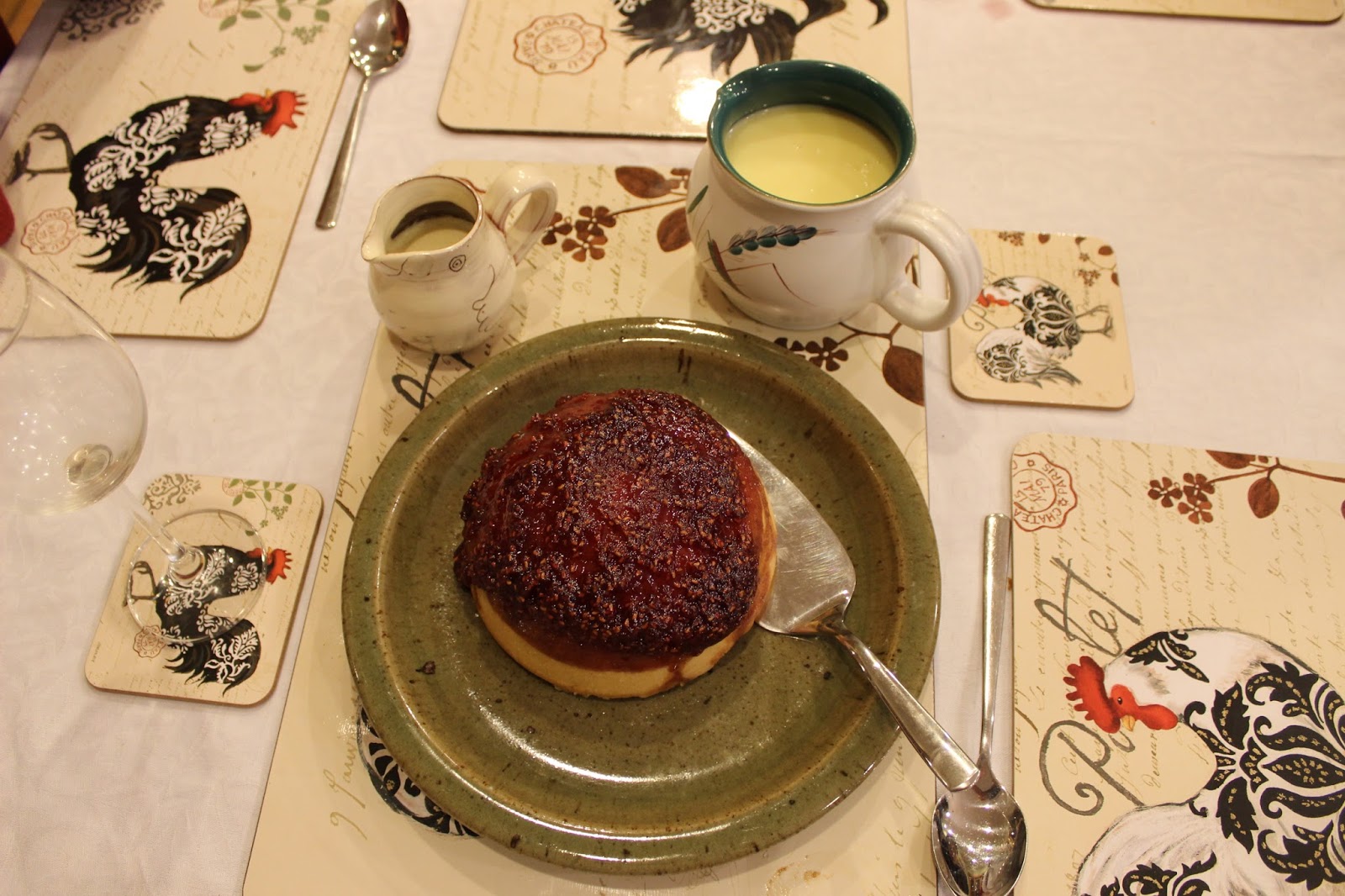
And this wouldn't have been a Sunday roast (albeit on Saturday) without pudding.  Our childhood favourite was Dominion pudding from the Edmonds book.  Cream 50g butter with 100g sugar, add an egg and beat well.  Add 1 cup flour sifted with 1 tsp baking powder alternately with 1 cup milk and mix until you have a smooth batter.  I was taught to always end with the flour.  Grease a pudding basin and put a few spoonfuls of raspberry jam on the bottom.  Pour over the batter and secure the lid on the basin.  Steam in  a large pan of boiling water for 1 1/4 hours.  If you have never done this before Edmonds is not helpful.  It says  "steam 1 1/4 hours".  Bring the water to the boil add the pudding, cover and turn right down.  It needs the full cooking time but will not spoil if it goes over. Serve with custard and/or cream.
The next day you could have roast beef sandwiches with horseradish, watercress and some sliced roast potatoes if there were any left over.  This is where that spare portion might come in handy.
Tonight we made a cottage pie with some of the left over meat.  I made a sofrito of onion, carrot, garlic and fennel.  I use whatever is in the fridge that might work including celery or leek which we don't have today.  It's not strictly a sofrito but that gives the general idea.
Add the leftover meat and vegetables finely chopped.  Add the leftover gravy, leaving some aside if you have a Yorkshire to reheat, and a good slosh of some kind of tomato sauce or chutney to give a good consistency of pie mix.  Turn mix into a pie dish.  I always use my mother's 1 3/4 pint Denby casserole dish.  (She used this dish for all potato topped dishes, rice pudding, crumble or with the lid for casserole.)  Top with some kind of mash.  I had celeriac and pumpkin in the freezer so mixed them together.
And now I have one meal quantity of beef left.  Any suggestions?

Sunday, August 2, 2015

Persian delights

In March 2011, I first made khoresht-e gheimeh then in November 2013 I discovered khoresht-e ghormeh sabzi.  I revisited both of them this winter and went on to make khoresht-e mast with chicken and maygoo polow with prawns and herbs.  Most satisfying, I mastered chelow, the classic Persian rice dish and this is now my go-to rice dish.  I am also working my way through the variations.  If you want to know more about Persian cooking borrow the book, Saraban, from the library.  If you just want to make a delicious meal let me tell you how.  I always make these dishes for six because they freeze well and then there is always something delicious in the freezer during the film festival when there may not be time to cook after a movie.
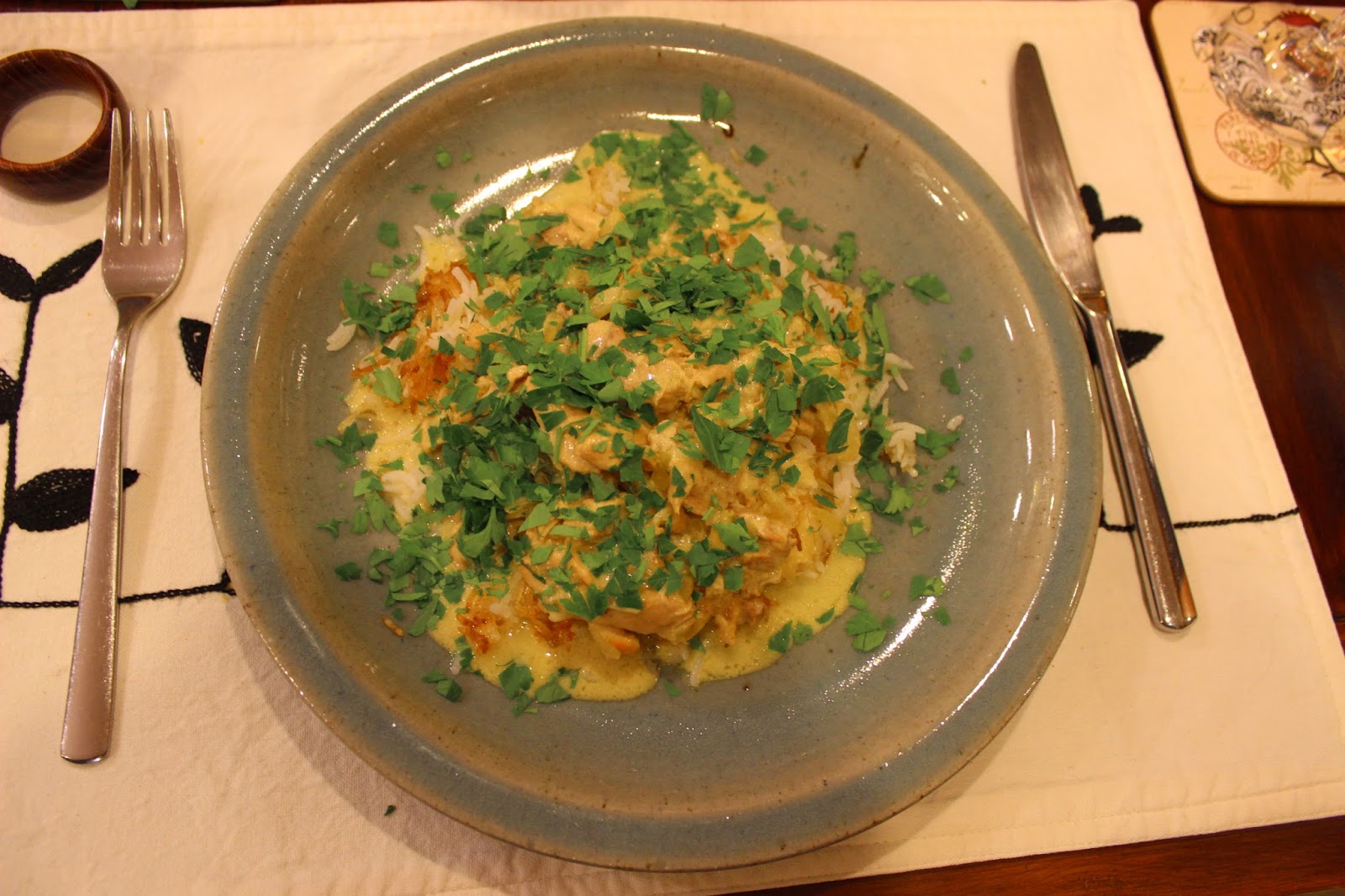
The chicken khoresht is great if you don't have two or three hours to cook the lamb version.  This will only take an hour once you've sweated the onions.  To start, sweat 2 finely chopped onions with 2 finely sliced celery sticks until soft.  Stir through 1 tsp ground cumin, 1/2 tsp  ground ginger, 1/2 tsp ground cardamom, 1/4 tsp cayenne, 1/2 tsp ground black pepper and cook for a few more minutes.  Cut 1 kg of boned chicken thighs into 2 or 3 pieces each.  Add them to the pan and brown briefly over a high-ish heat making sure they are all coated with the spicy onion mix.  Add a bay leaf, 500 ml chicken stock, a few saffron threads, zest and juice of a lime and juice of an orange.  Season with salt and simmer for an hour or so.  While the stew is cooking whisk 350g of Greek yoghurt with an egg.  When the stew is ready, whisk a few tablespoons of the hot broth into the yoghurt and egg mix then pour it all into the stew.  Add 1 tbsp slivered pistachios and cook at a bare simmer for five minutes to thicken.  Stir in one direction only and be sure not to let it boil or it will curdle at this stage.  Now Greg Malouf adds golden raisins but I do not.  It brings back memories of terrible 70s curries and I can't quite do it.  Apricots and prunes, yes but raisins, no.
Now as I mentioned above I feel I have mastered the Persian chelow and I am not sure what I was afraid of.  You need to allow about 80 minutes but most of that time it is looking after itself so it's no effort.  The recipe is for 6 so I just do 1/3 when making for two.
Wash 300g basmati rice and leave to soak in a generous quantity of warm water for 30 mins (30 minutes doing nothing with rice).  Strain the rice and rinse it again with warm water.  Follow these steps and you will be rewarded with perfectly separating grains.  Now boil a large saucepan of water, salt generously and stir in drained rice.  Boil at a rolling boil, uncovered for 5 minutes. I bring the water to the boil while the rice is soaking to save time and I turn it off if necessary so it only takes a minute or two to reboil when needed. Strain and rinse again and drain off as much of the water as you can.  Now is the tricky bit but it's not really tricky at all.  Melt about 40g of unsalted butter with 2 tbsp warm water and set aside.  Heat 1/4 cup oil with 1 tbsp water on a medium high heat in a large saucepan - the one you used to boil the rice.  When the oil begins to sizzle spoon in enough rice to cover the base of the pan in a thin layer - this is going to form a crust.  Spoon in the rest of the rice gradually building it up to a pyramid.  Don't tip it all in because you want it loosely piled to achieve the fluffy separateness.  Use the handle of a wooden spoon to poke a few holes down through the rice to the base of the pan.  This is to help it steam.  Now drizzle the melted butter over the rice.  Wrap the saucepan lid in a tea towel and tightly cover the pan.  Leave it on the medium high heat for a few minutes until you see some steam trying to escape then turn right down and leave for 40 minutes.  Another 40 minutes doing nothing with rice.  Don't peek.  It won't hurt if you leave it for up to an extra 20 minutes.
When you are ready to serve plunge the pan into a few inches of cold water in the sink.  The sudden change in temperature cause the rice to shrink from the sides of the pan loosening the delicious crunchy bottom.  Now invert the pan into a serving dish and it may plop out as one glorious mound with a beautiful golden crust.  Or it may not.  In which case just scoop the crust, known as the tah-deeg, over the top. Once you have mastered this you can do all sorts of variations to the crust with yoghurt, potatoes or bread.
And you can make an complete dish of the rice such as maygoo polow with the addition of herbs and prawns. Wash soak and parboil the rice.  Soak 1 tsp fenugreek seeds for 10 minutes, then gently fry in a frying pan with a small finely chopped onion, 1 tsp ground black pepper, 1 tsp turmeric, 1/2 tsp ground ginger.  Add a chopped deseeded tomato and 200g peeled prawns with tails on.  Don't worry if they're not.  Stir briefly until the prawns just begin to colour.  Remove the pan from the heat and stir through 1/3 cup finely snipped chives, 1/3 cup shredded flat leaf parsley, 1/3 cup shredded dill sprigs.  You can also add coriander if you must.  Now start to prepare your parboiled, drained rice for steaming.  Heat the oil and put the layer of rice in the bottom for the pan.  Scatter a layer of the prawn mix and layer up your pyramid with rice and the prawn mix ending with a layer of rice.  Poke the holes, drizzle over the butter, wrap up the saucepan lid and go off and do something else for 40 minutes.  Don't peek.  When done tip out as described above. 
You can serve all Persian meals with a herb salad and flat bread.  I sometimes serve stews with wilted spinach seasoned with nutmeg.
If you would like to carry the Persian theme through to coffee whisk some mascarpone with a little honey and lemon zest.  Slit some medjool dates to remove the stone, but don't cut in half.  Pipe the mascarpone mix into the dates and sprinkle with pistachios and rose petals.

Sunday, July 26, 2015

La Pasta in Casa

I thought it would be nice to make pasta and I bought 00 flour.  Some considerable time later I thought, "Must get on to that pasta making" and I bought a pasta machine.  More time passed and I thought, "Must get that pasta machine out of the box".  So at last the flour and machine were introduced.  It transpired that some years had passed between the initial thought and the action.  The flour was no longer viable and the pasta was not a success.  Undeterred I bought another bag of flour and this time it all came together.
Making pasta really is quite simple.  Just make sure your flour is fresh!  I consulted Marcella Hazan, her son, Giuliano and the New York Times.   This is what worked for me.  Start with 1 egg per 100g flour.  You need at least two eggs to get a quantity you can work with and you can dry it and store in an airtight container so there is no issue with having more than you need.  Before you begin, clear your work surface because you will need plenty of room once you start rolling.  Pour the flour into a mound on the work surface.  Note that marble is too cold and won't work.  Make a well in the centre of the flour and break the eggs one at a time into the well.  Beat the eggs gently with a fork until the yolks and whites are mixed together - actually this proved a bit hard and I resorted to whisking the eggs first before pouring into the well.  With the fork, gradually incorporate the flour into the egg until the egg is no longer runny.  Work from the inside wall of the well.  If the egg escapes onto the bench it is not easy to recapture.  Once you've reached the stage where you have quite a viscous mixture, quickly bring the remaining flour over the egg mixture and scoop it up, mixing with your hands until you have a moist but not sticky dough.  Wrap the lump of dough in cling film to stop it drying out at all and clean the work surface and your hands ready for kneading.  Knead the dough until it is very smooth and silky - this only takes a couple of minutes if all is well. Rewrap in cling film and rest for at least 20 minutes.
Set up your machine for rolling and get out lots of tea towels to lay out the rolled dough.   Cut a three-egg dough into six portions and keep the ones you are not working with wrapped in cling film.  Flatten the chunk of dough in your fingers and start to feed the dough through the machine starting at the widest setting.  Feed each portion through this setting three or four times, folding into three after each roll.  Then, reducing the rollers by one notch each time roll all the pieces through the machine and lay them out on dry tea towels.  Leave to dry a little so that it feels a bit leathery but not brittle.  Maybe 10-20 mins.
When they are ready, shape your pasta.  We made fettuccine according to the instructions on the machine.  To store the ribbons, wrap them loosely around your hands to form nests then leave to dry on a tea towel before storing in an airtight container.  They will keep for months.
To cook drop the pasta in a large saucepan of well salted boiling water and boil with the lid off for a few minutes until al dente; 2-3 mins will be enough on the day of making. 
I rediscovered the classic tomato sauce for pasta.  Put two tins of tomatoes in a saucepan with a halved onion and 100g butter.  Simmer over a low heat about 40 minutes until the tomatoes have reduced and slightly separated from the butter.  Discard the onion and either use the sauce immediately, set aside to reheat later or freeze. This sauce is indescribably good.   It will keep for a few days in the fridge. Serve this on any kind of pasta including filled shapes, which is our next project.  I served the first batch with cauliflower florets that I had lightly steamed then roasted in olive oil with a sprinkling of chilli flakes.  Just top with the sauce and some grated parmesan.
We used the reserved fettuccine with chicken and mushrooms with tarragon, which is a dish well worth trying.  We have made this two or three times and it is nice with any of the suggested accompaniments.
We  made some pappardelle by loosely rolling the sheets and cutting by hand about two centimetres wide.  We served this with my go to Bolognese recipe.  This sauce with pappardelle is one of my favourite pasta dishes and the home made pasta just made it better.
This experiment has been worth the effort and we will be keeping it up. Next we will be trying stuffed pasta.  If you have any suggestions about making pasta at home please share.  All ideas welcome.